This guide builds that process step by step, without recommending a brand or asking users to handle secrets through an online service. It distinguishes between a platform account, a self-custody wallet and a recovery procedure. The precautions outlined here should be adapted to the software selected, its official instructions and the actual abilities of the person who will use them.
In brief
- The wallet manages the means of authorizing transactions, not coins physically stored in the phone.
- A useful backup must be protected and recoverable through a procedure the user understands.
- Passing assets on to relatives requires a plan that separates proof that the assets exist, instructions and access secrets.
Bitcoin wallets in Botswana: knowing who controls the keys
Our guide to crypto wallets explains the general concepts. For your own setup in Botswana, start by identifying who can sign a transfer. If that ability belongs to a platform, your access depends on its account and rules. If it belongs to you, you must protect the keys and the means of recovering them without waiting for support to take over that responsibility.
An application may offer several models through a similar interface. Do not assume that you have self-custody simply because the word wallet appears in its name. Look for documentation on key control and recovery. Find out what happens if the device is lost, the company shuts down or the phone is replaced. The answers should be consistent with one another.
Bitcoin.org’s wallet security documentation covers backups, limiting exposed funds and offline storage. These principles do not require everyone to use the same setup. A complex method that is poorly understood can create more risk than a simple system applied correctly. Assess ease of recovery as carefully as resistance to theft.
The overview of crypto in Botswana provides additional context on the services environment. Wallet security does not answer every legal, tax or provider-related question. Conversely, a licensed company cannot reverse a signing error made with self-custodied keys. Keeping these responsibilities separate makes it easier to contact the right party when an incident occurs.
Separate the device, access code and recovery process
A code that unlocks a device does not necessarily serve the same purpose as a recovery phrase. The former may protect local access; the latter may allow the wallet to be reconstructed, depending on how it works. Losing the device with a valid backup therefore does not always have the same consequences as losing the only available backup. Read the instructions for the product you use carefully.
Do not automatically photograph recovery words for convenience. An image may end up in a synchronized gallery, a cloud backup or a shared device. Apparent simplicity can then create new copies that are difficult to track. Choose a storage method that matches your risks, and never enter these secrets into forms, messaging assistants or websites claiming to verify the wallet.
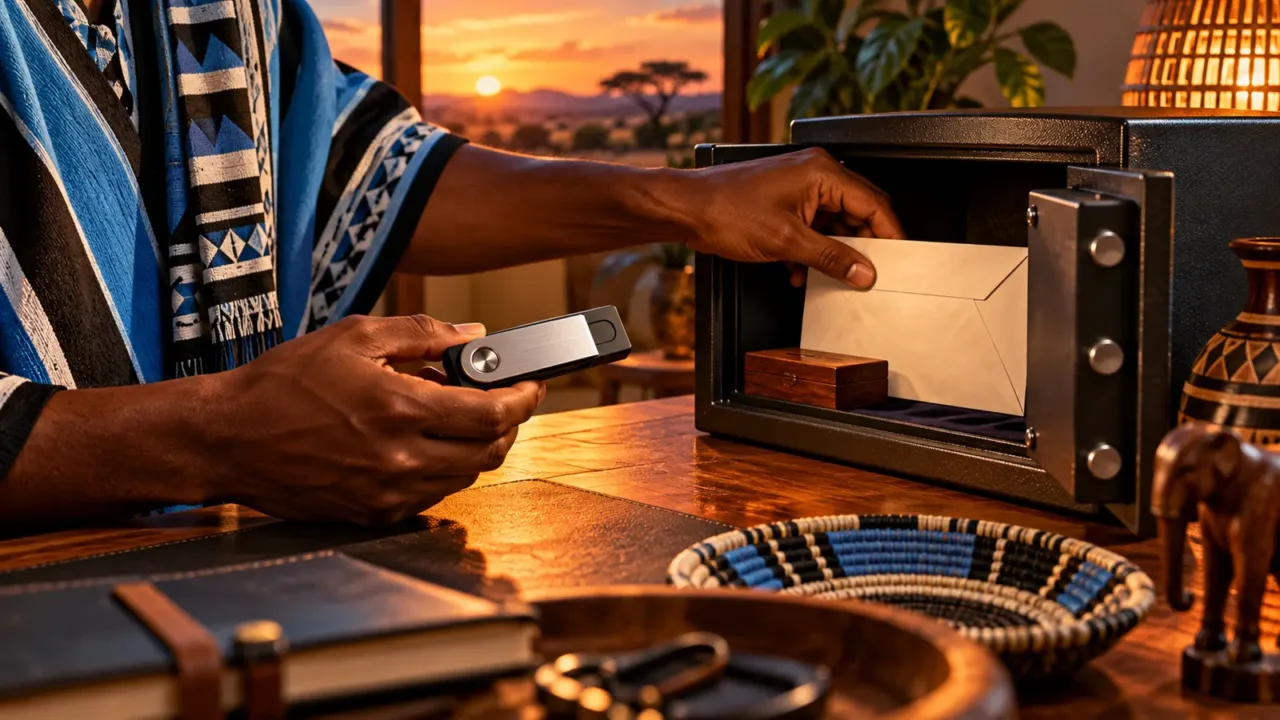
Assess physical risks without improvising an irreversible setup. Paper, metal and a safe have different properties when exposed to water, fire, theft or forgetfulness. The right decision depends on the actual storage conditions. A highly durable medium does not protect against someone who can read it freely. Location and access rights matter just as much as the material.
Keep the instructions understandable for your future self. A personal puzzle, altered sequence or deliberately incorrect word may seem clever when created. Years later, it could make recovery impossible. If you choose advanced features, make sure you understand their consequences and follow reliable documentation rather than inventing home-grown cryptography.
Prepare for recovery without exposing the wallet
The first recovery attempt should not happen in a panic after a theft. Before committing a significant amount, learn the official procedure in an appropriate environment and with an appropriate amount. Do not erase the only functioning device until a backup has been properly established. This guide does not prescribe a universal sequence, since software and devices use different mechanisms.
An exercise should test one specific ability: regaining access through the intended method and identifying the information required. It should never involve entering the secret on an unknown website. Prepare in calm conditions, without screen sharing or unnecessary remote assistance. If the documentation calls for an operation you do not understand, stop and seek an official explanation before continuing.
The guide to KYC and data helps distinguish identity from technical authorization. No passport request justifies giving a recovery phrase to an agent. Likewise, supposed support staff who want to take control of your computer to “synchronize” the wallet add a threat. Recovery must not become the moment when you surrender your secrets.
Record the outcome of the exercise without copying the secret into the report. Note the wallet type, the official instructions used and the non-sensitive information that will need to be located. A simple log can support continuity. It must not enable anyone who reads it to make a transfer or bring together all the elements needed to divert the funds.
Reduce transaction errors and fake messages
Before making a transfer, check the recipient through a reliable channel. An address received through messaging can be replaced, just as a compromised clipboard can alter what you paste. Verify the full destination as far as the interface allows, rather than checking only a few familiar characters. If a device provides confirmation on a separate screen, understand what it displays before signing.
Bitcoin.org’s information on precautions points out, among other things, that a payment does not come with a central cancel button. This makes preparation before signing important. A test transfer can reduce uncertainty about a destination, but it does not certify a seller’s future honesty and does not replace checking their identity or status.
Do not confuse a delay with a loss. A transaction may be awaiting confirmation or additional processing by a service. Check the transaction ID and context before sending another amount. Any replacement or acceleration options depend on the wallet’s features and conditions. Follow its documentation; anyone promising guaranteed acceleration in exchange for your secret is a warning sign.
The guide to crypto transaction costs helps explain fees before sending. For small amounts, a fixed cost can weigh heavily. Compare the actual need with the amount and urgency instead of mechanically multiplying transfers. Security measures should remain proportionate, without allowing a saving of a few fees to justify exposing an amount you cannot afford to lose.
Adapt the setup to everyday life
A custody strategy must remain usable when the connection or device is unavailable. Keep non-sensitive references outside the phone alone: the software name, the official download source and a description of the recovery model. Store the secrets separately. If everything is on the same lost device, a sound theoretical procedure may be unusable when it is needed.
Consider shared devices and maintenance habits. A relative may use the phone for another task, a repair technician may request an unlock or an automatic backup may synchronize more data than expected. Examine these situations before installing a wallet. Precautions should not rely on the assumption that no one else will ever touch the equipment.
A hardware wallet may change the exposure, but buying one does not replace checks on its origin, initialization and backup. Equipment prepared by a third party with a recovery phrase already supplied should warrant particular caution. Use the manufacturer’s official instructions and reject prefabricated secrets. The box and the device’s appearance alone are not sufficient proof of security.
The guide to selecting platforms points out that a relationship with a custodian raises different questions. You may have several needs, but do not multiply accounts and wallets without a plan. Each account adds access credentials, documents and monitoring obligations. A clear structure, with a defined role for each tool, is easier to maintain than a forgotten collection of applications.
Plan inheritance without making the funds accessible to everyone
Passing assets on first requires relatives to know that the assets exist. This information can be kept in an estate file without including the secrets themselves. Specify whom to contact and where the legitimate instructions are stored. Do not assume that someone will independently discover an application, understand how it works and find the correct backup among unorganized documents.
The legal dimension deserves separate attention. Technical access does not replace inheritance rules, and someone who knows a secret does not automatically become the legitimate beneficiary. Coordinate your plan with a professional competent for your situation. This guide does not offer a standard Botswana inheritance structure or claim that putting a public recovery phrase in a will would protect heirs.
For advanced features such as multisignature, examine the additional dependencies. The necessary elements must be preserved and the recovery conditions understood; simply distributing objects among several people is not enough. A multisignature setup may reduce certain risks while making execution more complicated. Do not adopt it solely because it appears more professional in a tutorial.
A well-organized Bitcoin wallet in Botswana must ultimately withstand ordinary events: a replaced phone, a misplaced document, the owner’s unavailability or a change in habits. The right method separates secrets, tests understanding and maintains suitable instructions. Security is not about making the wallet mysterious; it is about preventing unauthorized access without making legitimate access impossible.