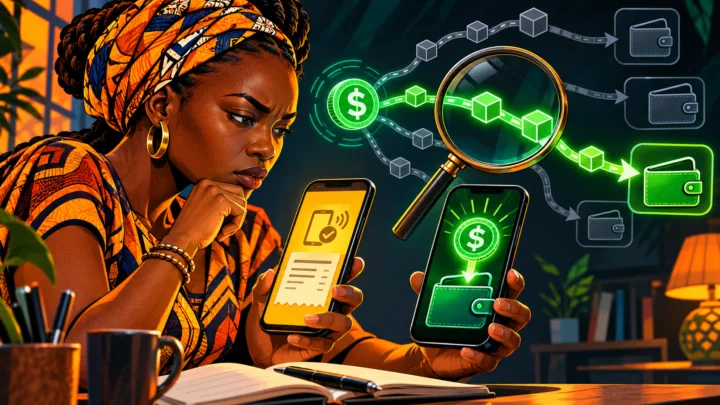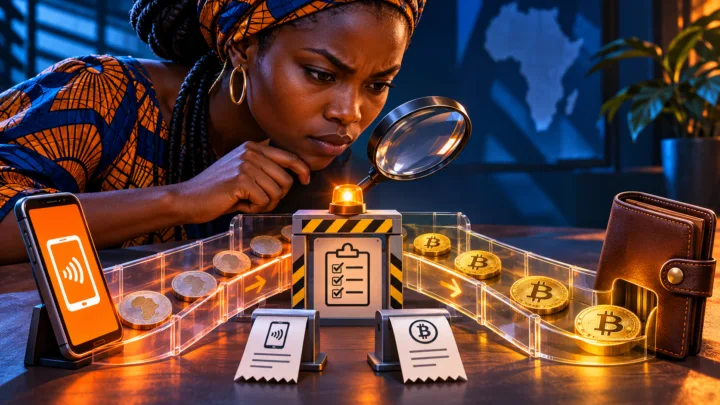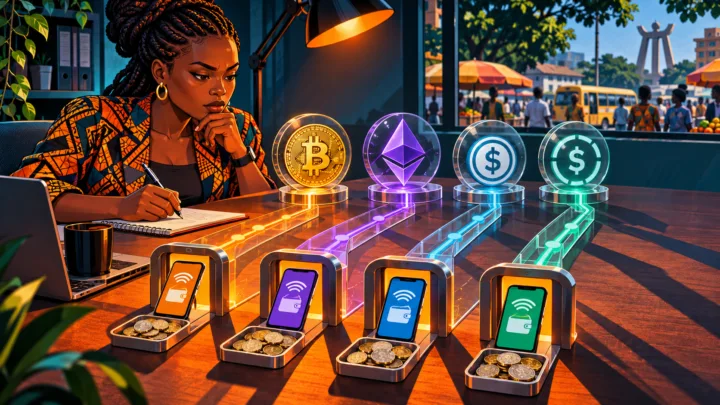
Buying Bitcoin with M-Pesa requires checking two separate operations: payment in local currency and delivery of Bitcoin. A service may accept the first without guaranteeing the second. The presence of the brand in an advertisement proves neither a partnership with the operator nor authorization to sell cryptocurrencies.
When preparing a purchase in 2027, it is therefore better to look for a verifiable process than for a universal list of platforms. This guide distinguishes mobile-payment coverage, the crypto provider’s terms and the evidence needed to check the amount actually received. The documents reviewed in November 2026 do not guarantee future offers.
In brief
- An M-Pesa account in one country does not automatically provide access to the same services in another.
- The relevant cost includes payment, the exchange rate, the purchase and any withdrawal to your wallet.
- Before making a large transfer, identify the seller, check the terms and test Bitcoin receipt.
Which countries and accounts need to be distinguished?
The first check concerns the account actually being used. Our guide to Bitcoin and mobile money in Africa explains why a payment channel and a crypto offering are not the same service. For M-Pesa, that distinction starts with the country of registration and the account currency.
A Kenyan number, a Congolese account and an Ethiopian account should not be treated as three identical gateways. Limits, identification requirements, transfer options and commercial terms may differ. A screenshot taken in one country is therefore not enough to confirm that a buyer elsewhere can reproduce the transaction.
An official example illustrates this limitation: Safaricom announced the launch of M-Pesa in Ethiopia on August 16, 2023. The announcement describes payment and transfer functions following a local license. It does not announce Bitcoin sales. Inferring crypto availability from this rollout would add information that the source does not establish.
In Kenya, the M-Pesa Global terms cover an international transfer service. They notably provide for required registration and the involvement of partners. These provisions do not certify that every exchange accepts all M-Pesa accounts, or that an international transfer can be used to fund any crypto purchase.
For each country under consideration, record the operator’s name, currency, account type, permitted residency and relevant service. If any of these fields is missing, compatibility remains unproven. A long but imprecise list offers less security than a single properly documented process.
How can you verify a compatible service without trusting its logo?
A platform may offer a direct purchase, a peer-to-peer marketplace or a payment integration. These three models distribute responsibilities differently. Before depositing money, the buyer should know who charges the payment, who receives the funds and who is responsible for delivering the Bitcoin.
For a direct purchase, ask for the company’s legal name, its terms and the product’s geographic restrictions. The name displayed during payment should match the advertised process or be explained contractually. A sudden request to pay an individual not mentioned in the documentation is a reason to stop—not to trust automatically.
On a P2P marketplace, the seller is a counterparty separate from the platform. Transaction volume and ratings provide indications, but they do not replace the dispute-resolution rules. Purchasing outside the order may remove the protections attached to that order, even if the conversation continues with the same username.
Safaricom’s Daraja portal presents APIs for integrating payments into web and mobile applications. This technical capability does not prove that every application displaying M-Pesa is approved to sell Bitcoin. A well-integrated form may also conceal an inadequately documented offer.
The strongest verification combines three elements: provider documentation naming the country and product, an offer available to the buyer’s account and explicit delivery terms. Without these elements, we cannot describe a service as compatible for 2027. This caution avoids turning a simple commercial possibility into a permanent recommendation.
How much Bitcoin remains after all fees?
The seller’s displayed price represents only part of the calculation. You must also record the payment cost, purchase commission, any withdrawal fee and minimum amounts. Our method for calculating crypto fees in Africa focuses on the net quantity obtained for the same total budget.
Consider a completely fictional example, with no actual M-Pesa fee or projected price. A buyer has 10,000 local currency units, including payment. The transfer costs 100 units. The seller offers one Bitcoin at 10 million local currency units and charges a 1% purchase commission on the amount available after payment.
After the 100-unit payment, 9,900 units remain. The purchase commission removes a further 99 units. The remaining 9,801 units buy 0.0009801 BTC at the hypothetical price used. If a withdrawal then costs 0.00003 BTC, the personal wallet receives 0.0009501 BTC. These amounts illustrate a calculation method only.
At the same reference price, the Bitcoin received represents 9,501 local currency units. The entry cost therefore reaches 499 units, or 4.99% of the initial budget. A competing offer advertised as having “zero commission” may cost more if its exchange rate further reduces the quantity delivered. Comparing only the lines labeled fees would miss this difference.
You must also distinguish between Bitcoin held on a platform and Bitcoin delivered to your own wallet. These outcomes serve different objectives. For a fair comparison, use the same delivery point and quote time, then check that no minimum prevents withdrawal of the small amount.
What evidence should you keep during payment and delivery?
Before confirming, record the order reference, authorized recipient, exact amount, timeframe and dispute procedure. Then keep the supporting documents in a protected personal location. The relevant records should make it possible to reconstruct the timeline without disclosing the account’s confidential code.
An SMS payment confirmation proves, at most, that an operation took place on the relevant mobile-payment network. It does not by itself confirm that Bitcoin was credited. For on-chain delivery, check the address and transaction on the Bitcoin network; for a balance held by a platform, review the withdrawal terms. A line visible on a dashboard does not provide the same control as a personal wallet.
Bitcoin’s documentation on important precautions highlights security issues and the largely irreversible nature of transactions. Checking the address before sending matters more than trying to recover funds after a mistake. A test limits the amount exposed to a configuration error, without guaranteeing all future transactions.
For Lightning, explicitly request compatible delivery rather than assuming that a standard Bitcoin address will work. The wallet must be able to receive the requested payment and display its outcome. If the seller switches networks or demands “unlocking” fees after payment, suspend the transaction and use the platform’s official support channel.
The guide to crypto KYC in Africa also helps distinguish contractual identification from improvised document collection. Sending an identity document to a seller through private messaging can create an additional risk. Share only the information required, through the designated channel and after verifying who is responsible.
How can you prepare for a first purchase without multiplying the risks?
Start with a budget that you can afford to have tied up during a dispute. Money needed for an urgent expense is not suitable for a test whose duration depends on several intermediaries. You should also have a regular payment option available if the purchase fails or the account requests additional verification.
Before the first transfer, simulate the exit as well. Where could the Bitcoin be sold? Which account would receive the local currency? What documentation would be required? The guide to crypto platforms accessible in Africa offers comparison criteria rather than a promise of universal access.
Keeping a reserve of local liquidity helps avoid selling under pressure at the wrong time. Bitcoin may lose value during the holding period, even if the purchase and withdrawal work perfectly. Mobile payment does not change this market risk; it simply adds another step to the acquisition process.
Also prepare for a specific incident. If the mobile payment succeeds but the seller does not deliver, which team will open the case and what evidence will it request? If the Bitcoin transaction reaches an incorrect address entered by the buyer, the claim may not fall under the same mechanism. Writing down these two scenarios before buying helps identify an empty recourse procedure. Support that responds only after requesting an additional deposit is not proof of reliability. The availability of an identifiable contact and written rules matters more than a highly active discussion group.
Finally, date your verification sheet. Compatibility confirmed today may change after a commercial, regulatory or technical update. For 2027, the right answer is not to commit permanently to a platform name; it is to verify, for the country and account concerned, who receives the payment and how the Bitcoin will actually be delivered.