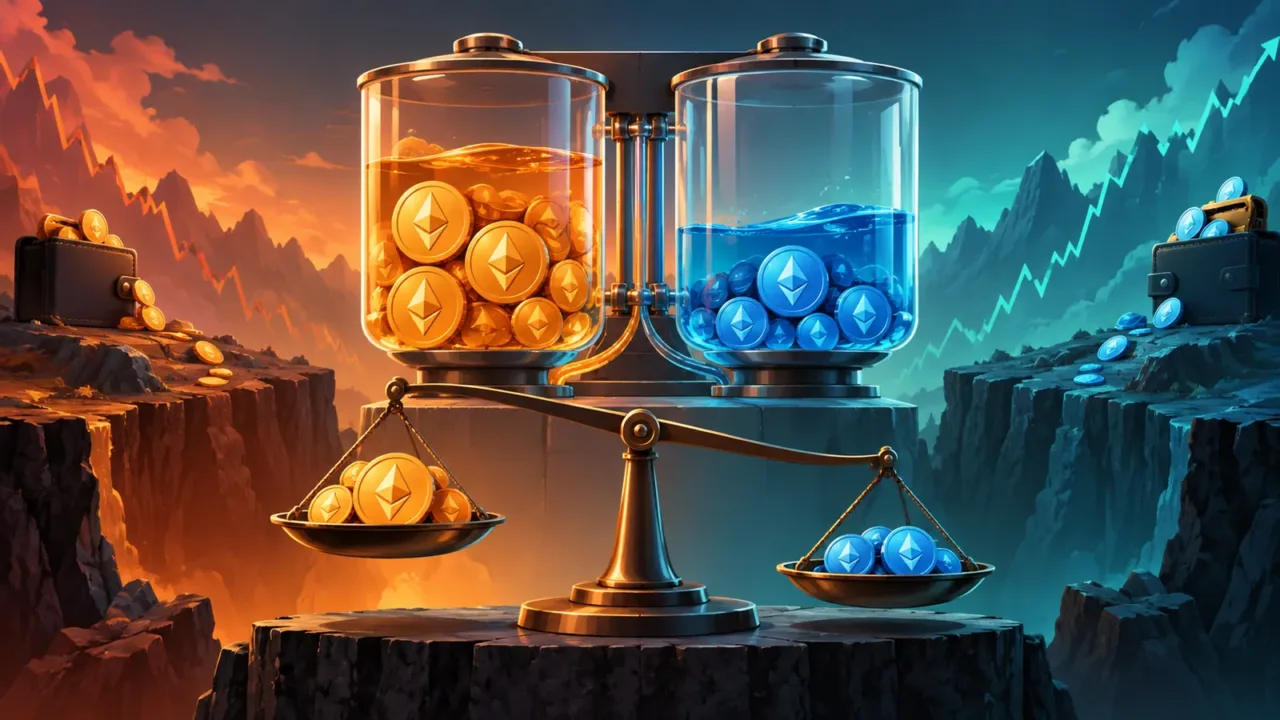
Why a pool creates impermanent loss
An automated pool relies on a smart contract and rules recorded on the blockchain. In the classic constant-product model, the quantity of the first asset multiplied by the quantity of the second follows the relationship x × y = k. Arbitrageurs trade with the pool whenever its price diverges from the external market, gradually changing the composition of the deposit.
Consider an ETH/USDC pool. When ETH rises, traders remove ETH from the pool and add USDC until the price returns close to the market level. The liquidity provider then holds less ETH and more USDC. If ETH falls, the reverse movement takes place. This automatic redistribution explains the difference compared with a portfolio that simply held both assets.
The word “impermanent” can sometimes be misleading. Withdrawing from the pool locks in the difference. A complete return of the price ratio to its initial level can erase it before withdrawal, but there is no guarantee that this will happen. The fees earned may offset some or all of the relative loss without eliminating the underlying mechanism.
Calculating the difference with a simple formula
For a 50/50 constant-product pool, the standard formula uses the ratio r between the new price and the initial price:
Impermanent loss = 2 × √r / (1 + r) − 1
If ETH doubles in price, r = 2. The result is approximately −5,72 %. This does not mean that the deposit necessarily loses 5,72 % in fiat terms. It means that the pool position is worth approximately 5,72 % less than the same assets held outside the pool, before fees and rewards.
Simplified example: a user deposits 1 ETH and 2 000 USDC when ETH is worth 2 000 dollars. Their reference portfolio totals 4 000 dollars. After ETH doubles, simply holding the assets would produce a portfolio worth 6 000 dollars. The pool rebalances the quantities, bringing the position’s value to approximately 5 657 dollars before revenue. The difference is about 343 dollars, or 5,72 % relative to the held portfolio.
Uniswap’s official support page explains this mechanism and notes that concentrated liquidity can amplify exposure. The formula above therefore provides a baseline, not a universal estimate for every protocol.
Adding fees and rewards to the calculation
A sound decision compares two net outcomes: the final value in the pool and the final value of simply holding the assets. The calculation should include trading fees earned, any tokens distributed, gas fees paid to enter or exit, and applicable taxes.
The yield displayed by an interface often reflects a recent annualized rate. An APR of 30 % observed over one week does not promise 30 % over twelve months. Trading volume, competition among liquidity providers and incentive levels can change quickly. Rewards paid in a volatile token also introduce price risk.
A cautious approach is to build three scenarios: limited variation, average variation and an extreme move. For each one, calculate impermanent loss and then subtract it from the expected revenue. Apply a discount to speculative rewards. This produces a range that is more useful than a single yield figure displayed in large type.
Why concentrated liquidity changes the risk
Some platforms allow liquidity to be supplied only within a specific price range. Capital works more efficiently while the market remains within that range, which can increase fees. In return, crossing the boundary progressively converts the position into a single asset.
A narrow range therefore requires more frequent monitoring and rebalancing. Each adjustment costs gas and can realize a relative loss. For beginners, a wide range or a traditional pool is easier to understand, even if the gross yield appears lower.
Crypto narratives around DeFi and tokenized assets often attract liquidity to new protocols. This rotation accelerates the decline in rewards after an initial campaign. It is important to distinguish fees generated by genuine usage from temporary subsidies funded by token issuance.
Do stable pairs reduce the danger?
A pool made up of two assets whose prices move together generally experiences a smaller divergence. Stablecoin pairs illustrate this case. However, the risk does not disappear: a stablecoin depeg can leave the provider almost entirely exposed to the weaker asset.
Before depositing, examine the quality of the reserves, external liquidity and redemption mechanisms. The guide to the advantages and risks of stablecoins helps assess this additional layer. A USDC/USDT pool is not the equivalent of a risk-free account; it combines two issuer risks, smart contract risk and market risk.
A practical checklist before providing liquidity
Start by identifying the pool’s weighting: 50/50, 80/20 or another ratio. Then record the entry price, any price range and the AMM’s formula. Calculate the difference across several price movements, and estimate net fees using a conservative volume assumption.
Also check the protocol’s age, audits, administrative powers, whether withdrawals can be suspended and the concentration of governance. Good crypto security practices limit wallet-related risks, but they cannot fix a protocol vulnerability or poor economic design.
Finally, start with a small amount. Record the value of the assets at the outset, accumulated fees, rewards and the exit cost. After a few weeks, compare the position with the reference portfolio. This personal measurement is more meaningful than a yield screenshot shared on social media.
Key takeaways
- Impermanent loss measures the relative shortfall compared with holding the same assets.
- A major price move, a narrow range or a stablecoin depeg increases the risk.
- Fees can offset the difference, but their future level remains uncertain and should be tested across several scenarios.
Yield alone is not enough to assess a pool
The right question is not just the annual rate. It is the net performance after rebalancing, fees, rewards, gas and technical risks. A pool can generate regular income while underperforming a simple holding strategy. Calculating impermanent loss therefore puts yield into context and helps investors choose an exposure compatible with their time horizon and risk tolerance.