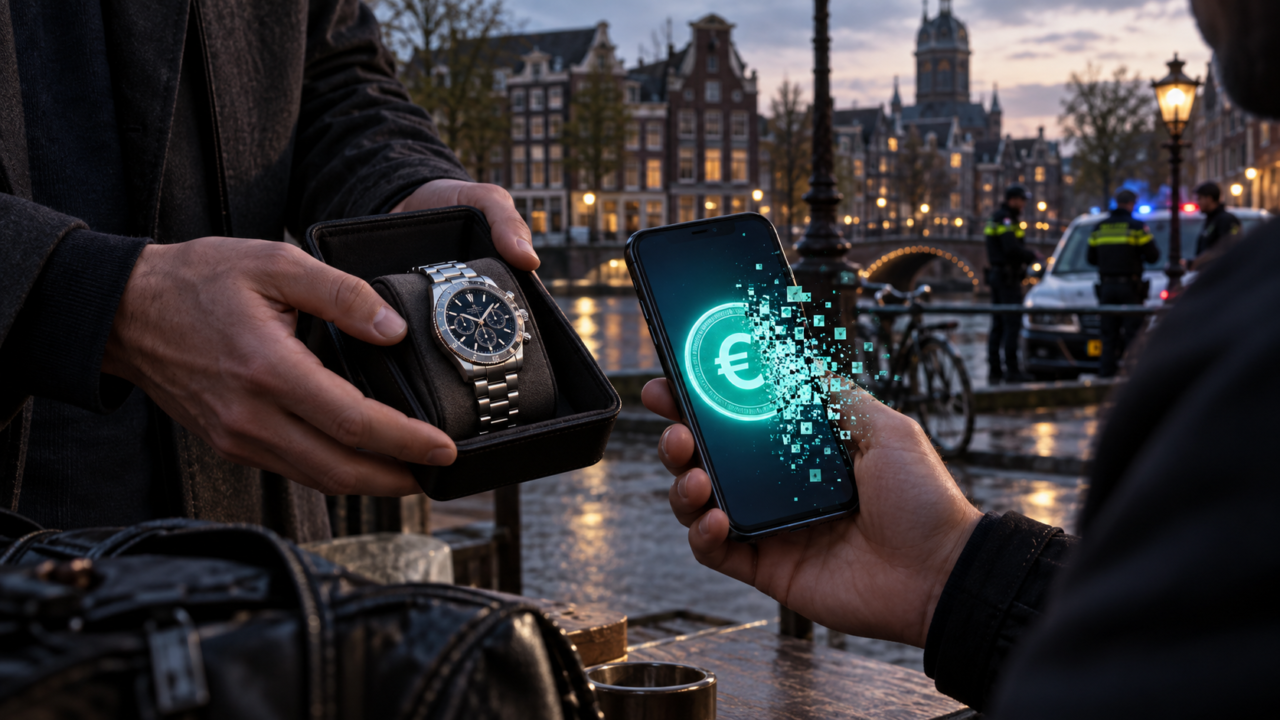
Crypto: the fake EURC looked genuine
The case perfectly illustrates one of the often-overlooked risks surrounding stablecoins. A token displaying “EURC” in a wallet is not necessarily the EURC issued by Circle.
The first reports date back to August 2025. In one of the cases described by Dutch police, a man from Almelo had listed his Rolex for sale on Marktplaats. During the meeting, he saw the crypto payment appear and handed the watch to the buyer.
The problem only emerged later, when he tried to convert the tokens he had received into euros: they were worthless.
Dutch police describe the fake EURC tokens as difficult to distinguish from genuine ones at first glance. However, they have not publicly specified the smart contract or blockchain used to create the copies.
The EURC ticker proves nothing
Technically, creating a token with the same name and symbol as a known asset is relatively simple on a blockchain that allows smart contracts to be deployed.
That is why the transaction must be checked in a block explorer, followed by verification of the network and, above all, the token contract address.
Circle publishes the official EURC addresses for each supported blockchain. EURC exists notably on Ethereum, Base, Solana, Stellar, Avalanche and other networks. On Base, for example, the official EURC token has the address 0x60a3e35cc302bfa44cb288bc5a4f316fdb1adb42.
A scammer can create another token and give it the EURC symbol. The wallet may then display a reassuring name even though the contract has no connection to Circle.
It is the digital equivalent of a very convincingly printed counterfeit banknote.
Two suspects arrested a year later
The investigation ultimately led to the arrest of a 24-year-old man from Geleen and a 45-year-old man from Leiden on September 9, 2026.
During a search linked to the 24-year-old suspect, police say they seized firearms and drugs. He was remanded in custody for fourteen days by an investigating judge. The 45-year-old suspect was released but remains under investigation.
The case adds a particularly effective variant to the scams already targeting crypto wallets. Here, there is no need to steal the seller’s seed phrase: it is enough to make them believe that a worthless payment is a genuine stablecoin.
Seeing “10,000 EURC received” is therefore not enough.
For a major sale, the network, the official contract address and the amount confirmed on-chain must be checked. Ideally, sellers should also verify that the token can actually be exchanged before handing over the item.
A Rolex is difficult to counterfeit convincingly. A crypto ticker, far less so.