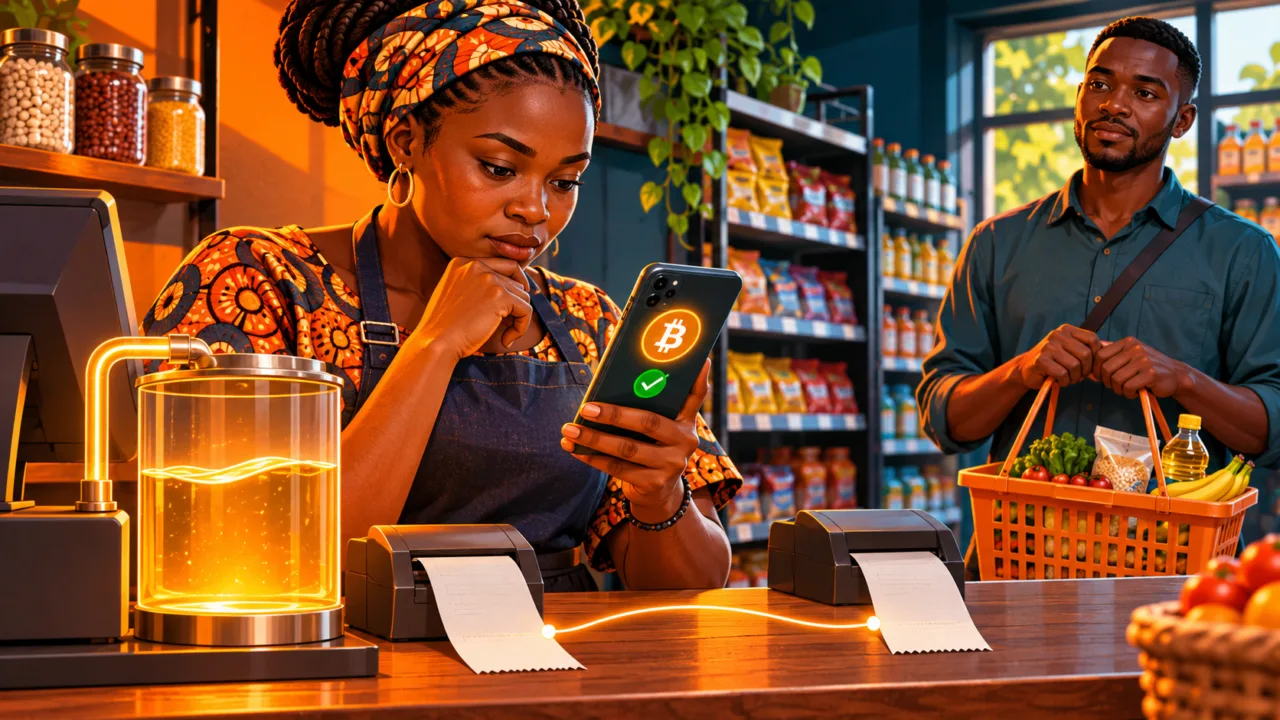
A Bitcoin Lightning wallet can make some small payments easier, but a business needs to assess more than the speed of an on-screen confirmation. It must be able to receive funds, reconcile sales, manage access and cover local expenses. Receiving liquidity and the ability to convert into the currency used by the merchant matter just as much as the advertised fees.
For 2027, Phoenix and ZEUS are among the software options worth examining, while BTCPay Server addresses the needs of a more structured checkout system. None is a universal recommendation for every African country. Here is how to compare these tools and their responsibilities without promising unverified local conversion or future availability.
In brief
- Self-custody, hosted accounts and connections to remote nodes involve different responsibilities.
- Receiving on Lightning may require inbound liquidity and result in additional fees.
- The checkout process must account for proof of sale, refunds and local conversion within the framework applicable to the business.
What checkout problem should the wallet solve?
The Bitcoin and Mobile Money in Africa guide distinguishes between two payment channels. Lightning does not turn a BTC balance into local mobile money. A business must therefore clarify whether its objective is to hold bitcoin or quickly obtain the currency it needs to pay suppliers.
A small shop run by one person does not have the same needs as a business with several employees. In the first case, a phone may be enough to test receiving funds. In the second, receiving payments, administration and spending authority must be separated, without sharing the owner’s secrets with the entire team.
Volume and average transaction size also influence the choice. Dozens of small sales require reliable reconciliation and repeated availability. An occasional larger sale may primarily raise a liquidity and cash-out issue. The number of available applications does not replace this assessment of the business’s needs.
Before installing anything, document the devices in use, the available connection, the person responsible and the backup process. If the network goes down, what other payment method will the business offer? A new solution should not bring all sales to a halt when the phone hosting it becomes unavailable.
Finally, check whether accepting this type of payment is lawful and review the country’s accounting requirements. Software available online does not constitute local authorization. This guide compares tools and procedures; it does not claim that all African businesses can accept Bitcoin under the same conditions.
Phoenix, ZEUS and BTCPay: what differences should you examine?
The official Phoenix repository published by ACINQ presents a self-custodial Bitcoin wallet that uses Lightning to send and receive. This positioning may appeal to users who want to control their keys. On its own, however, it does not prove that all the requirements of a professional checkout system will be met.
For Phoenix, examine the current version’s opening and receiving conditions, fees and restoration process. Availability in the app store and the associated service should also be checked in the country concerned. This guide does not provide a permanent fee schedule or promise universal support in 2027.
The ZEUS documentation on accessing Lightning describes, among other things, an embedded node and several ways to establish channels. It also explains the role of Olympus, its liquidity service provider. This setup requires an understanding of the fees and the model actually activated, rather than assuming that every incoming payment works the same way.
The BTCPay Server Lightning documentation outlines different configurations for merchants, including delegated custody, liquidity services and more autonomous management. BTCPay is not simply a mobile wallet competing with the other two: it is designed to organize payments around infrastructure that the business selects and administers.
These three options should therefore be compared by use case. Phoenix may be considered for a personal mobile wallet; ZEUS offers a way to examine more explicit node control; BTCPay fits a broader review of the checkout system and its connections. The right choice depends on the team’s skills and commercial process, not on a “best wallet” award.
Our analysis of self-custodial Bitcoin wallets helps distinguish key control from operational dependencies. Even when holding its own keys, a business must understand the role of a liquidity service, its device and its connection.
Why does receiving capacity matter?
On Lightning, having a balance does not guarantee that every payment can be received. Available channel capacity and associated services may also play a role. The merchant needs to understand what happens when a customer tries to pay an amount above the expected capacity, or when a new channel has to be created.
A service can simplify this step by providing liquidity, but that convenience comes with conditions. The cost may depend on a particular operation and may not resemble a small, uniform percentage of every sale. Checking the amount shown before receiving a payment helps prevent an incorrectly calculated commercial margin.
Take a completely fictional example. A shop receives ten payments of 5,000 satoshis, or 50,000 satoshis gross. If preparing the payment route costs 6,000 satoshis and receiving the payments incurs a total of 500 satoshis in fees, the net amount is 43,500 satoshis before conversion. The 13% cost in this example does not describe any real tariff.
With more sales using the same infrastructure, the impact of an initial cost may decline. But businesses should not assume that all subsequent sales will be free or that no new liquidity expense will arise. They should track the actual cost and capacity rather than extrapolating from a single favorable day.
The approach described in our guide to crypto fees in Africa extends this calculation to the currency the business can actually use. If the shop later sells the BTC to pay a supplier, conversion and withdrawal costs must be added. An inexpensive incoming payment can lose its appeal when local cash-out applies a wide spread.
How should sales, employees and refunds be managed?
Every sale should have a reference that can be matched to the payment received. A displayed QR code does not prove that the customer has paid, and a screenshot provided by the customer is no substitute for checking the invoice status in the checkout system. The seller should verify the payment in their own interface before handing over the product.
The pricing policy also needs a clear rule. If a product is priced in local currency but paid for in BTC, define the exchange rate used and how long the invoice remains valid. If payment is delayed, the checkout system must specify whether the request should be renewed rather than leaving an outdated quote in place without agreement.
A refund represents a new decision. The business must specify whether it will refund the original BTC amount or a value calculated in the currency of the sale, in line with its terms and applicable law. Network fees and price fluctuations should not emerge for the first time in the middle of a dispute.
With several employees, look for a payment function that does not unnecessarily grant permission to spend the entire treasury. Role separation should be tested in the chosen setup. Creating a shared account containing all secrets can make an incident difficult to attribute and access revocation more complicated.
Finally, retain exports or reconciliation records according to accounting needs. A technical transaction does not automatically describe the nature of the product sold. The checkout system must link the price, applicable tax, sale and payment without exposing customers’ sensitive information in a document accessible to the entire team.
What security measures and testing are needed before scaling up?
Backing up a seed phrase is a separate responsibility from day-to-day operation. With Lightning, the restoration procedure specific to the software and setup in use must also be documented. Do not assume that a simple file or phrase will restore every configuration in the same way.
Testing with a limited amount makes it possible to check a payment receipt, an authorized spend and the available supporting records. Also simulate losing the phone or having the administrator unavailable, without putting significant funds at risk. A procedure understood only by the person who installed it can weaken the business as soon as an unexpected problem occurs.
The cash reserve earmarked for immediate expenses must remain accessible in the currency required. Bitcoin’s price may change after the sale. Accepting a payment does not mean that the merchant must maintain exposure they do not want for their treasury.
Setting an operational balance cap can limit the consequences of a compromised device. The frequency of transfers to a different form of custody must nevertheless take costs and capacity into account. A security policy must remain practical; otherwise, employees may abandon it in favor of a less controlled shortcut.
Installing only versions obtained through the project’s official channels reduces the risk of using a deceptive copy. A link received after a checkout failure may offer a fake repair tool. The person responsible for installation should verify its source without entering secrets into an improvised form. Updates should also be prepared with a backup and an alternative way to accept payments, rather than launched without checks during a busy period.
In 2027, the useful wallet will be the one whose keys, liquidity, fees and records the merchant understands. The decisive test is not merely displaying “received,” but properly closing a sale, handling a possible refund and covering local expenses without relying on an improvised conversion.