Altseason has not arrived yet
Seeing Solana gain 10%, Zcash double or several mid-caps surge is sometimes enough to bring the word “altseason” back into the conversation. For now, the data tells a less spectacular story. Bref Crypto already noted in early September that this was primarily a selective rotation, not yet a genuine altseason. CoinMarketCap’s index was then at 45. On September 18, it stood at around 42.
CoinMarketCap’s methodology is fairly demanding. To declare an Altcoin Season, 75% of the 100 largest eligible cryptocurrencies must have outperformed Bitcoin over the previous 90 days. Below 25, CoinMarketCap instead considers the market to be in Bitcoin Season. Between the two lies a transition zone.
Bitcoin also maintains high dominance. It was still at 58.84% on September 13, compared with around 11.6% for Ethereum. This dominance means that a very large share of the crypto market capitalization remains concentrated in BTC.
That does not prevent the first signs of rotation. Solana gained around 11% on September 18 while Bitcoin rose by approximately 6%. Open interest in altcoin perpetual futures had even exceeded Bitcoin’s in early September, at nearly $40 billion versus $23.9 billion.
Capital is therefore beginning to look elsewhere. It simply has not spread everywhere yet.
The old altseason model is becoming less clear-cut
Previous cycles often followed a relatively predictable pattern. Bitcoin rose first. Its dominance increased. Once BTC stabilized, some profits moved into Ethereum, then large caps, mid-caps and eventually the most speculative tokens.
In 2021, this mechanism was powerful enough to lift projects with very few users, no revenue and sometimes barely functional products. Excess liquidity did much of the work.
The 2026 market is different.
Bitcoin now has spot ETFs. Ethereum does too. Solana, XRP, Hyperliquid, Chainlink and other assets either have or are beginning to have financial products capable of receiving institutional capital directly. Some of the money that would previously have circulated gradually throughout the market can now remain concentrated in a few regulated vehicles.
September 18 provides a good example. Bitcoin ETFs attracted $433 million in a single day. Ethereum received around $143.7 million, Solana $47.6 million, Hyperliquid $1 million and Chainlink $2.2 million. XRP, by contrast, recorded a slight outflow.
The full week is even more revealing. Solana funds attracted around $60.7 million, while Ether ETFs lost $140.6 million. Hyperliquid ended the period with approximately $3.1 million in inflows. This is not a uniform tide. It is selective.
That may be the major difference from the old altseason. The market could still rotate away from Bitcoin, but money no longer needs to move mechanically down to the thousandth token on CoinMarketCap.
It can choose.
And it is already beginning to do so.
“Quality alts” now have a genuine advantage
That leaves the question of what constitutes a quality altcoin. The term is often used simply to describe a token someone likes. That is not enough.
A solid project in 2026 should ideally combine several characteristics: substantial liquidity, genuine network usage, infrastructure that is difficult to replace, tokenomics that do not depend on perpetual issuance and, where the model allows it, fees or revenue demonstrating that real economic activity exists.
Security also matters. A blockchain with several billion dollars in assets but only a few validators, a fragile bridge or excessive administrative permissions carries risks that market capitalization alone does not reveal.
Institutional access is becoming a new variable.
Charles Schwab is, for example, preparing to open its millions of brokerage accounts to Solana, Avalanche and Chainlink. This is obviously no guarantee that SOL, AVAX or LINK will rise. It nevertheless fundamentally changes their accessibility compared with a token available only on a few offshore exchanges. Bref Crypto detailed this expansion of Charles Schwab’s offering in late August.
Chainlink offers another good example of what “quality” can mean without referring to price. The network now delivers several official US economic data points, including GDP and PCE inflation, directly to smart contracts on ten blockchains. This integration with US economic data illustrates the infrastructure role Chainlink is seeking to build.
The token can rise or fall. The infrastructure has measurable use.
In a selective altseason, that difference could become far more important than it was in 2021.
Wall Street is already creating its own altcoin selection
The arrival of ETFs is also changing the definition of a “large altcoin.”
In the past, the hierarchy was largely determined by crypto exchanges, on-chain liquidity and market capitalization. Now, a second ranking is emerging: which tokens can Wall Street actually buy within a regulated framework?
Hyperliquid illustrates this shift perfectly. HYPE entered the Nasdaq CME Crypto Index on September 1, with an initial weighting of 3.36%. Solana accounted for 3.79% of the same index, while Bitcoin dominated with 74.36%. Bref Crypto had detailed HYPE’s entry into this institutional index.
The signal is interesting. Until recently, Hyperliquid was seen as a purely crypto-native DeFi product. The token is now part of the same index architecture as Bitcoin, Ethereum, XRP and Solana.
This passage between the two worlds could become a huge barrier to entry during the next altseason.
Assets with market depth, derivatives products, custody infrastructure and regulated vehicles can receive significantly larger amounts of capital. The others will continue to depend almost exclusively on crypto traders.
The result could be a two-speed market.
A handful of altcoins will attract institutional flows.
A second category may benefit from solid on-chain use or a powerful sector narrative.
Then there will be thousands of tokens attempting to replicate 2021’s performance without having the necessary liquidity.
That is where the word “altseason” can become misleading. A rise in SOL, ETH, LINK, HYPE, ZEC and a few DeFi protocols does not necessarily mean that the entire alternative market is entering a bull market.
The market can perfectly well experience an altseason without a season for most altcoins.
Revenue, users and tokenomics will matter more
The gradual disappearance of the “everything goes up” principle also has a very simple explanation: the token supply has become enormous.
Each cycle adds new Layer 1s, Layer 2s, DeFi protocols, memecoins, AI networks, RWA tokens, gaming projects, DePINs and various applications. Available capital therefore has to be spread across far more assets than in 2017 or 2021.
With liquidity unchanged, that mechanically reduces the amount of money available for each one.
Investors are also paying much closer attention to issuance. A token can show an appealing market capitalization with only 15% of its supply in circulation. If billions of dollars’ worth of tokens allocated to private investors and teams are due to be unlocked over the coming years, the price increase must constantly absorb this new supply.
This problem does not exist with the same intensity for assets that are already widely distributed.
The same applies to revenue. The market is beginning to ask how much a protocol actually earns, not merely how much TVL it can attract through incentives.
Balancer’s recent history is almost a warning. The protocol had recognized technology and several years of history, but its new version did not generate enough revenue to justify continuing expenses. Technically interesting infrastructure therefore no longer even guarantees its own economic survival.
By contrast, projects capable of generating real fees have additional evidence that their users are willing to pay for the service.
That does not automatically make their token a good investment. Revenue may remain entirely within the company or protocol without directly benefiting the token. Dilution can also cancel out part of that value.
The next altseason could force the market to perform these calculations much more seriously.
A narrative attracts attention.
A product retains the user.
An economic model retains capital.
The next altseason could be sector-driven
Another difference is already visible in recent performance: moves are taking place by theme.
Koryu’s data on its universe of liquid cryptocurrencies showed significant divergence between sectors on September 18. The Layer 2s in its sample were up around 135%, DeFi 53%, AI 32%, memecoins 26%, Layer 1s 20% and RWAs 19%. The methodology has its own limitations, notably a restricted universe and a recent history, but the dispersion remains instructive.
The market is not rising uniformly.
It is choosing narratives.
RWAs are benefiting from the growing tokenization of stocks, bonds and funds. Ondo is already providing Blockchain.com with more than 170 additional tokenized stocks and ETFs, bringing its catalog to more than 430 traditional assets across several networks.
DeFi is benefiting from a return of volume and far more sophisticated products.
Artificial intelligence has its own speculative and infrastructure-driven wave.
Privacy coins have recently benefited from Zcash’s spectacular rally.
Memecoins, meanwhile, remain capable of absorbing substantial liquidity when risk appetite increases.
An altseason could therefore develop as a succession of mini-seasons.
Two weeks of DeFi.
Then Layer 1s.
Then AI.
Then RWAs.
Then the most speculative assets.
This kind of rotation would force investors to distinguish structural growth from a simple move lasting a few sessions.
That is also where quality projects can gain an advantage. When the narrative turns, an asset with users, liquidity and a useful product still has something behind it.
A token built entirely around FOMO has far less.
Bitcoin probably has to open the door
The irony is that the next altseason still depends largely on Bitcoin.
BTC has just reclaimed the $80,000 area and is attempting to break out of a structure that kept it between approximately $71,000 and $82,000 for several weeks. A sustained break above $82,500–$83,000 would significantly strengthen the case for a new upward move.
Historically, altcoins often perform better when Bitcoin rises enough to restore confidence, then slows without collapsing.
It is this intermediate phase that allows capital to seek higher returns elsewhere.
Bitcoin rising too quickly can instead absorb market liquidity and keep its dominance high. Bitcoin falling sharply generally drags altcoins even lower.
The ideal setup for an altseason therefore remains fairly specific: a strong but relatively stable Bitcoin.
We are not quite there yet.
Dominance remains close to 59% and the Altcoin Season Index is still far from 75. The Federal Reserve has also just raised rates, while markets are considering further increases. Reuters reported significant outflows from global equity funds again this week because of inflation and monetary policy concerns.
Global liquidity therefore still does not resemble that of 2021.
And yet, some altcoins are already beginning to outperform.
That is precisely what makes the coming weeks interesting.
This altseason probably will not save every former favorite
The classic mistake is to believe that every altcoin that reached a peak in 2021 or 2025 must necessarily return to it.
Nothing requires that.
Every crypto cycle has its graveyard of former leaders. Some networks lose their developers. Others lose their liquidity. One narrative is replaced by a new technology. A token becomes diluted by several years of issuance while its price remains far below its record.
The market capitalization required to reclaim the former ATH can then be much higher than when that record was set.
This is probably where the next altseason will be most unforgiving.
The bull run can return.
Capital can rotate away from Bitcoin.
Ethereum, Solana or various sectors can rise sharply.
And still, a large share of altcoins may remain permanently below their former highs.
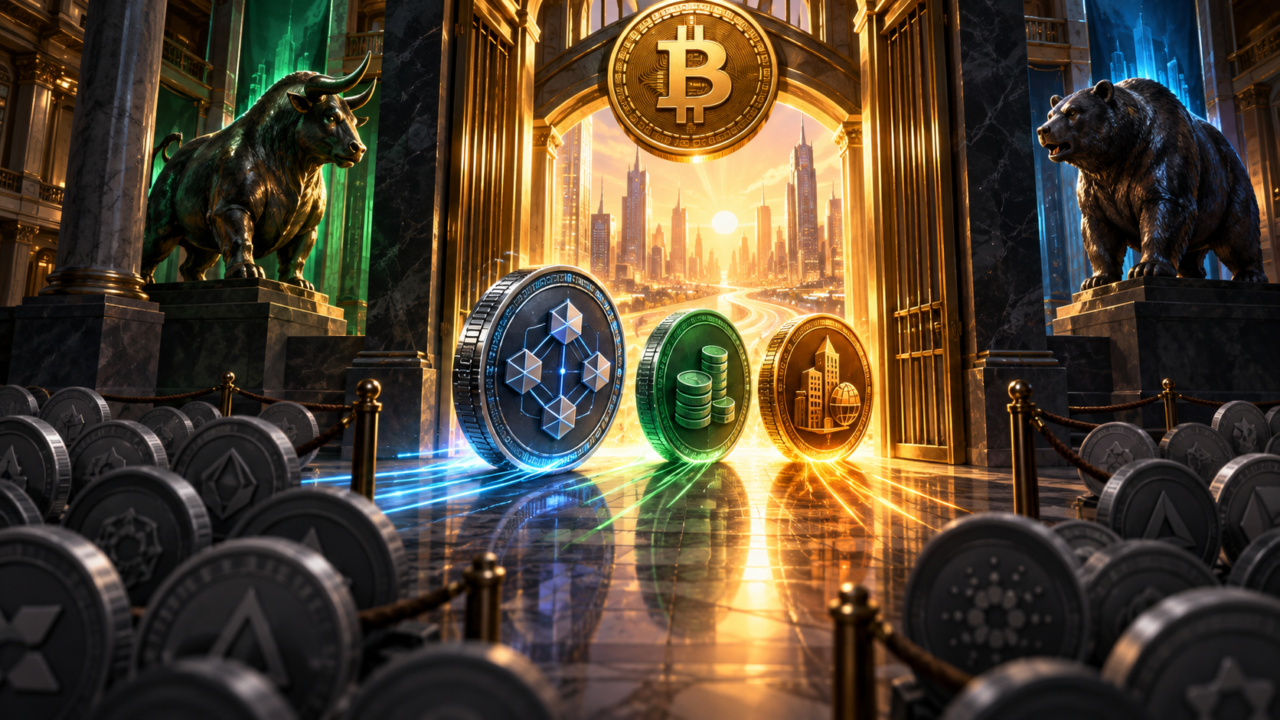
The word “altseason” suggests a season in which all boats rise with the tide. The institutionalized market of 2026 looks more like a competition for capital.
ETFs choose.
Indexes choose.
Major platforms choose.
Users choose.
And revenue eventually shows which applications are actually being used.
A genuine rotation into altcoins therefore remains entirely possible if Bitcoin’s bull run is confirmed. The first cracks in its dominance are already appearing, and some institutional flows are now reaching Solana, Hyperliquid, Chainlink and other assets directly.
But the next altseason could do something investors accustomed to 2021 will like much less: it could rise very high without taking the entire market with it.
This time, simply holding “altcoins” probably will not be enough.
The market will have to find a reason to want precisely those ones.