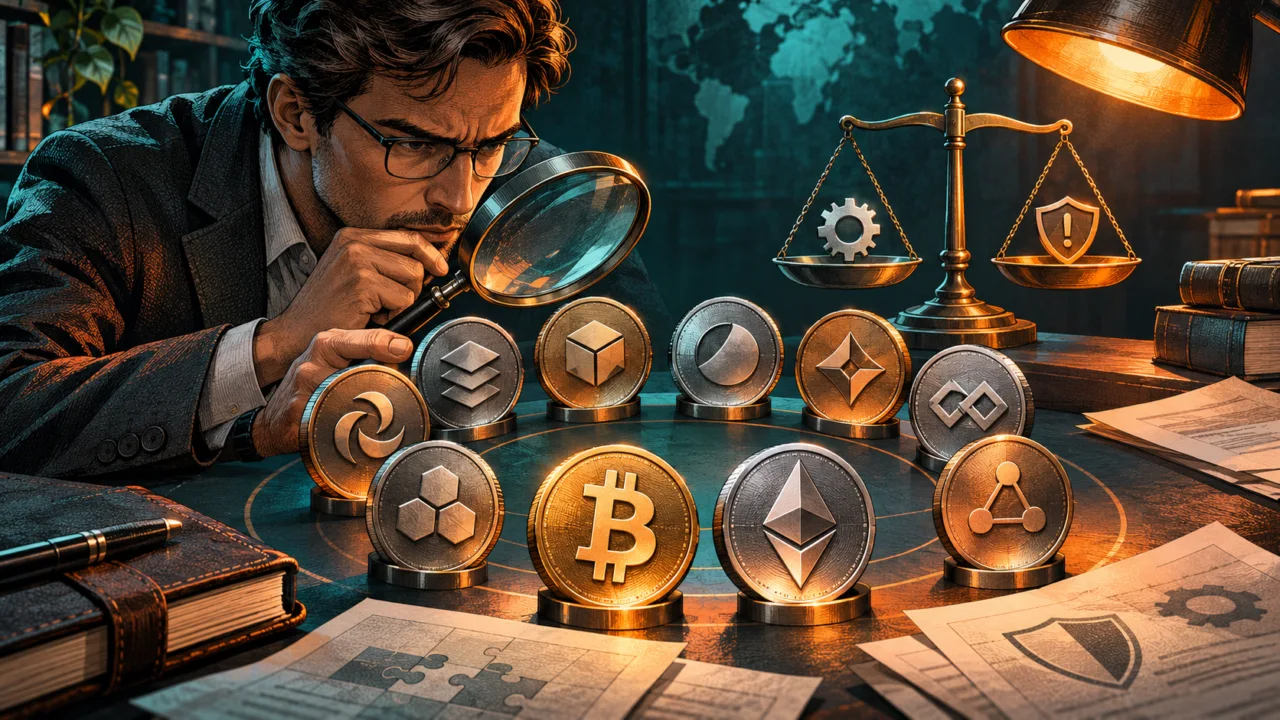
Which high-potential cryptocurrencies should be studied for 2027? A serious selection must look beyond the latest performance rankings: network utility, the token’s role, supply circulation and adoption conditions all matter. Bitcoin, Ethereum, Solana, Chainlink, Aave, XRP, Avalanche, Polkadot, Sui and NEAR represent ten different cases to examine—not ten promises of price gains.
This top 10 is an editorial research selection prepared on November 3, 2026. The order represents neither a probability of returns nor a safety ranking. The technical facts cited describe the projects reviewed; the outlook for 2027 remains conditional. No price target can turn an adoption hypothesis into a guaranteed investor profit.
In brief
- A useful network can still make a poor investment if the price already anticipates too much growth.
- The token’s economic role matters as much as the project’s activity: governance, fees and revenue are not interchangeable.
- This list is designed to compare ten investment theses; it does not recommend holding ten positions or investing all of your savings.
How to build a crypto top 10 for 2027 without selling a dream
This comparison examines ten theses and the conditions that could invalidate them. It complements the general guide to projects to study for 2027 without turning its selection into a return forecast. Here, each case should mainly make it possible to test what could contradict the favorable hypothesis.
Our guide to tokenomics and token unlocks provides a starting framework: how much is circulating, how much could reach the market and who holds it? Without those answers, talking about potential often amounts to extrapolating a chart. A large future supply can change an otherwise attractive technical thesis.
The second question concerns value transmission. Users may benefit from an application without holding its token over the long term. A company may adopt a blockchain without distributing its profits to holders of the native asset. The economic link therefore needs to be identified, rather than conflating protocol activity, a service provider’s revenue and the rights actually attached to the token.
The third check covers the price paid, available liquidity and risks. This article does not provide an up-to-date quantitative ranking of market capitalizations or revenue; it therefore does not claim to demonstrate undervaluation. Before making any decision in 2027, price, supply, incidents, governance and trading conditions will need to be reviewed again, with their date and methodology.
Bitcoin and Ethereum: two theses that should not be confused
1. Bitcoin: analyzing demand for a digital monetary asset
The Bitcoin case is primarily about why users want to hold or transfer BTC. Its reference documentation describes a model different from that of a company stock. Holding bitcoin does not grant a contractual share of profits or a repayment claim against a company.
For 2027, the key issue to monitor is whether demand persists, not merely whether issuance declines in the future. A scarce asset can lose value if buyers withdraw. The thesis must therefore withstand a scenario involving more expensive financing, significant selling or less favorable access to trading services.
2. Ethereum: linking network activity to demand for ETH
Ethereum offers a different form of exposure: applications, settlement and the security of a programmable network. The gas documentation explains how operations consume resources paid for in ETH. This mechanism alone does not establish a market valuation or guarantee that additional activity will push the price higher.
Research for 2027 should track how usage is distributed across different layers, as well as costs and technical choices. Efficiency improvements may facilitate adoption while changing the fees collected per operation. For investors, measuring rising activity is therefore insufficient without analyzing its economic effect and the competitive landscape.
Solana, Avalanche, Sui and NEAR: comparing application platforms
3. Solana: examining the quality of activity, not just its volume
The Solana documentation describes fees paid in SOL, with components linked to transaction execution. An investment thesis needs to go further: which use cases are recurring, which users are paying and how much activity depends on temporary speculative conditions? A rise in transaction counts does not answer those questions.
The favorable 2027 scenario assumes activity remains durable enough to support the ecosystem. The adverse scenario should examine competition, reliability, concentration and a decline in the most cyclical use cases. Stated technical capacity is not an automatic measure of benefit for SOL holders.
4. Avalanche: verifying how use cases drive demand for AVAX
The official presentation of AVAX describes its functions in fees and staking on the primary network. The architecture can support different environments; their existence does not, however, demonstrate proportional demand for the same token. Each new deployment must be assessed according to its actual mechanisms.
In preparing for 2027, one useful question is the distinction between announced projects and observable activity. Issuance and incentives must also be examined: attracting users by distributing rewards can produce flattering metrics without guaranteeing that they will remain once the subsidies end.
5. Sui: tracking growth while factoring in token circulation
The official SUI supply page outlines its functions and a circulation schedule. This provides a starting point for measuring the tokens that could reach the market. A promising protocol does not eliminate the need to incorporate this evolution into an analysis of value per unit.
The 2027 case should place usage growth, competition and available supply side by side. A rise in the number of projects is not enough if demand for the token does not keep pace. Conversely, an unlock does not automatically mean an immediate sale: it changes the possibility of circulation, not a transaction that has already taken place.
6. NEAR: distinguishing technical capabilities from economic adoption
The NEAR documentation presents tools for building contracts and applications, along with interactions between multiple chains. These capabilities provide concrete avenues for research. They prove neither a lasting advantage over competitors nor sufficient token demand to support a given valuation.
For 2027, analysis should focus on applications in use, user retention and technical dependencies rather than a single narrative built around artificial intelligence. Associating a project with a popular trend does not turn every token into direct exposure to the corresponding commercial market.
Chainlink, Aave, XRP and Polkadot: four other mechanisms to study
7. Chainlink: monitoring demand for services and its connection to LINK
Chainlink’s economic overview describes LINK as a token used for services and security mechanisms. That function deserves to be analyzed separately from the total value of operations facilitated by the infrastructure. Significant transaction value does not necessarily represent collected revenue or income distributed to holders.
The 2027 growth scenario depends on services that are actually used and on the applicable payment arrangements. Risks include competition, the pace of adoption and the gap between the network’s operational role and the expectations already priced into LINK.
8. Aave: analyzing token rights independently from deposits
Aave’s documentation describes AAVE as a governance token. Holding AAVE is not the same as depositing funds in a lending market and does not automatically provide the same return as a lender. Rights and economic mechanisms must be examined separately from protocol usage.
For 2027, investors can monitor lending activity, governance decisions and risks linked to collateral and contracts. Higher deposited amounts do not guarantee an equivalent improvement for the token. Changeable economic policies should be checked at the time of analysis rather than projected without limit.
9. XRP: verifying the token’s role in each announced use case
The XRP Ledger documentation distinguishes XRP, the native asset, from other assets that can circulate on the ledger. This distinction prevents all tokenization or payment activity carried out in the XRPL environment from being automatically attributed to XRP. The exact path of each transaction matters.
Research for 2027 should identify use cases that actually require XRP, liquidity constraints and supply concentration. An announcement involving a provider or service is not enough to demonstrate lasting buying pressure in the token market.
10. Polkadot: understanding demand for security and resources
Polkadot’s platform overview places DOT within the economic operation of its platform. The analysis must clarify the rules in force at the time: governance, security and access to resources do not necessarily have the same effects on supply and demand. Technical changes require the mechanisms to be reviewed rather than an old description repeated.
For 2027, a favorable scenario assumes that the capabilities offered attract users and generate economic utility. An adverse scenario must account for complexity, competition and the difficulty of converting an interesting architecture into lasting adoption. Ambitious technology does not eliminate the need to examine investment conditions.
Moving from ten cases to a limited, verifiable decision
This list is not a ten-asset portfolio to copy. Several projects target the same use cases and may react similarly to a liquidity withdrawal. Buying all of them can multiply transactions without reducing risk as much as the number of names might suggest. Diversification should concern actual exposures, not just ticker symbols.
One research test is to write down, for each selected asset, one reason to buy, one reason not to buy and one event that would invalidate the favorable hypothesis. If these three elements cannot be distinguished, the case needs more work. An editorial ranking is no substitute for a valuation analysis or a personal loss limit.
Execution costs also matter. Our guide to crypto fees and spreads outlines the components to compare, while the article on DCA explains how to spread out purchase times without eliminating market risk. No tool guarantees an entry at the right moment.
Before holding an asset over the long term, checking the wallet custody method and withdrawal options remains essential. The assets studied do not all use the same network or procedures. A sound economic thesis will not protect against sending a transfer to an unsupported network.
Potential for 2027 should therefore remain a documented, revisable and limited hypothesis. These ten cryptocurrencies make it possible to explore different mechanisms; their inclusion in the selection does not mean they will be worth their future price. The best outcome of this research is knowing when to reject an insufficient case, even when its narrative attracts significant attention.