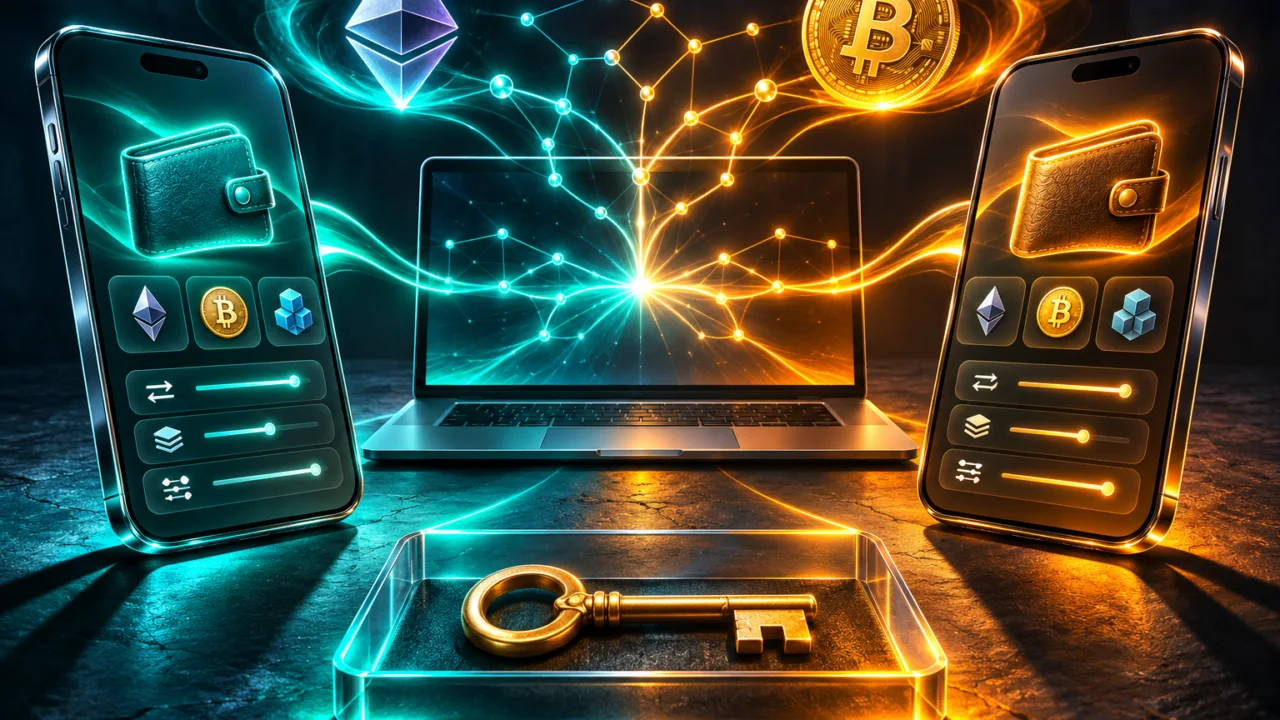
Trust Wallet or MetaMask in 2027: the comparison should start with the devices, networks and accounts actually in use. Both names refer to management and interaction interfaces—not a promise of returns or a bank account. Control of the keys remains central.
Official documents reviewed on November 5, 2026, also show why older comparisons quickly become outdated. MetaMask now documents Bitcoin alongside Ethereum and Solana, while Trust Wallet presents broad network coverage. These findings must be checked again in 2027, without assuming that every feature is available everywhere in exactly the same way.
In brief
The guide to self-custody wallets explains the difference between managing keys and entrusting assets to a platform. That choice comes before the comparison between applications.
- Compare the mobile version or browser extension actually installed, not an abstract brand.
- Importing a backup does not guarantee that every previous account will reappear automatically.
- Downloading a wallet for free does not eliminate network fees or fees charged by integrated services.
Compare devices and official downloads
The MetaMask download page offers paths for mobile and browser extensions. Readers should start from this official entry point and check the destination provided. An advertisement, the first search result or an identical logo is not enough to identify a legitimate distribution.
Trust Wallet also offers a mobile app and extension. Using multiple devices provides flexibility, but it can also increase the number of places where a secret may be exposed. Access convenience must be weighed against how backups and signing authority are organized.
On a computer, an extension interacts with the browser environment. Other extensions, the profiles in use and open websites all matter. On mobile, the device may also receive deceptive links, notifications and messages. No format makes it safe to treat every request as trustworthy.
The selection should therefore begin with a use case. Will the user mainly conduct transactions from a computer, monitor balances on a phone or sign with a hardware device? These choices call for checking specific features, rather than adding up advantages advertised for several different versions.
A comparison sheet should record the version, device and verification date. Without that information, a recently added feature may be wrongly attributed to an older installation. Users should also avoid installing several unknown applications in a rush to unlock an operation they do not understand.
Check network support without relying on outdated shortcuts
Trust Wallet advertises support for numerous networks. Its integration documentation distinguishes browser and mobile workflows. Support for a network does not mean that every related protocol, asset or service offers the same features in each version.
The shortcut “MetaMask only supports Ethereum” no longer reflects its documentation as a whole. Its Bitcoin guide describes a BTC account, with Native SegWit compatibility required for importing at the time of consultation. That limitation must be examined instead of assuming that every older Bitcoin wallet can be restored without difficulty.
The number of networks is not a security ranking. It can simplify tracking a diversified wallet, but it also increases the number of contexts that must be distinguished. The expected address, destination network and asset type should always be identified before sending funds.
The same symbol can refer to different tokens depending on the network or contract. Receiving a representation of an asset on another chain does not necessarily mean receiving the expected native asset. A wallet may display both without explaining their economic differences or risks on its own.
For a user focused on two networks, the relevant question concerns those two specific workflows. Adding eighty more networks to a table does not demonstrate an improvement in that user’s experience. The most useful coverage is the one that matches the necessary, documented and understood operations—not the most impressive number.
Understand imports and accounts that remain separate
Assets are not physically stored in the application. A new interface can view or use accounts when it has the appropriate means. That does not mean users should copy their backup into multiple applications simply to compare their interfaces, especially when significant funds depend on those secrets.
The MetaMask documentation on importing a phrase highlights the importance of derivation paths and supported configurations. The same phrase therefore does not guarantee that every expected address will appear automatically. Accounts added separately require particular attention.
The Trust Wallet extension overview also distinguishes accounts derived from a phrase from hardware or separately imported accounts. Users should inventory their accounts before changing interfaces. A missing balance on screen does not prove that the funds have disappeared from the network.
Our guide to smart wallets adds to this distinction. Account-access rules can go beyond simply possessing a phrase. Users need to understand the model actually created and the dependencies required to regain access.
A local password should not be confused with this recovery process. Changing an application password does not automatically change every secret that authorizes transactions. Conversely, reinstalling the software will not solve a lost backup if no other suitable mechanism was provided.
Compare signatures and granted permissions
Both interfaces can be used to interact with applications. Users must distinguish between a connection request, a message signature and a transaction that grants spending permission. A familiar-looking window can still present a dangerous request; the wallet brand does not validate the site’s legitimacy.
In its guide to token allowances, MetaMask explains that disconnecting an application does not necessarily revoke spending permissions already granted. This difference should be understood before using a protocol, regardless of which interface is used to connect to it.
Checks should cover the relevant contract, active account and scope of the permission. A very broad request does not have the same effect as a limit matching the specific need. If these details remain unclear, the right outcome may simply be to reject the signature.
Alerts and transaction previews should be treated as aids, not as general certification. A detection system may lack information about a new threat. The absence of an alert does not show that a contract, token or website carries no risk.
For funds that do not need to interact regularly with applications, separating use cases can limit exposure. The guide to hardware wallet limitations nevertheless points out that a hardware signature does not replace understanding. A hardware device’s backup should never be imported simply to use a new interface.
Measure the full cost of an identical transaction
A wallet available at no upfront cost may offer purchases or swaps involving providers and fees. Costs should be measured for an identical transaction at the same time: the same starting asset, network, amount and destination. The percentage shown in an advertisement does not summarize the full process.
Our guide to trading fees, spreads and gas helps separate these components. Users should also examine the final amount received, any conversion costs and the additional transactions required. An advantage on one line can disappear when the full route changes.
A swap between networks can add risks and costs that are not attributable solely to the wallet. The provider, bridging mechanism and asset received must be examined. This guide does not claim that an integrated button makes a transfer less risky than a properly verified external process.
Fictional example: one quote states that one hundred units will be received for a cost of one euro, while another offers one hundred two units for two euros. Without knowing the comparable value of the units and the conditions for receiving them, the fee amount alone is not enough to choose between the offers. The comparison should focus on the net result that can actually be used.
The offers available in 2027 are not yet established at the time of writing. Fees, providers and availability will need to be checked before a transaction. Users should retain the quote details and final result to identify discrepancies, rather than extending an outdated fee table indefinitely.
Choose a controlled workflow without multiplying secrets
The decision can be based on a personal table covering devices, essential networks, existing accounts, recovery, signature review and the cost of the process. Each field should correspond to an actual check. An advertised feature that is never used does not make up for a poorly understood contingency procedure.
For a multichain mobile use case, Trust Wallet offers an example to examine; for a workflow already organized around MetaMask, changing interfaces is not automatically an improvement. These examples identify neither a universal winner nor an individual recommendation. The exact version and account constraints determine their relevance.
In 2027, comparing Trust Wallet and MetaMask will therefore require checking how they have evolved rather than repeating old comparisons. The better choice is the one that makes clear which account is signing, what it authorizes and how access can be restored. Adding an application should never begin by handing over secrets to supposed support staff or a lookalike website.