
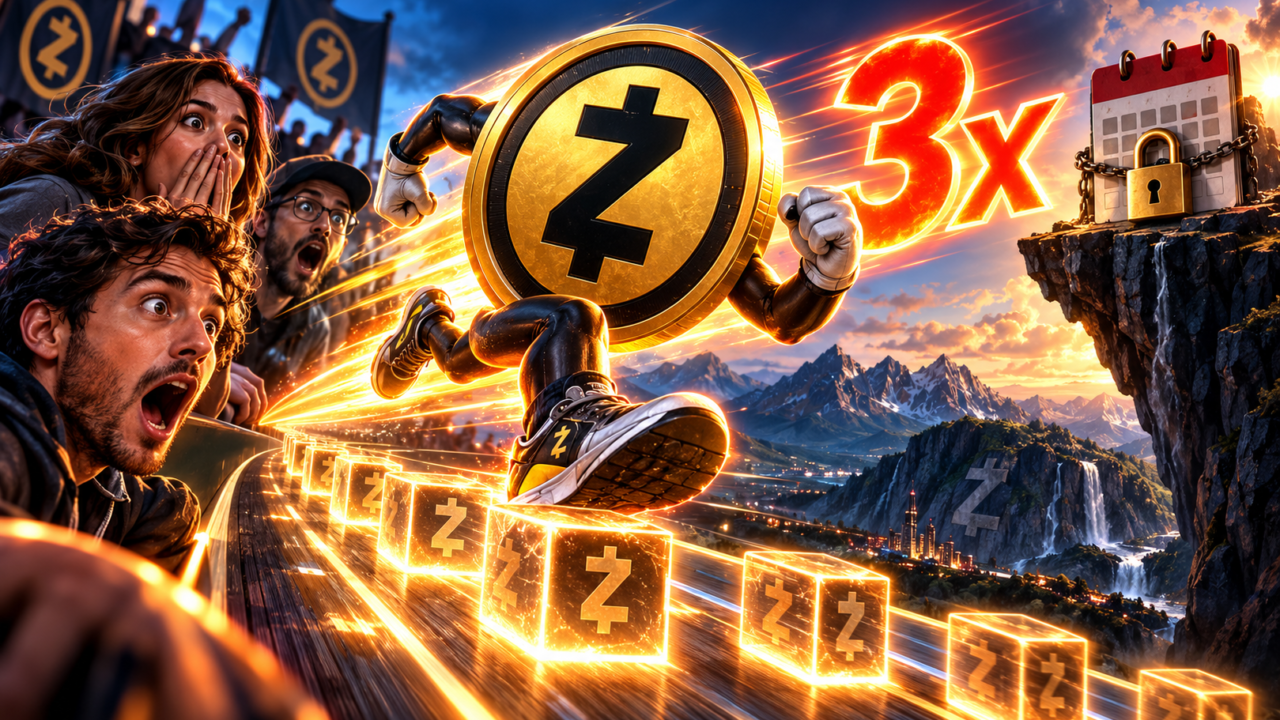
Zcash is preparing one of its most significant upgrades in years. The community has overwhelmingly voted to reduce the time between blocks from 75 to 25 seconds while keeping the current halving schedule intact. Around 2.4 million ZEC took part in the vote. The network therefore wants to speed up transactions and modernize its infrastructure without changing one of the features that most closely links it to Bitcoin: a capped supply of 21 million units and an issuance schedule that declines periodically.
Blocks every 25 seconds
The first change is fairly easy to understand. Zcash currently produces a block roughly every 75 seconds. With NU7, that target could fall to 25 seconds, making block production three times faster.
The vote among ZEC holders was almost unanimous: 99.9% of the coins that took part supported the change. ZIP 218 explains that the main goal is to reduce the time needed to obtain an initial confirmation.
For a transfer between two wallets, waiting 75 seconds is not necessarily a problem. It becomes more noticeable when a user deposits funds on a platform, pays a merchant or uses an application that depends on a fast confirmation.
This change also comes as Zcash is once again attracting significant capital. Bref Crypto recently followed ZEC’s move above $1,000, accompanied by new miners and renewed institutional interest.
The network was not congested enough to require an absolute emergency. NU7 is instead aimed at improving the user experience before usage becomes more substantial.
Orchard must handle more volume
Three times as many blocks does not only mean faster confirmations. It also changes the network’s capacity.
Developers estimate that Orchard’s throughput could rise from around 2.9 to 6.6 transactions per second under certain conditions. Orchard is currently Zcash’s main shielded pool. This is where private transactions using zero-knowledge proofs are executed.
The comparison with Bitcoin comes up frequently. Zcash retains a maximum supply of 21 million ZEC, uses Proof of Work and maintains its halvings, while adding a layer of privacy that Bitcoin does not natively offer. Bref Crypto had already examined this difference by analyzing Zcash’s ability to position itself as a private monetary alternative to Bitcoin.
Higher throughput, however, means more data to propagate. NU7 therefore provides for limits on the number of actions possible in Orchard and Sapling to prevent certain blocks from becoming unnecessarily large.
The tests produced a fairly surprising result: even with three times as many blocks, the maximum bandwidth required by some light clients could fall from 271 to 169 MB per day in the scenarios studied.
Going faster also increases stale blocks
The less appealing aspect concerns mining.
With a block every 25 seconds, miners have less time to receive a new block, verify it and adjust their work. Two miners may therefore find two competing blocks almost simultaneously. Only one will remain in the main chain.
Zcash developers tested this configuration on a network of 99 geographically distributed nodes. With 2 MB blocks, the rate of blocks becoming stale reached around 4.86%.
Today, that rate is closer to 0.4%.
The gap is significant. A higher rate can favor miners with the best connections, since their blocks propagate faster. Smaller infrastructures are more likely to work on a version of the chain that has already been superseded.
The authors of ZIP 218 nevertheless consider the observed level acceptable. Their comparison is based in particular on what Ethereum experienced when it still used Proof of Work.
NU7 will also need to revise how Zcash adjusts mining difficulty. Several parameters calculated by block count must be recalibrated because the network will produce three times as many blocks over the same period.
The halving remains off-limits
The vote on monetary policy was far less technical.
Zcash considered replacing halvings with a gradual, continuous decline in issuance. The maximum supply of 21 million ZEC would have remained unchanged, but miners would no longer have faced a sharp halving of their rewards every four years.
Holders overwhelmingly rejected the option.
98.9% of the ZEC that took part in the vote want to keep the halvings. More than 2.37 million ZEC supported the current system.
The alternative nevertheless had arguments in its favor. After the November 2020 halving, the network’s weekly difficulty fell by around 20.6%. After the 2024 halving, the decline reached nearly 17% over one week and then 23% over 30 days.
The reason is fairly mechanical. When the reward is cut in half, some machines immediately become less profitable. Miners may shut them down or redirect their computing power to other networks.
A smoother issuance schedule would have reduced that shock. Holders preferred to retain the sharp halving event.
Holders want to preserve Bitcoin’s DNA
This decision probably says more about Zcash than the vote on 25-second blocks.
The network can change its clients, its shielded pools or its production rate. Monetary policy is another matter.
Zcash inherited an important part of its economic structure from Bitcoin: Proof of Work, programmed scarcity, a cap of 21 million and periodic reductions in issuance. ZIP 234 proposed preserving the final scarcity while removing the dramatic effect of halvings.
The community did not follow.
This decision comes at a time when Zcash is benefiting precisely from its narrative proximity to Bitcoin. Part of the institutional interest in ZEC is based on the idea of a scarce monetary asset to which shielded transactions are added.
Changing the issuance schedule would have complicated that narrative.
It does not, however, resolve the question of funding network security. Rewards will continue to decline with each halving. Over time, miners will need to rely more heavily on fees or other mechanisms.
Zcash is already preparing for this transition, but without rushing. The community evidently prefers to preserve the current model as long as its economic cost remains manageable.
A reserve to pay miners later
The Network Sustainability Mechanism, or NSM, is intended to extend network funding when rewards become smaller.
Some fees could be temporarily removed from circulation. The project provides for around 60% to be allocated to this mechanism. These ZEC could then be gradually reintroduced into the rewards paid to miners.
No additional coins would be created beyond the 21 million cap.
Holders chose a highly conservative approach. Around 97% of the ZEC that voted want to wait until February 2031 before beginning this reissuance. More than 2.3 million ZEC supported this timeline.
This would give the network several years to observe developments in fees and hashrate before using the reserve.
The voting results nevertheless create a stronger impression of unanimity than actually exists. The main vote was weighted by the amount of ZEC held. Looking at the Zcash Community Advisory Panel, which consists of people rather than coins, the debate over issuance is much closer: 57 members supported smoothing the issuance, while 54 preferred to keep the halvings.
Capital and individuals therefore do not tell exactly the same story.
NU7 must also remove some of Zcash’s legacy code
The next upgrade must also do some housekeeping.
Sprout, Zcash’s original shielded-transaction system, has been practically abandoned. It has since been replaced by Sapling and then Orchard, which are more efficient and better suited to current use cases.
Less than 23,000 ZEC reportedly remain in the old Sprout pool. Deposits there have already been disabled, and its activity now represents only a tiny fraction of transactions.
Maintaining it nevertheless requires teams to preserve old code, test it and continue taking it into account with every protocol change.
Security also points in this direction. Bref Crypto recently analyzed the audits launched on Zcash and Monero after the discovery of a critical vulnerability. Fewer legacy components means less code to monitor.
The community therefore supports removing Sprout-related transactions with NU7.
The same logic applies to the development schedule. Features that are not ready in time can be postponed rather than holding up the entire upgrade.
September 30 is a deadline for preparing the components, not NU7’s launch date.
The activation date remains unknown
Zcash has still not set the block height at which NU7 will be activated on Mainnet. The official upgrade page still indicates that work is ongoing.
Nodes will also need to evolve. Zebra must gradually take on a larger role, while the legacy zcashd client is approaching the end of its role in major consensus changes.
The vote therefore mainly provides direction.
The network wants faster blocks. It wants to preserve the halving. It wants to prepare a mechanism capable of supporting miners later and remove certain historical components that have become almost useless.
Developers must now put all of this together without making Zcash harder for smaller miners to operate or heavier for users of shielded transactions.
The market context inevitably adds pressure. ZEC has risen sharply this year, and Bref Crypto recently reported a short position showing more than $25 million in unrealized losses after the token’s rally.
Price can attract attention for a few weeks. NU7 will need to work for much longer. For Zcash, that is probably where the future will be decided: accelerating enough to make privacy more practical without losing the monetary and technical characteristics that have allowed the network to endure since 2016.