

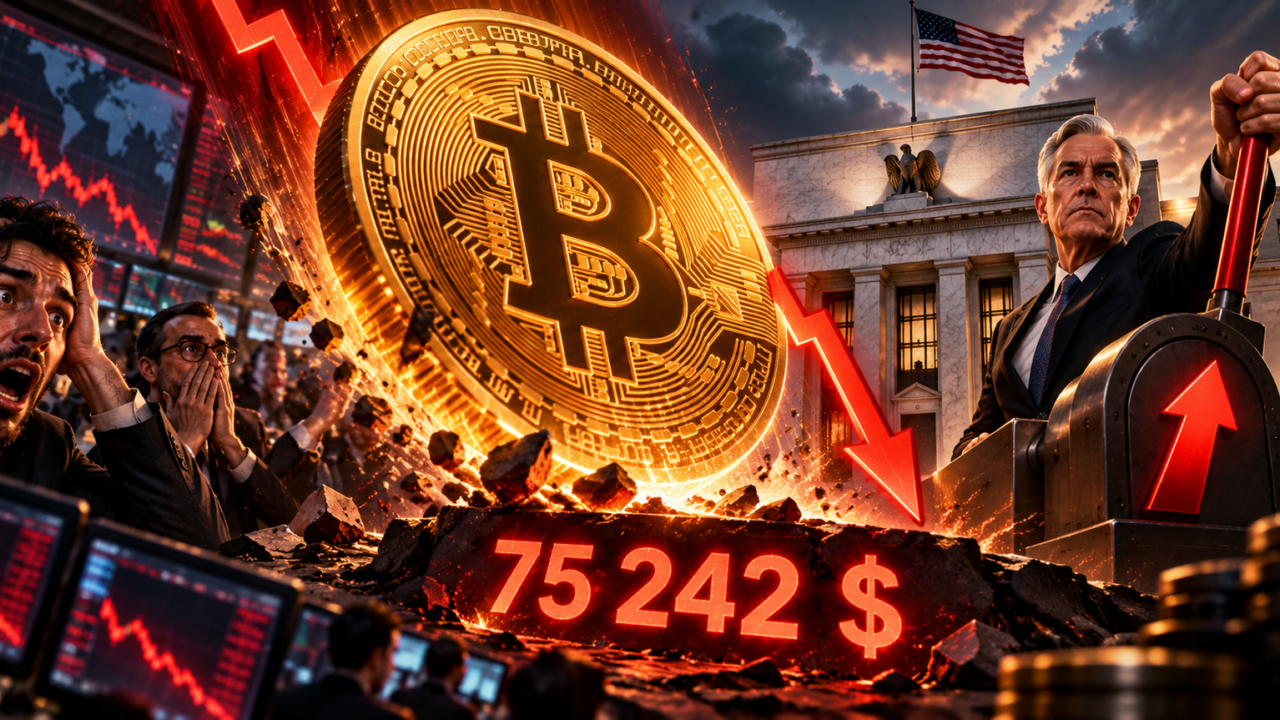
Twenty-five basis points, a policy rate now ranging between 3.75% and 4%, and Bitcoin falling as low as $75,242 during the session. The U.S. Federal Reserve has just raised interest rates for the first time since July 2023. The decision was widely anticipated, which explains BTC’s relatively contained reaction. The bigger issue lies ahead: the Fed’s new projections remain compatible with another hike before the end of 2026, while U.S. inflation is still at 3.4% and bond yields are already particularly high. For Bitcoin, the return of a more restrictive monetary cycle seriously changes the equation.
Bitcoin falls to $75,242 on decision day
Bitcoin touched $75,242 on Bitstamp on September 16, according to data reported by U.Today, during a day dominated by the Federal Reserve’s meeting. It was still trading around $77,500 two days earlier.
The decline did not come entirely as a surprise. Bref Crypto explained at the start of the month that Barclays was now expecting two Fed rate hikes in 2026, in September and December. The first move has now taken place.
The Federal Open Market Committee voted unanimously, 12-0, to raise the Fed funds target range by 25 basis points, bringing it to between 3.75% and 4%. The decision takes effect on September 17.
However, it is important to avoid oversimplification. The $75,242 low mentioned by U.Today was recorded during the day. The source does not establish that the entire decline occurred after the official announcement at 2 p.m. in Washington.
The immediate reaction to the decision was even relatively measured compared with what a “first rate hike in three years” might suggest.
The reason is simple: the market had been preparing for it. September was no longer really the surprise. The surprise now lies in December.
First rate hike since July 2023
It was necessary to go back to July 26, 2023, to find the Fed’s previous rate hike.
At the time, Jerome Powell was still heading the central bank. The FOMC added 25 basis points, taking the Fed funds target range to between 5.25% and 5.50%. The decision brought to a close the major monetary tightening cycle that had begun in 2022 to combat the surge in U.S. inflation.
Three years later, the backdrop has changed considerably.
The target range had fallen to 3.50–3.75% before the September 2026 meeting. Markets had spent several months debating the pace of future cuts.
They are now discussing further hikes.
That is the real regime change.
The Fed is no longer simply saying that rates need to remain high for longer. It is starting to raise them again.
Its September 16 statement was particularly direct. U.S. economic activity continues to expand at a solid pace, domestic spending remains resilient, productivity growth is strong and investment remains robust. The labor market is also not showing deterioration severe enough to force the central bank to prioritize employment over inflation.
Kevin Warsh therefore has something a central bank president appreciates when seeking to tighten policy: room to maneuver.
The economy is not in recession. Unemployment remains relatively stable. Inflation, meanwhile, has still not returned to 2%. The Fed can therefore target prices without immediately having to rescue economic activity. For Bitcoin, this is not the most comfortable monetary setup.
Inflation at 3.4% forces the Fed’s hand
The decision came just five days after a closely watched release. The U.S. CPI rose 0.4% in August and 3.4% over 12 months, according to the Bureau of Labor Statistics. The index excluding food and energy increased 0.3% for the month and 2.4% year over year.
Official BLS data show, above all, where some of the pressure is coming from: gasoline jumped 3.9% in August and accounted for more than one-third of the monthly increase in the headline index.
The rate hike did not come out of nowhere.
A few days before the meeting, Bref Crypto explained why the CPI could matter more than the Fed meeting itself for Bitcoin. Historical data from Coin Metrics showed that inflation releases often trigger greater immediate volatility in BTC than monetary policy decisions that are already widely anticipated.
That is precisely the current problem. The Fed is responding to data that Bitcoin had begun to digest before September 16. And the CPI is not the only concerning indicator.
In its new projections, the central bank estimates that PCE inflation will reach 3.7% in 2026, compared with the 3.6% forecast in June. For core PCE, the median rises from 3.3% to 3.4%.
These are small revisions. They nevertheless say something very clear: the Fed no longer believes disinflation is progressing quickly enough.
The Fed is already considering a second hike
This is probably the most important figure from the entire meeting for Bitcoin.
In the FOMC’s new economic projections, the median projection for the policy rate at the end of 2026 is now 4.1%.
The current range is 3.75% to 4%. Its midpoint is therefore close to 3.875%. Another 25-basis-point hike would take the range to 4–4.25%, with a midpoint of 4.125%.
In other words, the famous “dot plot” is consistent with a second 25-basis-point hike before the end of the year.
That is not a promise.
Kevin Warsh also declined to prejudge future decisions during his press conference. The projections reflect the individual expectations of Fed officials and do not constitute a collective commitment to a December hike.
That distinction matters greatly.
A sharp cooling in inflation in September or October could change the scenario.
A slowdown in the labor market could do the same.
Conversely, another acceleration in prices could strengthen support for a second move.
The calendar offers two meetings before the end of the year: October 27–28, followed by December 8–9.
The Fed therefore has two opportunities.
Markets will primarily seek to determine whether September represents an isolated adjustment or the beginning of a genuine new hiking cycle. For Bitcoin, the difference is enormous. A single hike already priced in can be absorbed. Three or four additional hikes would change the cost of global capital much more fundamentally.
Why higher rates weigh on Bitcoin
Bitcoin has no policy rate.
The protocol knows neither the Fed, nor Kevin Warsh, nor U.S. Treasury bonds.
Its price, however, knows them very well. When an investor can earn a high return on assets considered much less risky, the opportunity cost of holding a volatile, non-yielding asset increases.
Consider a deliberately simplified example.
If U.S. bonds yield 1%, accepting Bitcoin’s volatility in pursuit of higher performance may seem relatively attractive.
If a yield of close to 4% or 5% becomes available on U.S. debt, some capital may choose that return without having to absorb 20% corrections in BTC.
The same reasoning applies to the dollar.
A more restrictive monetary policy can support the U.S. currency. Bitcoin is primarily priced in dollars. A stronger dollar often creates a less favorable environment for risk assets and commodities.
Finally, rates affect financing.
Funds. Hedge funds. Companies. Firms holding Bitcoin. Miners.
All operate in an economy where the cost of debt rises when the Fed tightens financial conditions.
This does not mean that a rate hike automatically causes BTC to fall.
In July 2023, Bitcoin had in fact reacted little to Jerome Powell’s last hike, precisely because the decision was widely anticipated. The market can perfectly well rise in a high-rate environment if other forces—such as institutional adoption, liquidity, ETFs or growing demand—offset monetary pressure.
The current problem is the accumulation of headwinds.
And September offers several of them at the same time.
The 10-year yield breaches another worrying threshold
The Fed directly controls short-term rates.
The bond market controls much of the rest.
And that market is currently sending a fairly brutal message.
After the Fed’s decision, the two-year Treasury yield rose to around 4.725%, while the 10-year yield reached 5.003%, its highest level in nearly two decades, according to market data reported Wednesday.
The 5% threshold on the 10-year yield matters far more to the real economy than it might appear.
Mortgage loans, corporate financing, equity valuations and part of the global cost of capital are influenced by U.S. long-term rates.
Kevin Warsh attributes this rise to several forces.
The economy remains strong.
Capital investment is increasing sharply. Technology giants are building artificial intelligence infrastructure and raising enormous amounts of financing. Finally, geopolitical tensions are increasing the premium demanded to tie up capital over the long term.
AI appears here in a fairly unusual role. It is generally presented as a productivity engine capable of reducing costs over the long term.
In the immediate term, the massive construction of data centers requires chips, electricity, credit and hundreds of billions of dollars in investment.
“The competition for capital is real,” Warsh explained. For Bitcoin, a 10-year Treasury yield around 5% may be harder to ignore than a simple 25-basis-point move decided by the Fed.
The CLARITY Act adds a second source of pressure
Monetary policy did not arrive alone. One day before the Fed meeting, the U.S. Senate failed to advance the CLARITY Act in a procedural vote.
Before these two events, Bref Crypto had summarized a sequence in which the CLARITY Act and the Fed represented two major risks for crypto in less than 48 hours.
That is exactly what happened. The first shock was regulatory. The second was monetary. This combination helps explain why Bitcoin was already weakened going into Wednesday’s decision.
BTC was trading around $77,500 on September 14 after falling approximately 4% over a week. The failed Senate vote did not create a ban on the crypto market in the United States, and the CLARITY Act is not legally dead. Several Democratic senators have already indicated that they want to resume discussions.
Nevertheless, at least temporarily, it removes part of the regulatory catalyst expected by the industry.
The rate hike does exactly the opposite on the macro front: it increases an already known risk.
U.Today explicitly brings these two factors together to explain the current pressure on Bitcoin. It would be excessive to attribute every dollar of BTC’s decline to either the Senate or the Fed.
The crypto market operates with thousands of variables. But two events capable of altering institutional allocation within less than 24 hours deserve more attention than a simple red candle.
The next test may not be the next Fed meeting
That is the paradox of the current situation. The Fed has just taken its most restrictive decision in three years. And yet Bitcoin’s next major move could still come from economic data rather than from the central bank itself.
The market already knows the general scenario. Inflation is too high. Rates are at 3.75–4%. Another hike is possible. The new information will now be the data that determines whether this scenario needs to become more aggressive or more flexible.
Every CPI release matters. Every employment report matters. Energy prices matter too. Bond yields matter even more. The market already demonstrated this mechanism on September 4. Bitcoin fell below $80,000 after a U.S. employment report came in much stronger than expected. The reasoning was simple: more jobs give the Fed greater freedom to maintain a restrictive policy.
Since then, the risk has become reality.
The first hike is done.
September’s projections suggest that the Fed could add another 25 basis points.
And the expected PCE rate of 3.7% shows that it does not anticipate a rapid return to 2% this year.
For Bitcoin, therefore, $75,242 is not the most important figure of the day.
The market has already experienced much more violent moves.
The real change lies elsewhere: since July 2023, investors could assume that the peak of the rate-hiking cycle was in the past.
That is no longer true.
The Fed has just reopened that door.
A single hike is not enough to condemn Bitcoin’s rally. It does not erase the asset’s scarcity, institutional demand or long-term behavior.
It nevertheless forces investors to factor in a variable they had almost removed from the equation: the price of money can still rise in the United States.
The December meeting may reveal how far.
The statistics released before then will probably provide the answer well in advance.