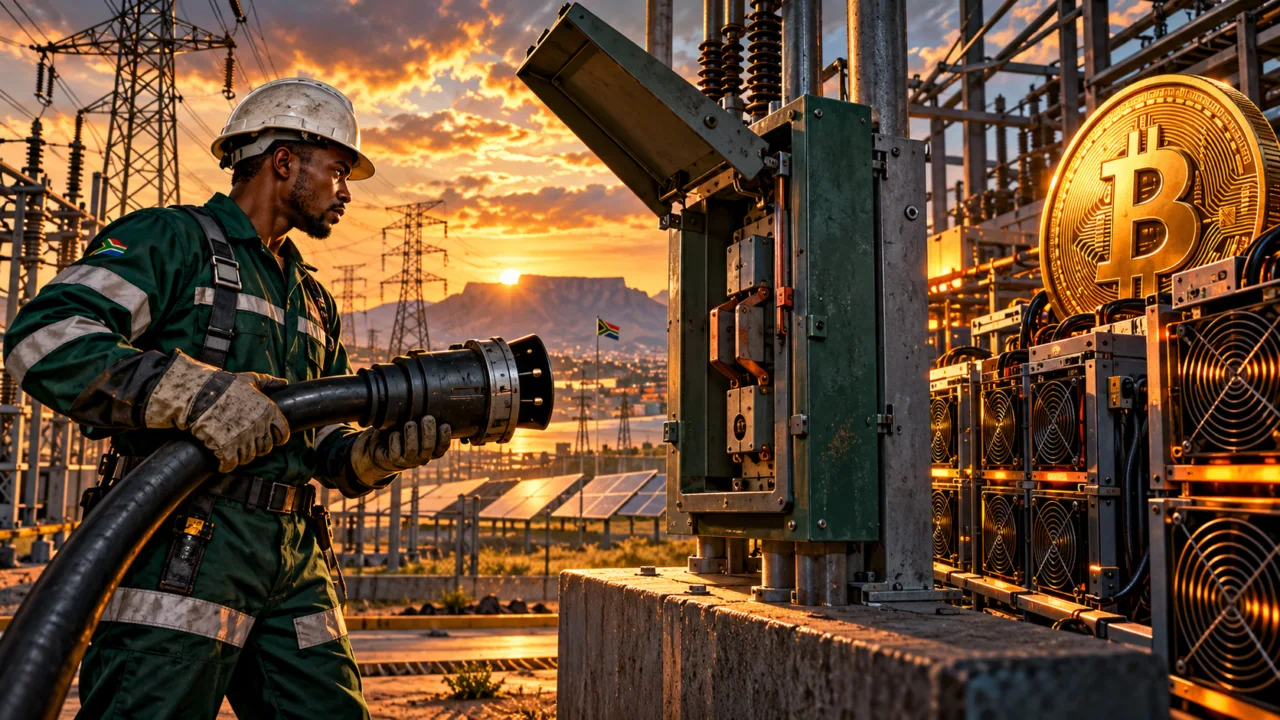
Bitcoin is becoming an ideal customer for Eskom
Eskom will not buy ASICs and mine Bitcoin for its own account. Its plan is to supply electricity to mining companies capable of rapidly increasing or reducing their consumption. That distinction matters.
The strategy closely resembles the model BrefCrypto recently described: Bitcoin miners are increasingly turning to cheap electricity that is difficult to monetize otherwise.
An industrial furnace cannot be shut down instantly. A conventional data center also requires a highly stable power supply. A Bitcoin mining farm, by contrast, can switch off thousands of machines when the grid comes under pressure, then restart them when electricity becomes available again.
That is precisely what interests Eskom.
In its latest results, the company said it now faces structural excess capacity estimated at between 2 and 3 GW over the coming years. Its electricity sales have also declined by around 2% per year over the past decade.
Eskom’s official plan therefore explicitly lists a “Bitcoin mining pilot” among the options being considered to stimulate demand.
What a turnaround.
Up to 7,000 MW available during the day
The surplus could become much larger at certain times. According to discussions reported around the project, Eskom may have 5,000 to 7,000 MW of excess capacity during the day, particularly when solar generation sharply reduces demand on the national grid.
This power would not necessarily be available around the clock. That is precisely what makes Bitcoin interesting.
A miner could agree to a contract allowing Eskom to reduce or cut its power supply whenever the electricity system needs it. In return, the mining company would receive a more favorable price during periods of excess supply.
The proposed project would run for two years and operate according to the location of the facilities. Eskom would then be required to submit its results to Nersa on a regular basis.
The proposal comes as South Africa’s crypto market is already relatively developed. Local hedge fund Peregrine Capital now considers that a small Bitcoin allocation may have a place in a portfolio, while banks, exchanges and regulators are simultaneously working on payments and stablecoins.
The energy industry could now join that movement.
For Eskom, every megawatt sold during a period of weak demand primarily represents additional revenue from capacity that is already available.
Nersa is already holding up the project
The pilot has not yet received final approval, however.
Several Nersa members have questioned Eskom about the justification for a tariff specifically intended for crypto miners. Their reasoning is straightforward: if a factory, data center or another consumer can offer exactly the same flexibility, why should Bitcoin alone benefit from cheaper electricity?
The regulator is particularly concerned about potential tariff discrimination and the risk that other consumers could ultimately bear part of the cost indirectly. One alternative would be to offer these rates to all customers capable of rapidly adjusting their consumption, regardless of their business activity.
The debate comes as South Africa is already building a much stricter framework for its crypto sector. BrefCrypto recently reported that Pretoria also wants to tighten controls on cross-border crypto transfers.
Eskom therefore finds itself in a situation that would have seemed almost unimaginable a few years ago. The company known internationally for load shedding is now looking for ways to sell electricity it can sometimes no longer offload.
Bitcoin offers a rather unusual answer: turning electricity demand into a flexible load.
The question is whether Nersa will allow Eskom to reserve this advantage for miners or force the utility to open the scheme to all industries capable of playing the same role. Either way, the idea of Bitcoin mining as a buyer of last resort for electricity has gained a particularly interesting testing ground in Africa.