Bitcoin: AI Pushes Miners Toward Cheap Energy
AI is attracting the best power sites used by Bitcoin miners. ViaBTC argues that mining will survive thanks to cheap energy.
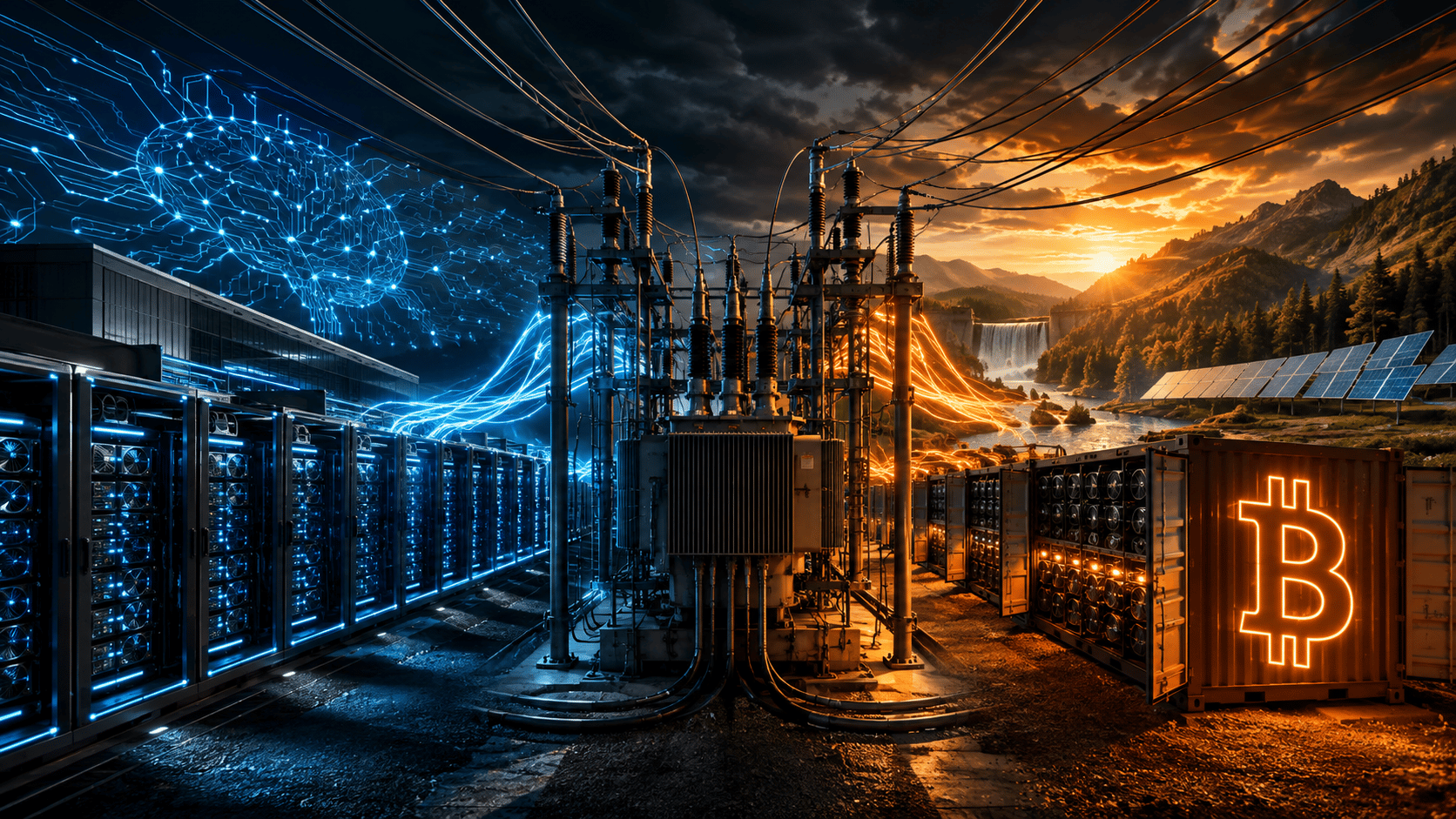
Artificial intelligence is beginning to absorb the best power sites once reserved for Bitcoin mining, without necessarily threatening the network. That is the thesis put forward by Haipo Yang, founder and CEO of ViaBTC, in a sponsored opinion piece published by U.Today. The figures add weight to the debate: hashrate, above 1.1 ZH/s in October 2025, has repeatedly returned to around 900 EH/s this year, while difficulty fell by 11.16% in February and then by 10.09% in June. At the same time, Core Scientific is losing money on its self-mining operations while its data centers generate nearly $80 million in quarterly gross profit. AI is not replacing Bitcoin ASICs, however. It is targeting a much scarcer resource: immediately available electricity.
Miners are now earning more from AI
The shift is no longer theoretical. Riot Platforms has already signed a $9.1 billion AI contract, while several former mining champions are redirecting their infrastructure toward high-performance computing.
Core Scientific probably offers the clearest example. In the second quarter of 2026, its Bitcoin self-mining business generated $21.5 million in revenue, but incurred $33.7 million in direct costs. The result was a gross loss of $12.2 million and a margin of -56%. Its data-center colocation business, by contrast, generated $79.98 million in gross profit, with a 59% margin. These figures come from filings with the SEC, not a market estimate.
TeraWulf has already gone a step further. Of its $44.8 million in second-quarter revenue, $31.9 million came from HPC, or 71% of the total. Digital-asset mining accounted for only $12.8 million. A year earlier, HPC had generated no revenue at all.
Haipo Yang’s argument starts precisely from this transformation. If the same power infrastructure generates more revenue by hosting AI GPUs than by running ASICs, a listed company has little reason to remain loyal to Bitcoin on principle.
Shareholders, meanwhile, look at margins.
Bitcoin and AI do not compete for the same machines
However, it is important to avoid a technical misunderstanding.
A Bitcoin ASIC and a GPU designed for artificial intelligence are not interchangeable. Bitcoin ASICs are built to perform one highly specialized operation: calculating SHA-256 as quickly and efficiently as possible.
They cannot be converted into Nvidia accelerators capable of training a large language model.
The reverse is also true. It is technically possible to perform certain cryptographic calculations with GPUs, but mining Bitcoin with them against modern ASICs is generally not economically competitive.
AI is therefore not directly “stealing” machines from the Bitcoin network.
The competition occurs upstream: land, capital, transformers, substations, grid connections, fiber and, above all, available megawatts.
This distinction is fundamental.
A mining farm built five years ago may have secured several hundred megawatts, obtained the necessary permits and installed all the electrical infrastructure. For an AI company seeking to build a data center today, acquiring or leasing that site can save several years.
IREN illustrates this shift. As of June 30, the former miner had a portfolio of grid-connection agreements representing approximately 5 GW across several countries. It has begun dismantling its Bitcoin equipment and expects to complete most of its transition to AI Cloud by December 31, 2026.
The miners’ real asset may therefore not have been just their hashrate.
It was their access to electricity.
Electricity is becoming the battleground
And that electricity is becoming far more sought after.
The International Energy Agency estimates that data centers consumed approximately 415 TWh in 2024, or 1.5% of global electricity. In its central scenario, consumption would reach approximately 945 TWh in 2030. Artificial intelligence is the main driver of this increase.
In the United States, data centers could account for nearly half of electricity-demand growth by the end of the decade.
This completely changes the value of a connected megawatt.
Building GPUs is not enough. They must be powered. The IEA points out that a data center can be built in two or three years, while major power infrastructure often takes much longer to plan and develop.
That is precisely the advantage some miners have.
They arrived earlier in areas where energy was abundant and industrial demand for several hundred megawatts appeared weaker. They built substations, negotiated contracts and secured land.
AI is now arriving with greater purchasing power.
This explains why Wall Street investors are now oscillating between Bitcoin and the AI infrastructure of former miners.
Mining is therefore being pushed out of premium sites.
That does not mean electricity is scarce everywhere.
Mining can use electricity that AI wants less
This is probably Haipo Yang’s most interesting argument.
An AI data center generally wants a highly stable power supply. An expensive training session or a cloud service used continuously does not cope well with an outage simply because the sun has set or the grid is asking consumption to be reduced.
A Bitcoin miner can operate differently.
A machine can be switched off quickly, restarted several hours later and resume exactly the same activity. The network does not need a particular ASIC to remain available 24 hours a day.
This flexibility opens up a much less prestigious electricity market: solar surpluses, isolated hydropower, associated gas that would otherwise be flared, periods of negative prices or renewable generation curtailed by grid capacity.
ENGIE’s case in Brazil is particularly telling. Its Assú Sol solar complex has 753 MW and is the group’s largest operating solar farm. Grid constraints nevertheless sometimes prevent all of its output from being delivered. ENGIE has confirmed that it is considering batteries, as well as data centers dedicated to Bitcoin mining, to create local demand when the electricity cannot be properly transported.
In this situation, Bitcoin is not necessarily competing with OpenAI or Anthropic.
Sometimes, it is competing with… the waste of a kilowatt-hour.
ASICs can simply change owners
If major publicly traded miners choose AI, their hashrate does not necessarily disappear with them.
An ASIC that has become unprofitable in a large U.S. data center where electricity is expensive can be resold on the secondary market. At a much lower acquisition price, the same machine may become economically attractive again at a small hydropower plant, a facility with excess solar power or in a region where the megawatt-hour costs substantially less.
The machine’s energy efficiency does not change. Its economics do.
A miner buying a new ASIC must amortize the initial investment in addition to paying for electricity. Someone acquiring a heavily discounted older machine can accept a lower utilization rate if they have access to nearly free energy at certain hours.
This could bring about a fairly profound transformation of the industry.
In recent years, mining had become institutionalized: gigantic farms spanning several hundred megawatts, Nasdaq-listed companies and billions raised on financial markets.
AI could partially reverse this movement. Companies with the best grid connections are finding more value in data centers, while machines are migrating to energy producers, private operators and smaller businesses.
Haipo Yang obviously has an economic interest in this interpretation: ViaBTC operates one of the world’s leading mining pools. His opinion piece published by U.Today is also explicitly marked “Sponsored.” His conclusion should therefore be viewed as an interested analysis, not an independent study.
Company data nevertheless show that the shift he describes has already begun.
Bitcoin adjusts difficulty automatically
One concern remains: if AI attracts some miners, can the resulting drop in hashrate weaken Bitcoin?
In the short term, the protocol has its own adjustment mechanism.
Every 2,016 blocks, or approximately every two weeks, Bitcoin recalculates mining difficulty to bring the average production rate back toward one block every ten minutes. Bitcoin mining relies precisely on this combination of ASICs, proof of work and difficulty adjustment.
If many miners disconnect, blocks slow down. At the next adjustment, difficulty decreases. All else being equal, the remaining machines then receive a larger share of newly issued BTC.
2026 has already provided two spectacular examples.
On February 7, difficulty fell by 11.16%, its sharpest decline since the 2021 Chinese ban. It then fell by 10.09% on June 14.
Yet the network did not enter a downward spiral.
On September 5, difficulty even rose by 1.31% to 127.45 trillion, with implied hashrate estimated at approximately 912 EH/s over the previous epoch.
The mechanism does not guarantee that hashrate will remain high. It simply allows mining economics to rebalance when some participants leave the market.
A drop in hashrate is still not neutral
It would also be wrong to conclude that Bitcoin can lose any amount of computing power without consequences.
Hashrate directly contributes to the economic cost of an attack on the network. The less computing power devoted to Bitcoin, the fewer resources are theoretically needed to try to control a significant share of mining power.
Difficulty adjustment protects the pace of block production.
It does not magically recreate the power that has disappeared.
This is where the AI question becomes genuinely interesting. If it merely temporarily moved a few publicly traded companies into more profitable activities, Bitcoin could easily absorb the shift through the remaining operators and a global redistribution of ASICs.
If, over the longer term, every form of cheap electricity became more profitable for AI or other industries, the equation would be different.
Haipo Yang argues precisely that this scenario is unlikely because not all units of energy have the same economic value.
A stable megawatt connected to fiber and available 99.99% of the time is highly attractive to an AI data center. A burst of solar generation lost every lunchtime in the middle of a congested grid is much less so.
Bitcoin can buy that difference.
Its competitive advantage would therefore no longer be simply finding the cheapest electricity, but monetizing electricity that other activities struggle to use.
The 2028 halving will be a far more serious test
AI is not the only problem miners will have to address.
Bitcoin’s fifth halving is expected in 2028. The block subsidy will then fall from 3.125 BTC to approximately 1.5625 BTC, regardless of electricity costs, Nvidia GPUs or the ambitions of cloud companies.
The protocol does not negotiate.
To maintain the same revenue level after the halving, miners will have to offset the reduction through some combination of a higher Bitcoin price, transaction fees, lower difficulty or reduced operating costs.
This will probably be when the new energy geography described by ViaBTC is truly tested.
The largest, best-connected sites could continue migrating toward AI. Bitcoin operators will then have to become even more disciplined: cheaper machines, more efficient ASICs, leaner financing and, above all, direct access to low-cost energy sources.
IREN’s example already shows how far the change can go. The company recorded $578.2 million in mining revenue for fiscal 2026, compared with only $128.8 million from its AI Cloud business. It nevertheless chose to progressively reallocate its sites toward AI and recorded $638.8 million in impairments, mainly related to the withdrawal of mining equipment.
Yesterday’s revenue is therefore no longer enough.
Companies are weighing the future value of their megawatts.
AI is not killing Bitcoin; it is sorting the miners
Haipo Yang’s question ultimately deserves a more precise answer than a simple yes or no.
Yes, artificial intelligence is already taking infrastructure away from Bitcoin mining. Core Scientific earns significantly more from colocation than from its own ASICs. TeraWulf now derives 71% of its quarterly revenue from HPC. IREN expects to have nearly completed its transition away from mining by the end of 2026.
And energy pressure is unlikely to disappear. The IEA forecasts around 950 TWh of global data-center consumption in 2030, almost twice the 2025 level in its updated estimates.
That does not mean AI can eliminate mining.
The two activities do not buy exactly the same energy product. AI places an extremely high value on continuity, existing grid connections and infrastructure capable of hosting GPUs immediately. Bitcoin is much more tolerant of intermittency, interruptions and remote sites.
This may be the most important shift.
The next generation of miners will not necessarily win by building the largest farm beside the best power grid. They may win by seeking out the megawatts that no one else knows how to use at the right time.
AI is therefore transforming mining less into an obsolete industry than it is raising the price of the best locations and forcing Bitcoin back toward its most distinctive economic advantage: a computing load capable of following electricity instead of requiring electricity to follow it.
For the network, hashrate around 900 EH/s and the recent return to slightly higher difficulty indicate that it is still a long way from a security crisis.
For publicly traded mining companies, however, the break has already arrived.
À propos de l’auteur

Evan's Selemani
J’ai plongé dans Bitcoin dès 2017, bien avant qu’il ne devienne un sujet grand public. Depuis, j’ai transformé cette immersion de terrain en expertise concrète : analyse des cycles de marché, compréhension fine des protocoles, décryptage des narratifs et des enjeux réglementaires. Rédacteur crypto et formateur sur le terrain, je traduis la complexité de la blockchain en contenus clairs, précis et stratégiques, pensés autant pour les investisseurs avertis que pour les nouveaux entrants.