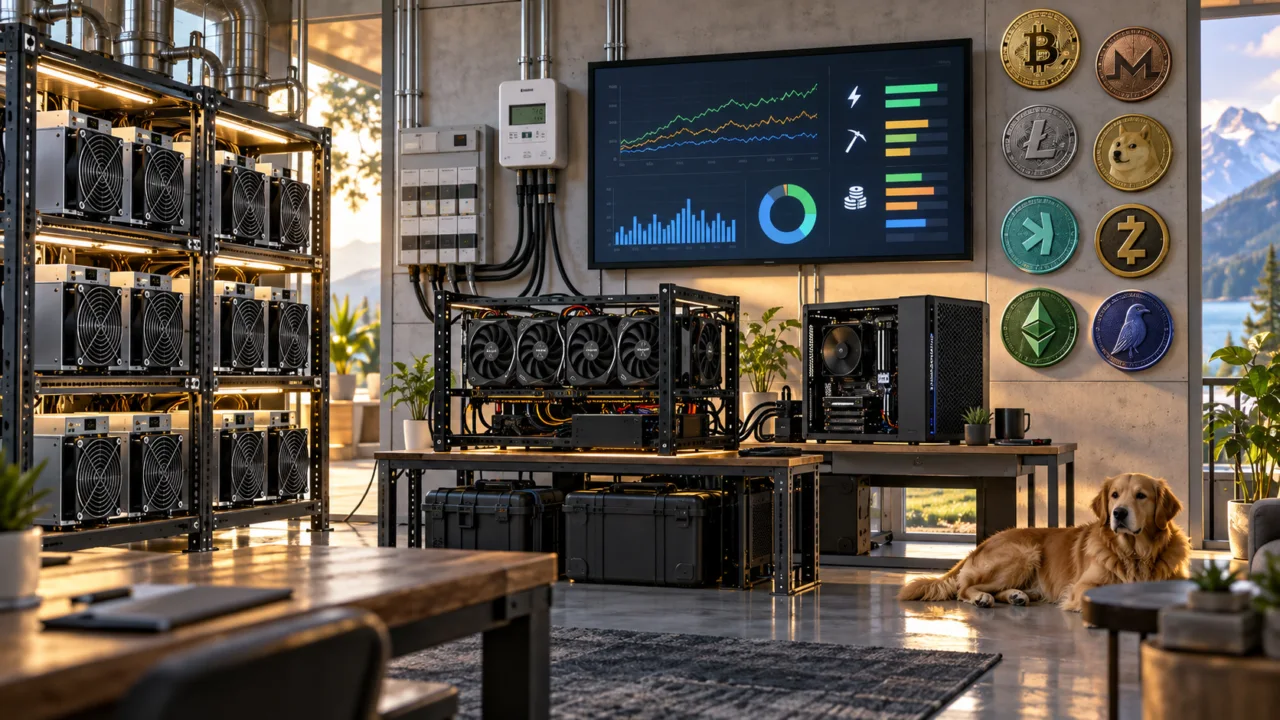
Bitcoin, Monero, Litecoin, Dogecoin, Kaspa, Zcash, Ethereum Classic and Ravencoin remain among the main cryptocurrencies to mine in 2026. Yet they have very little in common when it comes to the hardware required. Bitcoin has become an intensely industrial ASIC market. Monero remains accessible with a standard processor. Litecoin and Dogecoin can be mined simultaneously with Scrypt ASICs. Ravencoin still leaves room for GPUs, while Kaspa has moved in just a few years from GPU mining to a market largely dominated by ASICs.
Choosing a cryptocurrency to mine simply because its price appears high is therefore the wrong approach.
The calculation starts elsewhere.
How much does electricity cost? What hardware do you already have? How much power does it consume? What is its hashrate? What difficulty does the network impose? What reward is distributed? How much is the cryptocurrency you earn worth? And above all, how much will the machine still be worth if difficulty rises or the asset’s price falls?
As of September 2026, these questions matter more than ever. On Bitcoin, hashprice stood at around $40.93 per PH/s per day on September 21, despite BTC’s recent rebound. For the least efficient machines, the margin can disappear quickly once electricity costs are paid.
Not every mineable cryptocurrency is intended for the same type of miner.
Mining a cryptocurrency starts with choosing the right hardware
Before looking at the token’s name, look at the machine. BrefCrypto’s report on ASICs and their role in cryptocurrency mining explains why CPUs, GPUs and ASICs are no longer interchangeable.
A CPU, the standard processor in a computer, can perform a wide range of calculations. That versatility makes it well suited to algorithms such as Monero’s RandomX.
A GPU performs a huge number of operations in parallel. Graphics cards dominated part of the crypto-mining industry for years, particularly Ethereum before its move to Proof of Stake. They remain relevant for networks such as Ravencoin.
An ASIC takes the opposite approach. Its circuitry is designed almost exclusively for one family of calculations. An SHA-256 ASIC built for Bitcoin is extremely efficient at SHA-256, but it cannot suddenly be converted into a Monero miner.
That is what makes the choice so important.
A GPU owner should not simply search for “the most profitable cryptocurrency” in a ranking that includes Bitcoin. Their hardware cannot compete with Bitcoin ASICs.
The same applies to someone with a recent CPU: Monero may make sense, while Kaspa makes far less.
A useful ranking of mineable cryptocurrencies therefore starts with a very practical question:
What are you going to mine with?
Bitcoin remains the mining giant
Bitcoin remains by far the leading Proof-of-Work network.
The Bitcoin technical documentation explains how miners perform SHA-256 calculations to find a hash below the target set by the network. When a valid block is found, the miner receives the block subsidy along with the fees from its transactions.
Since the April 20, 2024 halving, the base reward has been 3.125 BTC per block. It will fall to 1.5625 BTC at the next halving, expected approximately in 2028.
On paper, 3.125 BTC represents a considerable sum.
In practice, the competition is enormous.
Mining Bitcoin with a personal computer is now almost impossible to justify economically. Even a powerful GPU is several orders of magnitude behind modern ASICs.
The market now revolves around how many terahashes can be produced for every watt consumed.
This efficiency is often measured in joules per terahash, or J/TH. The lower the figure, the better the machine.
Hashrate Index estimated hashprice at around $40.93 per PH/s/day on September 21, 2026. Its energy-hashprice calculation indicated roughly $136 in gross revenue per MWh for fleets below 14 J/TH, compared with just $51 per MWh for machines between 25 and 38 J/TH.
That is not profit.
The machine, staff, cooling, connectivity, repairs and, in some cases, financing still have to be paid for.
Bitcoin may be the strongest cryptocurrency to mine without being the easiest.
Electricity determines almost everything on Bitcoin
BTC’s price naturally attracts attention.
For a miner, the price of a kilowatt-hour may matter even more.
A machine generally runs 24 hours a day. A difference of a few cents per kWh therefore becomes significant when a mining operation has hundreds or thousands of ASICs.
This is precisely why part of the industry has moved toward regions with cheap or surplus electricity. BrefCrypto has already examined how competition from AI is pushing Bitcoin miners toward the least expensive energy sources.
Profitability calculations must also include hashprice, meaning the revenue generated by one unit of SHA-256 computing power.
It depends in particular on Bitcoin’s price, network difficulty, transaction fees and the block reward.
A 20% rise in BTC improves dollar revenue if everything else remains unchanged.
Except that everything else does not necessarily remain unchanged.
New machines come online.
Hashrate rises.
Difficulty adjusts.
The share of rewards corresponding to each unit of computing power declines.
That is why a bull market does not automatically turn every Bitcoin farm into a money-printing machine.
For an individual, Bitcoin becomes especially relevant when three conditions come together: an efficient ASIC, highly competitive electricity and the ability to run the machine long enough to recoup its price.
Without those conditions, buying BTC directly may sometimes cost less than producing it.
Litecoin and Dogecoin can be mined together
Litecoin is another major Proof-of-Work cryptocurrency that can still be mined.
The difference lies in its algorithm: Scrypt rather than SHA-256.
Litecoin’s current reward is 6.25 LTC per block, with blocks produced approximately every 2.5 minutes. The last halving took place in August 2023.
But mining Litecoin alone now tells only part of the story.
Dogecoin also uses Scrypt and has supported Auxiliary Proof of Work, or AuxPoW, since 2015. This system allows the same computing work to secure Litecoin and Dogecoin simultaneously.
In other words, miners do not necessarily have to choose between LTC and DOGE.
The same Scrypt hashrate can generate rewards on both networks through a pool compatible with merged mining.
Dogecoin currently distributes 10,000 DOGE per block, in addition to transaction fees. Its documentation also states that profitable mining now requires specialized ASIC hardware.
This LTC+DOGE pairing is therefore particularly interesting when comparing mineable cryptocurrencies.
The profitability of a Scrypt ASIC depends on more than Litecoin’s price.
DOGE adds a second source of revenue.
During certain market periods, that component can even become decisive.
The downside is obvious: modern Scrypt ASICs are expensive and consume a great deal of energy. An old computer does not become competitive simply because Dogecoin began as a meme.
Monero remains the CPU kingdom
For someone who genuinely wants to experiment with mining on a computer, Monero is one of the most interesting examples.
XMR uses RandomX, a Proof-of-Work algorithm specifically designed to favor general-purpose processors and limit the advantage of ASICs.
The Monero project explains that RandomX relies in particular on random code execution and memory-intensive operations. CPUs are generally much more efficient than GPUs for this algorithm.
This completely changes the economics of mining.
There is no need to buy an ASIC costing several thousand dollars to get started.
A computer equipped with a good processor can mine XMR.
That does not mean it will be profitable.
A slow CPU that consumes a lot of electricity may produce less XMR than the cost of its power. But the barrier to entry is much lower than on Bitcoin.
Monero also has a distinctive monetary policy.
Since 2022, the network has been in its tail emission phase. A reward of 0.6 XMR is created approximately every two minutes, ensuring that a continuous issuance remains available to reward miners. Relative inflation gradually declines as the total supply increases.
Miners can choose a conventional pool, solo mining or P2Pool.
Monero notably encourages P2Pool, which allows revenues to be pooled while maintaining a peer-to-peer, non-custodial operation.
For genuinely learning how mining works without turning an entire room into a data center, Monero remains hard to ignore.
Kaspa is no longer a GPU paradise
Kaspa long attracted a large number of GPU miners.
That era has changed.
KAS uses kHeavyHash and a blockDAG architecture that differs from a traditional linear blockchain. The mainnet now operates at 10 blocks per second, following the evolution made possible by Crescendo.
The project remains entirely Proof of Work and claims a launch without a premine or preallocation.
Its monetary policy is also distinctive.
Instead of one large halving every four years, the reward declines gradually each month according to a geometric factor. Over an average year, the cumulative reduction is approximately equivalent to a halving.
Official documentation estimated that around 95% of all KAS would already have been mined by approximately July 10, 2026. The estimated maximum supply is around 28.7 billion KAS.
This means future issuance is shrinking rapidly.
Above all, the hardware industry has caught up with Kaspa.
GPUs that had made KAS popular with individuals have gradually been overtaken by kHeavyHash ASICs.
This is the classic Proof-of-Work scenario.
An algorithm becomes profitable.
Manufacturers invest in specialized chips.
Difficulty explodes.
The general-purpose miner sees their returns collapse.
Kaspa therefore remains a major cryptocurrency to consider for mining in 2026, but much less so for someone looking to quietly repurpose an old graphics card.
The calculation must now account for ASICs, energy efficiency, KAS’s price and declining issuance.
Zcash remains a distinctive ASIC option
Zcash can still be mined.
The network uses Proof of Work with Equihash, an algorithm initially designed to limit the advantage of specialized hardware.
ASICs eventually arrived.
In 2026, profitable ZEC mining is therefore largely a matter of specialized hardware.
Its monetary policy recalls Bitcoin’s: a maximum supply of 21 million ZEC and periodic reductions in issuance.
The current total subsidy is 1.5625 ZEC per block period, according to Zcash’s economic documentation. Since November 2024, 80% of this issuance has gone to miners, or approximately 1.25 ZEC, while the remainder funds various ecosystem mechanisms. Miners also receive transaction fees.
Zcash is interesting for another reason: its price has experienced sharp fluctuations, and the mining sector adapts to them very quickly.
BrefCrypto recently tracked the revival in activity among Zcash miners as ZEC moved above $1,000.
This kind of rally mechanically changes dollar revenues.
Then the competition follows.
More miners switch on their machines.
Hashrate rises.
Difficulty increases.
The initial gain is partly absorbed.
This is a fundamental feature of mining.
A cryptocurrency that appears highly profitable this week attracts hashrate precisely because it is profitable.
The ranking eventually corrects itself.
Ethereum Classic still attracts some GPU miners
Ethereum has not been mineable since The Merge on September 15, 2022.
Ethereum Classic, however, still uses Proof of Work.
ETC uses ETCHash, a close derivative of Ethash. Hardware historically used to mine ETH could therefore be redirected to Ethereum Classic after Ethereum moved to Proof of Stake.
The network applies a monetary policy sometimes called “fifthening.”
Rather than halving its reward as Bitcoin does, Ethereum Classic reduces it by 20% every five million blocks.
A new reduction took place on July 22, 2026, at block 25,000,001. The base reward fell from 2.048 ETC to 1.6384 ETC.
This reduction is recent.
A calculator still using 2.048 ETC therefore currently overestimates production.
That is a recurring problem with searches such as “the most profitable cryptocurrency to mine.”
Pages remain indexed for months even though the reward, difficulty or dominant hardware has changed.
ETC may still interest owners of compatible GPUs.
ETCHash ASICs also exist, however, increasing competitive pressure.
Profitability therefore depends heavily on the exact graphics card model and electricity rate.
A GPU that has already been paid off may remain economically attractive under conditions in which building a new mining operation would not be.
The difference between hardware already paid for and hardware purchased today is enormous.
Ravencoin remains one of the genuine GPU mining networks
Ravencoin deserves a special place on this list.
The network uses KAWPOW, an algorithm designed to favor the characteristics of general-purpose GPUs and limit the economic advantage that an ASIC could provide.
The project has even changed algorithms several times throughout its history to preserve that objective.
Blocks arrive approximately every minute.
The monetary policy calls for a reward reduction every 2.1 million blocks, or approximately every four years. This mechanism is written directly into the consensus parameters.
After the second halving in 2026, the reward now stands at 1,250 RVN per block. Network data available in September also indicated a DAG close to 5.9 GB, making older low-memory cards much less practical.
Ravencoin therefore remains a genuine option for GPU miners.
That does not mean every card is profitable.
KAWPOW places heavy demands on the GPU and can consume a great deal of electricity.
RVN’s price also remains decisive.
But unlike Bitcoin, Litecoin, Dogecoin or Kaspa, the competition does not necessarily require buying a chip designed exclusively for one algorithm.
For someone who already owns one or more recent enough graphics cards, RVN remains one of the first assets to test in a profitability calculator.
Not necessarily to choose.
To test.
Ethereum is no longer a mineable cryptocurrency
This may seem obvious to experienced users.
It still needs to be said.
Ethereum can no longer be mined.
Since The Merge, Ethereum has used Proof of Stake. Validators deposit ETH to participate in consensus instead of providing computing power through GPUs.
This means that a website promising in 2026 to “mine Ethereum” with your graphics card deserves immediate scrutiny.
It may be referring to another cryptocurrency that is mined and then automatically converted into ETH.
It may be offering cloud mining.
It may simply be using outdated terminology.
Or it may be a scam.
This confusion stems from Ethereum’s historical importance in GPU mining.
Before September 2022, ETH accounted for a huge share of global GPU-mining activity. When that demand disappeared, computing power moved to Ethereum Classic, Ravencoin, Ergo, Kaspa and other networks.
Revenues were squeezed as a result.
Why?
Because billions of dollars’ worth of hardware suddenly had far fewer available rewards to compete for.
This is an excellent illustration of mining’s economic logic.
Hardware does not create profitability by itself.
It competes for a limited amount of newly issued cryptocurrency.
The more competing computing power increases, the smaller the share of the pie each miner receives.
Which cryptocurrency should you mine with a CPU?
For a general-purpose CPU in 2026, Monero remains the clearest reference among major projects.
RandomX was specifically designed for this situation.
That does not mean it makes sense to run just any computer 24 hours a day.
Processors vary enormously.
Core count.
Cache.
Memory bandwidth.
Power consumption.
Cooling.
Purchase price.
An old laptop may produce a few hashes while becoming extremely hot for almost no revenue.
A modern processor with plenty of cache and the right configuration will be much more efficient.
The calculation must also include a frequently overlooked question: was the machine already available?
If you own an unused PC, the initial investment cost is almost zero.
If you buy a setup solely to mine XMR, the cost of the processor, motherboard, RAM and power supply must be included in the calculation.
Two miners using exactly the same CPU can therefore have completely different profitability.
Monero offers something that has become rare in Proof of Work: the ability to genuinely participate in the network without ordering specialized hardware.
For technical experimentation or a small setup powered by very cheap energy, that matters.
For getting rich with a desktop computer, much less so.
Which cryptocurrency should you mine with a GPU?
The field is narrower.
Ravencoin remains one of the clearest options thanks to KAWPOW.
Ethereum Classic can also be mined with compatible ETCHash GPUs, although the presence of ASICs increases competitive pressure.
Other Proof-of-Work projects exist, including Ergo and several smaller chains, but including them in a profitability ranking requires even greater caution.
A small-cap cryptocurrency may show spectacular theoretical returns.
Then the miner tries to sell.
The order book is almost empty.
Or the price falls 20% after a few new miners arrive.
The advertised profitability disappears.
For a GPU, however, flexibility is a major advantage.
A graphics card can switch from one algorithm to another.
A Bitcoin ASIC can perform only an extremely limited family of tasks.
This flexibility allows GPU miners to react when economic conditions change.
It also preserves resale value.
A good graphics card can be used for gaming, 3D rendering, AI or other workloads.
An obsolete ASIC may end up with very little value if its mining revenue falls below its electricity cost.
This is an important economic difference that simple daily-revenue calculators often overlook.
Which cryptocurrency should you mine with an ASIC?
With an ASIC, the choice is determined by the algorithm, not by personal preference.
An SHA-256 ASIC can target Bitcoin or other SHA-256-compatible chains, although Bitcoin is by far the largest market.
A Scrypt ASIC can participate in merged Litecoin/Dogecoin mining.
An Equihash ASIC can be used for Zcash and certain compatible chains.
A kHeavyHash ASIC targets Kaspa and potentially other projects using the same algorithm.
Choosing a machine therefore indirectly means choosing an ecosystem.
This specialization explains why any purchase requires much greater caution.
Suppose an ASIC earns $15 a day today.
If the cryptocurrency’s price falls, a new model twice as efficient arrives or network difficulty surges, revenue can decline much faster than expected.
The machine continues consuming power regardless.
Professional miners often refer to the break-even electricity price: the maximum electricity rate at which a machine can still operate before energy costs exceed its revenue.
As a machine ages, that threshold falls.
That is how a perfectly functional ASIC can become economically unusable.
It is not broken.
The network has simply made it too expensive to run.
Solo mining or a pool: the cryptocurrency alone is not enough
Choosing the right cryptocurrency is still not enough.
You also have to decide how your hashrate will be used.
Solo mining means that a miner tries to find a block independently.
If successful, the miner receives the corresponding reward.
If no block is found, there is no reward.
On a large network such as Bitcoin, an individual could theoretically mine alone for years without producing a single block. Spectacular strokes of luck sometimes occur, but statistically they look more like a lottery.
A pool changes that distribution.
Thousands of miners combine their hashrate.
The pool finds blocks regularly.
The reward is then distributed according to the work contributed, using a method such as PPS, FPPS or PPLNS.
Revenue becomes much more regular.
The pool generally charges a fee and introduces an additional dependency.
Monero offers an interesting variant with P2Pool, which seeks to combine more regular payments with a decentralized, non-custodial architecture. The project highlights the pool’s lack of a central wallet and direct payments to miners.
The available computing power therefore also determines the model.
A few Monero CPUs?
P2Pool may make sense.
A huge ASIC fleet?
The questions become much more industrial.
How do you calculate profitability in practice?
The formula appears simple:
mining revenue minus all costs.
The problem lies in the word “all.”
Revenue depends on your machine’s hashrate, network difficulty, the distributed reward, transaction fees, the cryptocurrency’s price and the equipment’s actual uptime.
Costs begin with electricity.
Then come the pool, cooling, fans, power supply, internet connection, repairs and replacement parts.
The purchase price must then be amortized.
A machine bought for $8,000 that generates $8 in net revenue per day has not “earned $8” in the full economic sense if its capital has not yet been recovered.
It is gradually paying back the investment.
Time is therefore a central variable.
An ASIC may appear capable of paying for itself in twelve months.
Then a new generation arrives four months later.
Difficulty rises.
ROI stretches to two years.
Then the market falls.
The same calculation suddenly points to four years.
That is why no serious list can claim that “this cryptocurrency is the most profitable” without providing at least the machine, its hashrate, its power consumption and the cost per kWh.
Everything else is a snapshot.
Sometimes one that is only a few hours old.
In Africa, energy can create a particular advantage
Mining may seem paradoxical on a continent where access to electricity remains irregular in several regions.
Yet there is another side to the equation.
Some areas have substantial hydroelectric, geothermal, solar or gas capacity that may be underused because of insufficient transmission lines or a lack of immediate local demand.
A Bitcoin miner is a particular kind of electrical load.
It can be installed close to generation.
It can operate 24 hours a day.
And, above all, it can be shut down quickly when electricity is needed elsewhere.
These characteristics explain the interest seen in various African countries.
This does not mean that all cheap African energy should be devoted to mining. In a region where households and businesses lack electricity, the political and social question is obvious.
The local context must therefore be part of the calculation.
In the DRC, where crypto use is developing within a distinctive financial and digital environment, having enormous theoretical hydroelectric potential does not automatically mean having stable, low-cost power for a mining farm.
The electricity grid.
ASIC imports.
Security.
Connectivity.
Taxes.
Maintenance.
Everything matters.
A cheap kWh available only eight hours a day may be less attractive than slightly more expensive power available continuously.
So which cryptocurrency is best to mine?
There is no single answer.
For a modern SHA-256 ASIC with very cheap electricity, Bitcoin remains the benchmark.
For a Scrypt ASIC, Litecoin and Dogecoin are particularly interesting because merged mining makes it possible to capture both rewards with the same work.
For a CPU, Monero retains an almost unique position among major networks.
For a kHeavyHash ASIC, Kaspa remains the obvious asset to watch.
For an Equihash ASIC, Zcash is one of the main markets.
For a GPU, Ravencoin and Ethereum Classic remain two important names, with very different technical profiles.
The conclusion changes immediately, however, if electricity is expensive.
A cryptocurrency can be excellent to mine in a farm powered at $0.03 per kWh and loss-making in an apartment at $0.20.
The hardware also changes the answer.
A GPU bought in 2021 has a different economic cost from a new card purchased today solely for mining.
And the objective matters.
Some people want to generate daily cash flow.
Others want to accumulate coins they believe are undervalued.
Still others mine to participate in the decentralization of a network.
These strategies do not necessarily lead to the same choice.
The cryptocurrencies worth mining are not necessarily the ones worth buying
This is probably the most useful distinction.
A cryptocurrency can be excellent to buy and poor to mine.
Bitcoin is the perfect example.
Someone with $5,000 can buy BTC directly.
Or they can buy an ASIC.
In the second case, they then need electricity, a suitable electrical installation, cooling, an internet connection, time and a strategy for paying off the machine.
Mining is therefore not a magical way to obtain cryptocurrency for free.
It is a business that transforms capital + energy + hardware + operations into digital assets.
BrefCrypto’s complete guide to Bitcoin helps distinguish the value of the network from the specific economics of those who secure it.
The same reasoning applies elsewhere.
Mining XMR because an unused CPU is already running in a solar-powered setup may be rational.
Buying several new computers solely because a calculator reports a few dollars in daily revenue is an entirely different decision.
In 2026, the best approach is therefore to start with the hardware and energy available, then compare compatible networks.
Not the other way around.
Bitcoin dominates SHA-256 ASICs.
Litecoin and Dogecoin form a highly distinctive pairing thanks to merged mining.
Monero maintains a genuine CPU entry point.
Kaspa has become an ASIC industry.
Zcash retains its Equihash market.
Ethereum Classic and Ravencoin extend the life of GPU mining.
The landscape remains varied.
Profitability, however, still comes down to a few very tangible variables: how much the machine produces, how much it consumes and how much what it mines is worth.