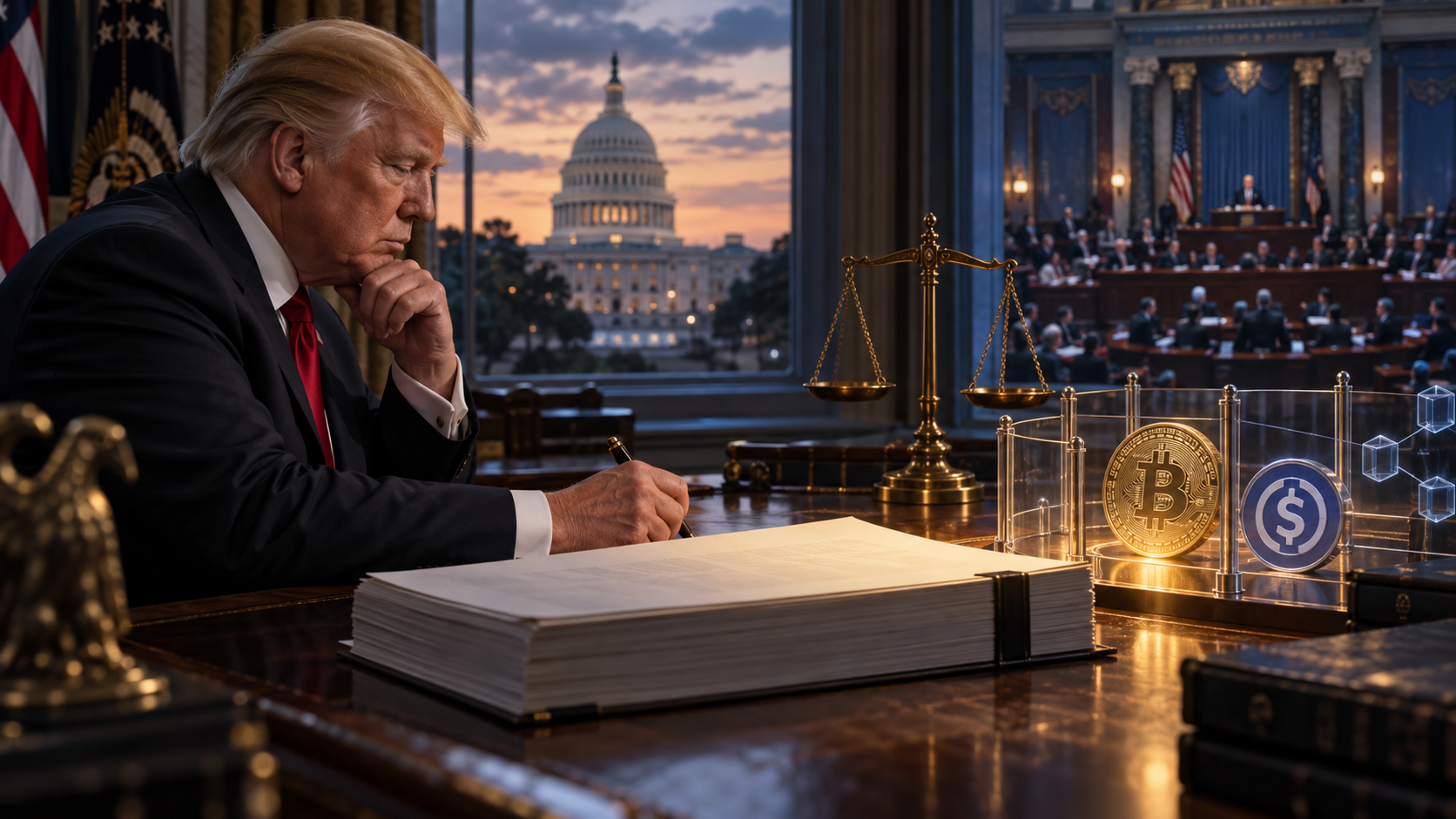
Donald Trump has finally agreed to comply with the new ethics restrictions in the CLARITY Act. The final text published on Sunday incorporates most of the bipartisan compromise negotiated over conflicts of interest involving U.S. political officials. After months of deadlock, one of the main obstacles to America’s major crypto overhaul has therefore eased. The hardest part remains: securing 60 Senate votes on Tuesday, September 15.
Crypto: Trump accepts ethics compromise
Cynthia Lummis, Tim Scott and John Boozman published on September 14 what they describe as the final version of the CLARITY Act. The document incorporates 126 substantial changes requested by Democrats during the negotiations.
The main one concerns Donald Trump.
Bref Crypto reported just days ago that the CLARITY Act was heading to the Senate without having secured the 60 votes required, notably because Democrats were demanding more safeguards concerning the president’s and his family’s crypto activities.
This time, Trump has accepted most of the Tillis-Gallego compromise. The rules would cover the president, vice president, members of Congress, other federal officials, judges and their spouses.
According to Cynthia Lummis’s official statement, state attorneys general would also have a role in enforcing the conflict-of-interest rules.
One limitation remains, however: the text does not appear to extend these restrictions to the children of political officials. The Trump family’s activities involving World Liberty Financial, USD1 and the TRUMP memecoin will therefore likely continue to fuel the debate.
Banks also secure a new safeguard
The compromise is not limited to ethics.
The new version of the CLARITY Act gives the Treasury secretary the power to intervene if rewards associated with stablecoins begin causing significant deposit outflows from community banks.
This mechanism functions as a “circuit breaker”. It could be activated during the 18 months following the law’s entry into force if payment stablecoins cause outflows large enough to threaten certain banking institutions.
This was one of the issues that still divided banks and the crypto industry. Platforms would not be able to pay interest directly simply for holding a stablecoin, but certain rewards linked to its use would remain possible.
The text also tightens the rules around trading between affiliated entities, conflicts of interest on exchanges and consumer protection.
Bref Crypto had already noted that Circle presented the CLARITY Act as the missing piece of the U.S. regulatory framework. The final version therefore seeks to preserve this innovation-friendly architecture while addressing more of the concerns raised by banks, Democrats and law enforcement agencies.
Even the Blockchain Regulatory Certainty Act has been narrowed: some protections granted to developers remain in place, but their scope does not extend in the same way to criminal prosecutions.
The 60 votes remain the real test
Trump has moved. That does not mean the CLARITY Act is safe.
The first verdict will come Tuesday, September 15, at 2:15 p.m. in Washington. The Senate must vote on cloture for the motion allowing consideration of the bill to begin.
It will take 60 votes.
Republicans hold 53 seats, and several defections remain possible. The bill’s backers therefore still need a significant group of Democrats or independents.
Polymarket’s odds nevertheless responded: they rose from around 22% to 32–34% for the CLARITY Act to be enacted in 2026 after the new compromise was published.
Bref Crypto had also shown that the National Sheriffs’ Association had already withdrawn its opposition to the bill. Another obstacle has fallen today with Trump’s agreement on ethics.
The timetable remains brutal, however. Even a victory on Tuesday would not make the CLARITY Act law. Congress would still have to debate amendments, pass the bill in the Senate and then reconcile this new version with the House version before the midterm election period.
The compromise on Trump therefore genuinely changes the balance of power.
It does not replace the votes.
After more than a year of negotiations, the CLARITY Act is finally coming before the Senate with a version Republicans describe as the “last and best offer.” Tuesday will show whether Democrats consider the concessions sufficient.
Auteur/autrice

evans@brefcrypto.com
Publications similaires

Bitcoin: Je, $65,000 inaweza kweli kuwa sakafu ya bei?
Je, dola 65,000 zinaweza kuwa bei ambayo Bitcoin haitawahi tena kushuka chini yake? Nadharia hiyo imezidi kupata nguvu tangu wastani wake wa...
Lire la suite
Bitcoin: Can $65,000 Really Become a Floor?
Could $65,000 become a price Bitcoin never revisits on the downside? The thesis has gained traction since its 200-week moving average crossed...
Lire la suite
Bitcoin : les 65 000 $ peuvent-ils vraiment devenir un plancher ?
65 000 dollars pourraient-ils devenir un prix que Bitcoin ne reverra plus jamais par le bas ? La thèse prend de l’ampleur...
Lire la suite
Crypto: Balancer inaandaa kufungwa baada ya v3 kushindwa
Balancer inaweza kutoweka polepole baada ya zaidi ya miaka mitano miongoni mwa majina makubwa ya DeFi. Itifaki hiyo ya crypto inaandaa kufungwa...
Lire la suite
Crypto: Balancer prepares to shut down after v3 fails
Balancer could gradually disappear after more than five years among DeFi’s biggest names. The crypto protocol is preparing an orderly wind-down following...
Lire la suite
Crypto : Balancer prépare sa fermeture après l’échec de v3
Balancer pourrait disparaître progressivement après plus de cinq ans parmi les grands noms de la DeFi. Le protocole crypto prépare une fermeture...
Lire la suite