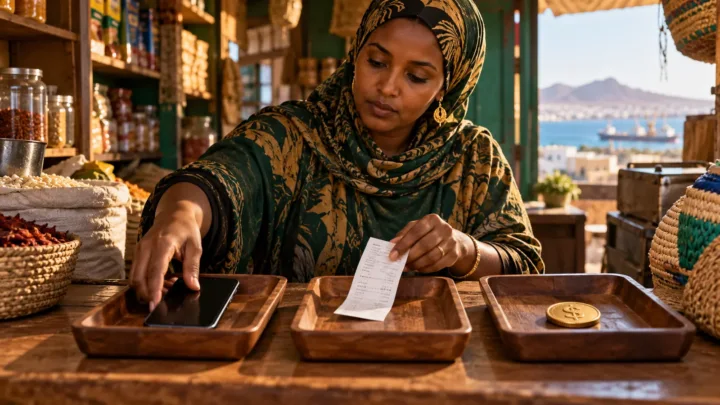
Digital Africa is moving fast. Yet the news published over the past 48 hours shows that the next battle is no longer only about connecting more people. Services must now be made reliable, inclusive and secure enough to withstand growing dependence on digital technology.
Digital Africa: connectivity is no longer enough
Ghana has just provided a stark illustration. Importers say that the unavailability of Ghana.gov at the port for nearly a week caused delays and financial losses. When customs operations depend on a platform, an IT outage can ultimately become a public-service outage.
This vulnerability ties into the African debate over digital infrastructure sovereignty. The contrast with Nigeria is striking. The country had 192.23 million active telecom subscriptions in June 2026, up from 189.68 million a month earlier. Broadband penetration has now reached 56.79%.
Greater connectivity means more services, payments and activities relying on the Internet. Infrastructure availability has therefore become an economic issue.
Ghana is also working on the next stage. The MoMo Fintech Lab, supported in particular by the Bank of Ghana, aims to enable students, developers and startups to design new use cases involving payments, digital identity, security and access to financial services.
Digital Africa is therefore no longer simply short of users. It is beginning to build its own services ecosystem.
Inclusion becomes a real-world test
Nigeria has also just recognized three innovations that highlight an often-overlooked reality: a digital service can work perfectly and still remain inaccessible to part of the population.
At the Nigerian Communications Commission’s “Technology Without Barriers” hackathon, SORA won 3 million naira for an employment and training platform designed for people living with disabilities. Clear Signal transforms power outage alerts to make them accessible to blind, deaf or hard-of-hearing people. IKOR uses AI to enable dictation and voice-based writing.
That is another definition of innovation.
Ghana, for its part, is focusing on skills. Its new Green TVET initiative notably introduces solar energy, smart agriculture, digital tools and green technologies into vocational training.
In Nigeria, initiatives are also encouraging young people to move beyond simply using ChatGPT and AI assistants and learn to develop their own solutions. This ambition accompanies Nigeria’s reform aimed at adapting data protection to artificial intelligence.
For the DRC, the issue deserves to be stated plainly: training people to use a tool is not enough. The challenge is to have developers, technicians, entrepreneurs and researchers capable of adapting technologies to local problems.
AI, biometrics and children: rules are coming
Kenya could take this reflection much further. The Kenya Artificial Intelligence Bill 2026 published by Parliament provides for the creation of an AI Commissioner, the classification of systems according to their risks and specific obligations for AI systems considered sensitive.
Certain offenses could cost up to 5 million Kenyan shillings. High-risk systems would notably be subject to assessments, required to retain information about their data and provide greater explanations of how they operate.
In the same country, Worldcoin could resume its operations after the closure of a police investigation into the collection and transfer of personal data. Its system relies on iris scans to create a digital identity.
This is precisely the kind of technology that makes it necessary to discuss consent before mass adoption.
Cybersecurity adds another urgent concern. More than 100 companies, including OpenAI, Anthropic, Microsoft, Google and AWS, have just warned that AI-assisted cyberattacks could become far more widespread and sophisticated in the coming months. Hospitals, water-distribution systems and Internet infrastructure are among the sectors mentioned. This warning follows the accelerated adoption of AI by cybercriminals in Africa.
And younger people are not spared. Following the agreement reached by Meta in the United States on the safety of minors, Amnesty International is notably calling for hyper-personalized recommendation algorithms to be disabled by default for children.
The debate over Digital Africa is therefore moving to a new level. It is no longer enough to count SIM cards, launched applications or people trained.
A digital infrastructure can be massive and still fail. An AI system can be powerful and exclude certain users. A digital identity can simplify access to services while collecting biometric data that cannot be replaced.
Africa is clearly accelerating. Its success will now depend far less on the number of technologies adopted than on how they are built, secured and made accessible.