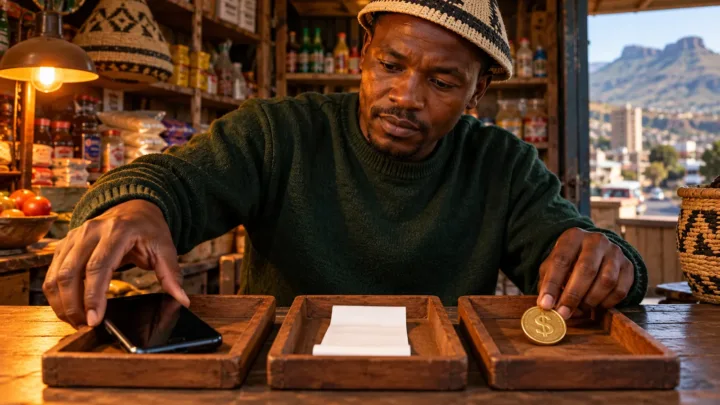
A mobile number in an advertisement does not prove an official integration with a crypto seller. A familiar payment brand does not automatically guarantee the assets promised by an independent counterparty. This guide outlines the evidence and responsibilities to examine without certifying any locally approved channel. The calculations are hypothetical and do not reflect current M-Pesa or Bitcoin provider fees.
In brief
- A debit from M-Pesa alone does not prove that bitcoins were delivered.
- The order, payment and asset transfer must be reconciled separately.
- Identities, the net price and recourse conditions should be verified before any funds are sent.
Bitcoin with M-Pesa in Lesotho: define the two services
Describe the process in one precise sentence: your account pays a beneficiary, and then a counterparty must deliver a specified amount of BTC. The guide to buying crypto with Mobile Money helps distinguish these roles. If the seller cannot explain this chain, the payment instruction is insufficient. A simple phone-based process does not remove the commercial obligations linking the different movements.
The official M-Pesa Lesotho overview describes a mobile payment and transfer service. That page does not prove that Vodacom sells or guarantees bitcoins offered in an independent advertisement. The customer should therefore ask what relationship is being claimed when a contact refers to a partnership. The payment method’s name must not become an endorsement of the seller’s reliability.
Before proceeding, identify the crypto provider, the beneficiary and the custody arrangement. A platform may arrange the order without administering the mobile account. An operator may process the payment without controlling the receiving wallet. A promise of a full refund requires specific evidence. Without this separation, an incident may be directed to a party that has no power to fix the failed step.
The technical existence of a channel does not settle the applicable law. Check eligibility and the regulatory framework for the activity before transferring funds. This guide does not present any seller as approved by default and does not suggest bypassing controls. Significant uncertainty should remain a question to resolve before payment, rather than a problem whose implications the customer discovers only after delivery fails.
Build three types of evidence instead of relying on a single screenshot
The commercial order should specify the asset, quantity, price, timing and delivery conditions. The mobile payment should have its own reference, amount and status. Delivery requires evidence suited to the custody model used. A blockchain transfer and an internal platform credit cannot be verified in the same way. Reconciling them shows exactly what has been completed.
A screenshot received in a conversation may show an attempted payment, a scheduled instruction or an altered image. Check the official channel for the relevant account to verify the final status. The recipient, amount and reference must match the order. A message announcing success is not a substitute for this check, even when it imitates the familiar interface of a known service.
For a Bitcoin transaction, verify the network, destination and other relevant details. A genuine transaction ID involving another address does not prove that you received the funds. Conversely, the absence of a public movement is not enough to reject a credit described as internal. First establish which product and custody model are involved. The guide to how crypto wallets work helps distinguish these situations without confusing a displayed balance with control of the assets.
This evidence must remain useful without exposing secrets. A complaint file may show references and a timeline; it should not contain a recovery phrase or private keys. The seller does not need them to explain the order. Anyone requesting those details is not asking for ordinary proof: they may be seeking the ability to move the wallet’s assets.
Compare the total cost with the BTC actually received
In a hypothetical example, the seller receives 500 LSL and the channel adds five LSL. The order specifies 0.0005 BTC, but a deduction leaves 0.00049 BTC available for use. The total expense reaches 505 LSL. The effective price is approximately 1,030,612.24 LSL per BTC. These assumptions describe neither an actual M-Pesa fee nor a current offer in Lesotho.
Any difference in quantity should be explained before the purchase. A fee may be charged in local currency or in the asset, depending on the service. The guide to calculating the full cost of crypto helps bring all cost items onto a consistent basis. An advertisement with no visible commission may still be more expensive if its exchange rate or withdrawal deduction reduces the final amount more significantly.
If the plan is to convert back into maloti later, include the resale in the model. The purchase price does not guarantee the exit price. Available volume, minimums and processing times may also differ. A comparison with an ordinary payment should extend to the amount actually available for the final need, rather than stopping at the first balance credited to a crypto application.
The price-fixing window must be clear. What happens if payment is delayed or the order expires? A counterparty should not reveal only after receiving the money that it can freely change the quantity. Ask for a written, understandable condition before sending the funds. The budget should accommodate a defined outcome, not depend on an improvised negotiation once the money is gone.
Verify account holders and protect the mobile account
The beneficiary must match the verified instructions and the service’s rules. Any change of number or name requires independent confirmation. An urgent explanation received privately is not enough. Adding an assistant or another account holder can complicate proof of payment and compliance checks. The seller’s supposed reputation does not replace consistent identities throughout the process.
Use genuine information and an account that matches your circumstances. The guide to KYC, data protection and recourse helps examine the documents and the collection channel. Borrowing a relative’s phone or account to get around a limit creates an additional dependency. In a dispute, the statements and rights of the actual account holder may become central to the case.
Do not give confirmation codes to anyone promising quick assistance. Read each screen before approving an action. A request presented as a simple verification may authorize a transfer or change account access. Contact the official service through its published details when the process seems unusual. Secrecy protects the account; disclosing it does not prove good faith.
For a payment error, contact the operator promptly and describe the facts. A correction request does not guarantee a refund. Do not assume that a mobile transaction is always reversible before initiating another transaction that may not be. The rules and deadlines for the two services may differ, requiring coordination and evidence rather than reliance on a universal cancellation button.
Prepare the wallet and Bitcoin delivery
The destination must match the exact asset and expected network. A representation on another protocol may introduce intermediaries or may not be accepted by the recipient. Do not choose a withdrawal solely because its fee appears low. Check the official instructions and minimum amounts before paying, so you do not buy a fraction that will be difficult to move.
Decide on custody in advance. An intermediary account depends on the company’s rules and systems. Self-custody requires a prepared recovery process and protected secrets. The guide to comparing platforms based on their evidence helps assess this choice. No model removes the need to understand what could make the funds unavailable after an outage, suspension or handling error.
A limited test may verify documented compatibility in an appropriate setting. However, you should know its cost and the specific question it is designed to answer. A first delivery does not certify the seller’s compliance, solvency or future conduct. Keep a limit independent of that success, since some arrangements deliberately use small, normal transactions to encourage larger deposits later.
When an escrow platform is involved, keep communications within its channel and read the dispute rules. A request for early release or payment outside the order may weaken traceability. The mechanism does not automatically guarantee every external movement. Its scope must be understood before confirmation, not inferred from assurances given solely by the counterparty.
Reconcile each step and address the right incident
After the transaction, compare the order, payment and delivery, including their times and amounts. This timeline helps distinguish a missing debit, an unfulfilled order or an amount that was not credited. A general statement that the transaction is not working is less useful than a file showing the exact failed step. The reconciliation should preserve context without multiplying unnecessary copies of personal data.
Then direct the request to the party that controls that step. Mobile support may examine a payment reference; the seller or platform must respond regarding the sale. An external complaints body may not cover the entire chain. Its jurisdiction must be checked for the relevant service and parties, without promising repayment simply because a local brand appears at the beginning of the process.
Stop any new transactions if a significant anomaly appears. A release payment or urgent tax should be independently confirmed with the official channel. Fake recovery agents may exploit frustration and reuse genuine information to persuade victims. Do not give them an advance or confidential details in exchange for a promise of certain recovery. Protecting funds that remain accessible is a separate priority from handling the initial loss.
Bitcoin with M-Pesa in Lesotho should therefore be understood as a relationship between two services, not as an integration guaranteed by the payment method’s name alone. A serious process makes clear who pays and who delivers, with the corresponding evidence. If that answer is missing before payment, suspending the plan preserves your room to decide. The ease of a mobile transaction must not obscure the responsibilities involved.