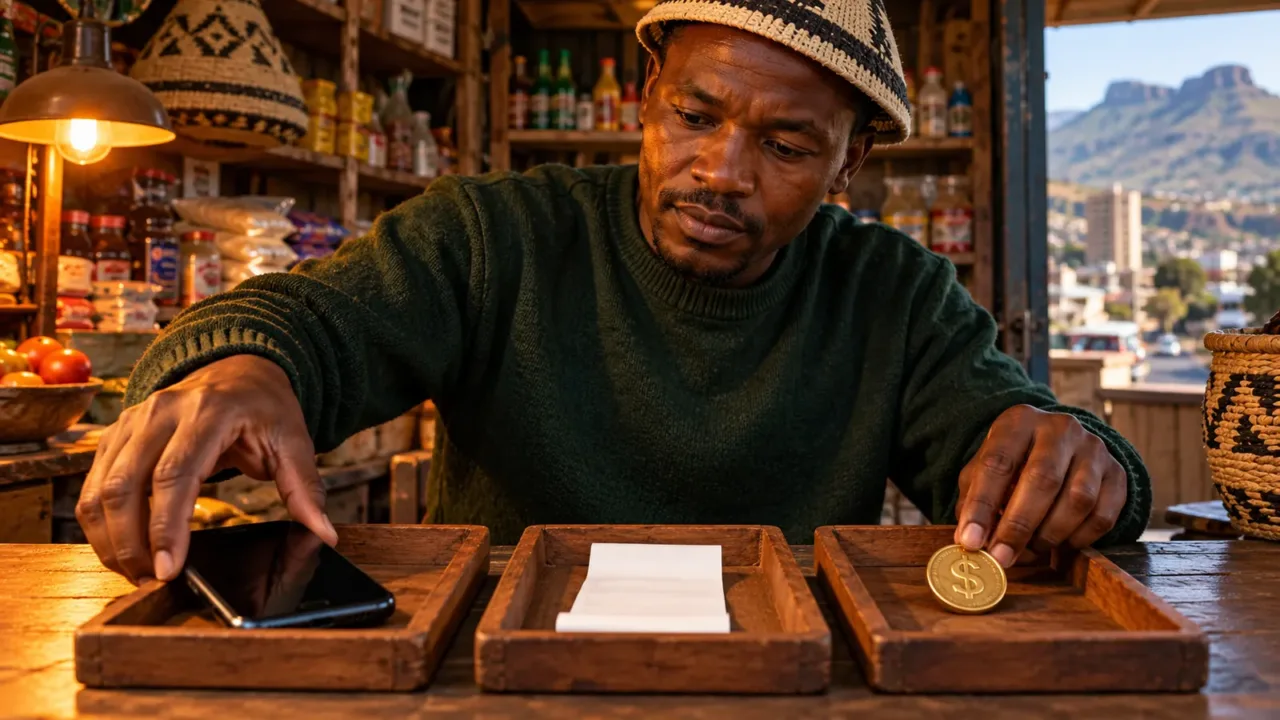
The critical issue arises when a payment goes through but the promised assets never reach the customer. Who then holds the relevant evidence, and who can actually intervene? This guide sets out a verification method suited to Lesotho, without certifying a local P2P market or a commercial integration. The calculations use illustrative assumptions only, never current EcoCash rates.
In brief
- An EcoCash receipt proves a mobile-money transaction, not automatically the delivery of USDT.
- The relevant price compares all the maloti debited with the units that can actually be used.
- Account terms, the crypto contract and complaint channels must be checked separately.
USDT with EcoCash in Lesotho: identify every party
Start by mapping the flow of funds. The Mobile Money and crypto guide distinguishes between payment, exchange and custody. Your mobile account pays a beneficiary; a separate obligation provides for the delivery of a specified asset. When one person claims to handle everything, still ask which company is responsible for each commitment and which documents can verify it.
The official EcoCash Lesotho presentation describes a mobile-money service within the Econet ecosystem. It is not enough to establish that EcoCash sells USDT or guarantees an independent listing. Do not apply the terms of a product with the same name in another country. A shared brand name does not make accounts, contracts and competent authorities interchangeable.
On the crypto side, identify the seller, any platform involved and the party holding the assets. A marketplace may arrange the transaction without controlling the seller’s mobile account. A personal wallet may receive the tokens without offering any commercial recourse. The exact role matters more than a phrase such as “secure payment,” which says neither which step is protected nor how that protection works.
The absence of proof of an official integration does not, by itself, show that every conceivable exchange is prohibited. It mainly means that the EcoCash name cannot be presented as a guarantee concerning the seller. Check the terms of use and the legal framework governing the activity before making any payment. A transaction whose compliance remains uncertain should not proceed merely because its technical execution appears easy.
Read current terms without relying on an outdated fee schedule
The EcoCash terms published on the operator’s website help identify contractual issues, including customer identification, account operation and permitted transactions. However, the document reviewed includes a limits table that notably refers to 2014. It cannot be used to certify the limits or fees applicable today. Request current confirmation before preparing a budget.
This precaution changes how offers should be compared. The cost of a transaction cannot be determined from a table found in a search engine. Record the quote displayed through your official channel, its date and the associated conditions. If the amount varies according to the type of beneficiary or the transaction selected, preserve that context. A rate removed from its framework can make your estimate unusable.
Terms intended for agents do not necessarily replace those applying to individuals. A professional contract may set out different responsibilities and its own distribution obligations. Look for the text corresponding to your status as a customer and to your country. If you are unsure which entity is party to the contract, ask the official service for its full identity rather than inferring it from an app’s name.
Identifying the mobile account does not amount to universal validation of the crypto file. A platform may request additional documents or review the source of funds. Our report on KYC in Africa explains why several parties may conduct separate checks. Provide documents only through authenticated channels, and never allow a seller to request your login credentials or mobile secret code.
Calculate the net price before confirming payment
Consider a fictional example: the seller offers 90 USDT at 18 LSL per unit. The quoted price is 1 620 LSL, plus 9 LSL in assumed fees for the purposes of the example. Your total outlay therefore reaches 1 629 LSL. If one additional unit is deducted as a delivery fee, you ultimately have 89 USDT, not the 90 units advertised.
The effective price is 1 629 divided by 89, or approximately 18,30 LSL per usable USDT. This measure makes it possible to compare offers presented in different ways. One seller may advertise a low rate but add several deductions; another may include certain fees in the price. The guide to the full cost of a crypto purchase sets out the items to compare before choosing.
Test the exit under the same scenario as well. Suppose the 89 USDT can then be sold for 17,50 LSL, with no additional fees in this simplified assumption. You recover 1 557,50 LSL. The gap with the initial debit is then 71,50 LSL. A token intended to track the dollar can therefore produce a loss in local currency even without a major change in its reference price.
Do not treat this example as a commercial rate. The conversion rate, seller premium, mobile fees and network costs vary according to actual conditions. A quote should specify its validity period and the net quantities. If these elements remain unclear, do not compare services based solely on the line that appears cheapest: first request a calculation that can be fully reconciled.
Match the order, receipt and delivery
Before paying, retain the order showing the asset, network, net quantity, amount and recipient. After payment, keep the official reference for the mobile transaction. Check its status in your own account, not only in an image sent by the counterparty. A forwarded notification may have lost its context; a receipt should never be treated as proof of everything that was supposed to happen next.
For a blockchain delivery, verify the network actually used and the asset received. The protocols supported by Tether show that the same commercial name can correspond to several technical environments. The destination must support the exact protocol used for the transfer. A correctly copied address is not enough if the receiving service does not support the selected asset or network.
An internal platform credit requires a different check. You may see a balance without directly holding the keys needed to move the asset. Review the withdrawal terms, thresholds and any additional checks. The crypto wallet guide helps distinguish an account with an intermediary from a self-custody wallet. The custody model changes both the evidence and the responsibility.
Finally, bring the three elements together in a single file. The beneficiary’s name, order reference and quantity delivered should form an intelligible chain. If anything changes after the agreement, ask for an explanation before paying. A new number sent through a private message can break that continuity, even when the contact uses the name and photo of someone you already know.
Handle an incident without paying a second time
A pending payment, an incorrect recipient and a missing crypto delivery are not the same incident. First record the observable facts: time, status, amount and reference. Direct the payment issue to the relevant official channel. For the unfulfilled crypto obligation, use the procedure set out in the contract or on the marketplace. Sending multiple messages without identifying the relevant step mainly risks confusing the evidence.
Do not assume that a debit means a second transfer will automatically resolve the situation. Someone may invent a validation tax, an account-unfreezing fee or an urgent penalty. Demand the contractual basis and verify it independently. When a complaint process exists, remain within its official channel and observe the applicable deadlines. No seller should obtain your mobile code, recovery phrase or remote access to your device.
A small test may reveal a procedural problem, but it does not turn a counterparty into a reliable business. Fraudsters may complete an initial transaction to prepare a larger request. Limit the amount exposed according to the actual risk and your available avenues of recourse. A transaction that succeeded yesterday does not prove that the next offer involves the same identities or conditions.
Preserve the documents without publishing your personal data in a public group. A useful file contains enough information to be checked, not all your secrets. Hide unnecessary details when seeking outside advice. Keep the originals in a protected location and record the steps you have taken. This discipline supports a serious complaint without creating a second vulnerability after the initial incident.
Decide whether the transaction really meets your needs
Buying USDT is not an end in itself. First define the need: payment, transfer, temporary holding or a later exchange. Compare the solutions that can genuinely meet that need in your situation. Taking a detour through a digital asset can add network, custody and conversion risks that the original plan did not require. The visible cost should not conceal this additional complexity.
Also examine the promise of stability. USDT targets a dollar reference, not a fixed amount in maloti. Its availability in an account does not guarantee immediate conversion into cash or a universal right to direct redemption from the issuer. The terms of the seller, custodian and issuer may all affect the exit. Funds intended for urgent expenses should not depend on a poorly understood chain.
Before confirming, you should be able to name the beneficiary, explain the net-price calculation, identify the network and describe the available remedy. A missing answer on any decisive point is a reason to wait. The goal is not to get through checks at any cost, but to decide on verifiable commitments. Contractual restrictions cannot be bypassed by changing the country name or borrowing an account.
The clearest sign of preparation is ultimately a simple reconciliation: what was meant to be paid, what was debited and what should become usable. If that comparison is impossible before placing the order, the commercial presentation still lacks precision. EcoCash and USDT may appear in the same transaction flow, but their responsibilities do not merge. Keeping them separate makes the decision clearer and the record stronger.