
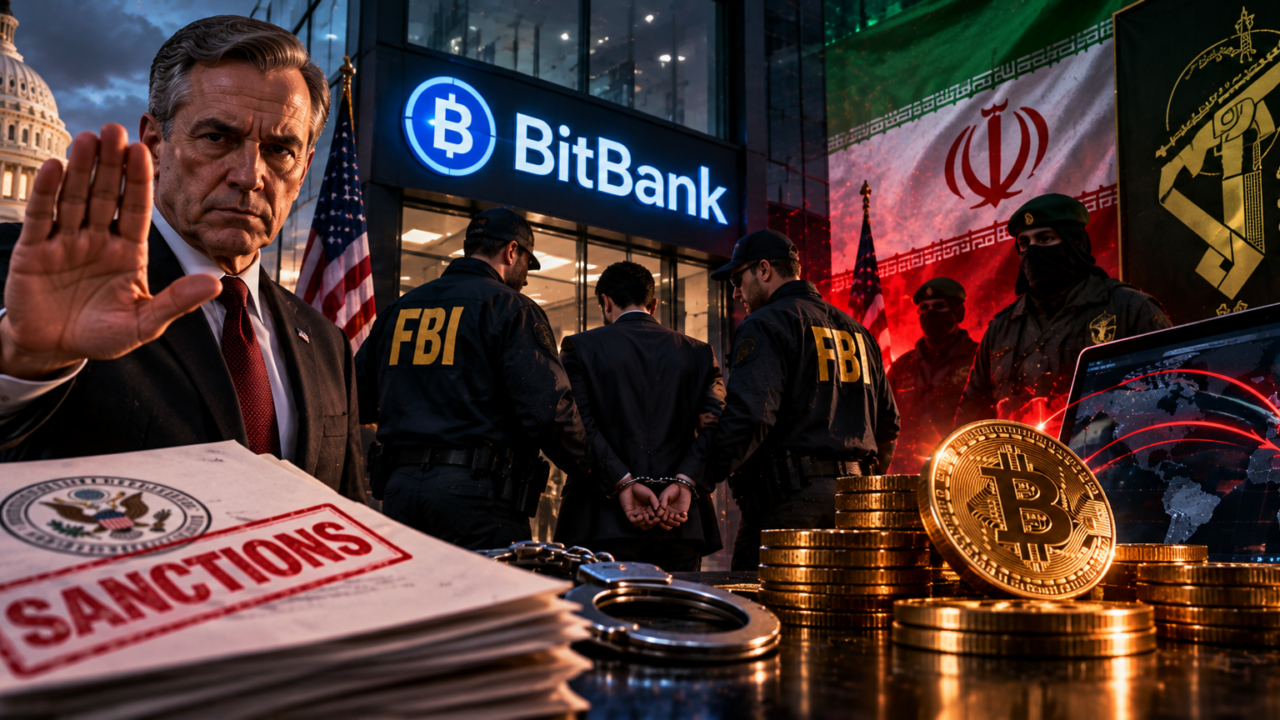
Hundreds of millions of dollars in Bitcoin allegedly passed through BitBank to Iran’s Islamic Revolutionary Guard Corps (IRGC) between June and July 2026. On September 17, the U.S. Treasury sanctioned the Iranian exchange, along with its developer and three associates of financier Babak Zanjani. Washington also says the platform was used to transfer payments collected by Hormuz Safe, the Iranian maritime initiative associated with the Strait of Hormuz. Above all, the case marks a new stage in the financial battle surrounding Bitcoin: unlike USDT, BTC has no issuer capable of freezing it. The United States is therefore shifting pressure toward the companies and individuals that make its use possible.
BitBank allegedly transferred hundreds of millions in Bitcoin
The new sanction is based on a particularly serious allegation. According to the Office of Foreign Assets Control, BitBank allegedly facilitated the transfer of hundreds of millions of dollars in Bitcoin to the Islamic Revolutionary Guard Corps, or IRGC, between June and July 2026. The U.S. Treasury did not portray BitBank as a simple exchange used occasionally by sanctioned clients. Instead, it described the platform as a central part of the digital financial infrastructure built around Babak Zanjani.
The case extends a trend already visible with stablecoins. In May, Bref Crypto detailed how Tether froze more than 344 million USDT linked to two addresses that U.S. authorities attributed to Iranian networks. With Bitcoin, the equation is far less direct: no company comparable to Tether can press a button to make BTC unusable.
The official U.S. Treasury statement also indicates that BitBank is controlled by Babak Zanjani, an Iranian financier already listed under U.S. sanctions. OFAC simultaneously sanctioned Pishtaz Simorgh Electronic Trade Company, which develops BitBank’s software, as well as Hossein Ali Zaker Hossein, Mohammad Mahdi Zaker Hossein and Seyed Adel Heidari.
An important distinction must be maintained here. The transfers to the IRGC are allegations made by the U.S. Treasury. Reuters reports the same accusations while attributing them to Washington, but the detailed amounts and flows were not publicly documented transaction by transaction in the statement reviewed.
The U.S. action therefore targets infrastructure that Washington believes was used to circumvent sanctions, not Bitcoin as a protocol.
Hormuz turns Bitcoin into a strategic settlement tool
BitBank also appears in a much broader case involving the Strait of Hormuz.
Since June, Hormuz Safe Marine Services Authority allegedly used the exchange to transfer payments it received to Iranian authorities, according to OFAC. Washington had already sanctioned the entity after the Treasury accused it of accepting payments in Bitcoin and other digital assets for services linked to maritime passage.
The issue extends far beyond crypto. The strait remains one of the most sensitive points in global energy trade, and the military tensions of 2026 have already disrupted traffic and oil prices. At the end of August, Bref Crypto was still following the latest U.S. strikes around Hormuz and Iran’s response, as risks along maritime routes rose sharply.
This context explains why an alternative payment system interests Tehran. Sanctions cut off or complicate access to certain banks, currencies and international settlement infrastructure. Technically, Bitcoin makes it possible to transfer value without seeking authorization from a U.S. correspondent bank and without depending on an operator capable of blocking the transaction at the protocol level.
That does not mean Bitcoin makes sanctions irrelevant. A BTC payment leaves a public record. If the recipient’s address is eventually identified, authorities can track subsequent movements and pressure the exchanges, custodians, brokers or companies that handle those bitcoins.
The situation around Hormuz illustrates this paradox perfectly. Bitcoin can bypass part of the traditional banking infrastructure. It does not eliminate the intermediaries many users still need to buy, sell or convert their BTC.
BitBank sits precisely at that point.
Washington cannot order the Bitcoin network to cancel a payment. It can try to make the exchange facilitating that payment much harder to use.
Babak Zanjani returns to the center of the network
This is not the first time Babak Zanjani’s name has appeared in U.S. cases.
The Iranian financier was sentenced to death in Iran in 2016 over allegations related to the misappropriation of funds associated with the National Iranian Oil Company, which itself is sanctioned by the United States. His sentence was later commuted in 2024. In 2025, he returned to the public eye through several economic and infrastructure projects linked to Iran.
The digital side of his network had already drawn OFAC’s attention.
On January 30, 2026, the Treasury took an initial series of measures against Zanjani and digital-asset projects such as Zedcex and Zedxion. A new wave of sanctions followed on July 24 against several commercial entities associated with his group.
TRM Labs, which worked on this infrastructure, says it expanded its analysis beyond blockchain transactions alone. The company examined corporate records, payment platforms, digital infrastructure and the various commercial entities surrounding Zanjani. This mapping identified several companies that were subsequently targeted by OFAC.
BitBank was another piece of the puzzle.
According to the Treasury, Zanjani had publicly promoted the exchange since at least 2024. Several companies in his network also described it as a partner. Pishtaz Simorgh, the platform’s developer, is itself a subsidiary of Dot One Value Creation Group, which had already been sanctioned.
The model described by Washington therefore combines visible companies with much more discreet financial channels. Some entities provide conventional commercial services. Others allegedly served, according to OFAC, to transfer digital assets and circumvent financial restrictions.
This combination makes sanctions more complex.
Cutting off a single blockchain address is not enough when a network can create another one. Washington is now seeking to trace the people who control the companies, develop the platforms or organize the transactions.
Bitcoin resists freezing, not surveillance
The contrast with USDT is particularly instructive here.
In April, Tether helped block more than $344 million in USDT on two Tron addresses that U.S. authorities attributed to Iranian interests. Bref Crypto later showed how Arkham mapped wallets attributed to Iran’s central bank, providing additional visibility into their transaction histories.
This operation was possible because USDT has an issuer.
Tether can place certain addresses on a blacklist and prevent the affected tokens from circulating normally. Although USDT uses a public blockchain, its monetary layer remains administered by a company.
Bitcoin works differently.
There is no Bitcoin company capable of blocking an address. No chief executive can cancel a validated transaction. No government can call a central issuer and ask it to burn BTC held by a given address.
That is an obvious advantage for anyone seeking to move value without relying on an intermediary.
It is also a problem for the traditional enforcement of sanctions.
Authorities must therefore work around the protocol rather than within it. They can sanction an address. Monitor its movements. Identify its presumed owners. Block assets held by companies under U.S. jurisdiction. Threaten intermediaries with secondary sanctions. However, they cannot prevent the global network from validating a Bitcoin transaction that complies with the consensus rules.
This difference likely explains why Washington is increasingly focusing on exchanges.
Bitcoin held in self-custody remains technically mobile.
A user seeking to convert several hundred million dollars into fiat, pay a regulated company or go through a centralized platform becomes far more exposed to controls.
Bitcoin’s decentralization therefore shifts the point of control.
It does not eliminate it.
Washington now targets Iran’s entire crypto ecosystem
BitBank is not an isolated sanction.
On June 2, OFAC had already designated Nobitex, described by the Treasury as Iran’s largest crypto exchange, along with Wallex, Bitpin and Ramzinex. Washington said Nobitex processed more than half of the digital-asset inflows into Iran in 2025 and facilitated transactions involving the IRGC and various sanctioned entities.
Two months later, on August 7, the Treasury announced new measures against platforms that U.S. authorities accused of enabling the laundering of significant volumes of digital assets for networks linked to Iran. OFAC then targeted, among others, entities it considered to have been used to maintain indirect access to the international financial system.
The major shift came on August 24 with Operation Economic Outcast. Washington explicitly expanded its campaign to infrastructure and international actors potentially facilitating certain activities in Iran’s digital sector. Bitcoin Magazine described the decision at the time as a new stage in the U.S. offensive against Tehran’s crypto economy.
BitBank followed less than a month later.
The progression is fairly clear. First, specific wallets and transactions. Then, major domestic exchanges. Next, the digital-asset sector as a whole. Finally, developers and executives associated with the targeted infrastructure.
The Treasury now warns that foreign companies may also face sanctions if they facilitate certain transactions with blocked entities. The September 17 statement emphasizes the risk of exclusion from the U.S. financial system and the secondary sanctions that could target non-U.S. actors.
This is therefore no longer just a battle between Washington and a handful of Tehran-based exchanges.
Every international service provider handling these flows must assess its exposure.
Sanctions can isolate BitBank without stopping Bitcoin
In practical terms, designation under sanctions blocks the property and interests in property of BitBank and the designated individuals when they are in the United States or under the control of U.S. persons. Entities 50% or more owned by blocked persons are also covered. Transactions involving these actors are generally prohibited for U.S. persons, unless an applicable license or exemption applies.
This can have significant consequences for an exchange.
Its partners may leave.
International infrastructure providers may cut off their services.
Foreign platforms may refuse deposits from addresses associated with BitBank.
Banks may avoid any relationship with companies that have dealt with the platform.
Data providers and blockchain analytics companies may also add the identified addresses to their monitoring systems.
Liquidity then becomes the central problem.
An exchange may technically continue receiving bitcoins, but converting them into dollars, dirhams, euros or other assets becomes far more difficult if most regulated actors refuse to act as the counterparty.
This is where U.S. sanctions retain considerable power even against a decentralized network.
They do not break Bitcoin.
They make its large-scale economic use more difficult.
However, this mechanism has limits. Peer-to-peer transfers remain possible, new addresses can be generated and some counterparties may choose to disregard U.S. jurisdiction. Monitoring then becomes a permanent game involving blockchain analysis, new addresses, intermediaries and legal structures.
The result is therefore neither “Bitcoin makes sanctions useless” nor “Washington can block Bitcoin.”
Both claims would be too simple.
A public blockchain can also become a compliance weapon
The use of Bitcoin by sanctioned entities also highlights an apparent contradiction in the network.
Bitcoin is difficult to censor at the protocol level.
It is also extremely transparent.
All transactions remain recorded on a publicly accessible blockchain. Addresses are pseudonymous, not necessarily anonymous. When an analytics company, exchange or authority links an address to a person, a significant part of that person’s financial history may become visible.
This is what makes on-chain analysis so powerful in sanctions cases.
Investigators do not directly see “Babak Zanjani” written in a Bitcoin transaction. They can, however, start with an identified address, observe its counterparties, track subsequent movements and look for the point at which the funds reach a platform with KYC information.
This logic had already been visible with Iranian stablecoins. USDT simply added one more step: once the addresses were identified, Tether could also freeze the tokens.
Bitcoin removes that final option.
The others remain.
That is probably the real lesson of BitBank. Bitcoin gives a sanctioned state or company a rail that Washington does not directly control. But the blockchain erases neither surveillance, sanctions applied to individuals nor the need for liquidity.
OFAC appears to have understood this.
Rather than trying to stop Bitcoin, the United States is now sanctioning the gateways that connect Bitcoin to the rest of the economy.
BitBank.
Its developer.
Its executives.
Its partner companies.
And potentially the international actors that continue to provide them with services.
This strategy can make the use of Bitcoin far more costly without touching the protocol itself.
That is precisely what distinguishes this new offensive from the USDT freezes observed a few months earlier.
With a centralized stablecoin, Washington can trace the chain of control back to the issuer.
With Bitcoin, it must encircle the network.
The protocol continues to produce one block after another.
The battle is shifting all around it.