Crypto Africa: Tether bets on self-custody
The principle may sound technical. Yet it changes a great deal.
With a conventional custodial wallet, an exchange or platform holds the private keys needed to move a user’s crypto. With self-custody, the user retains that control. Shiga now wants to apply this model to services much closer to everyday banking.
This shift comes as stablecoins are already connected to mobile money and local currencies across several African markets. The challenge is therefore no longer simply buying USDT. Users must now be able to hold, send and convert it without multiplying intermediaries.
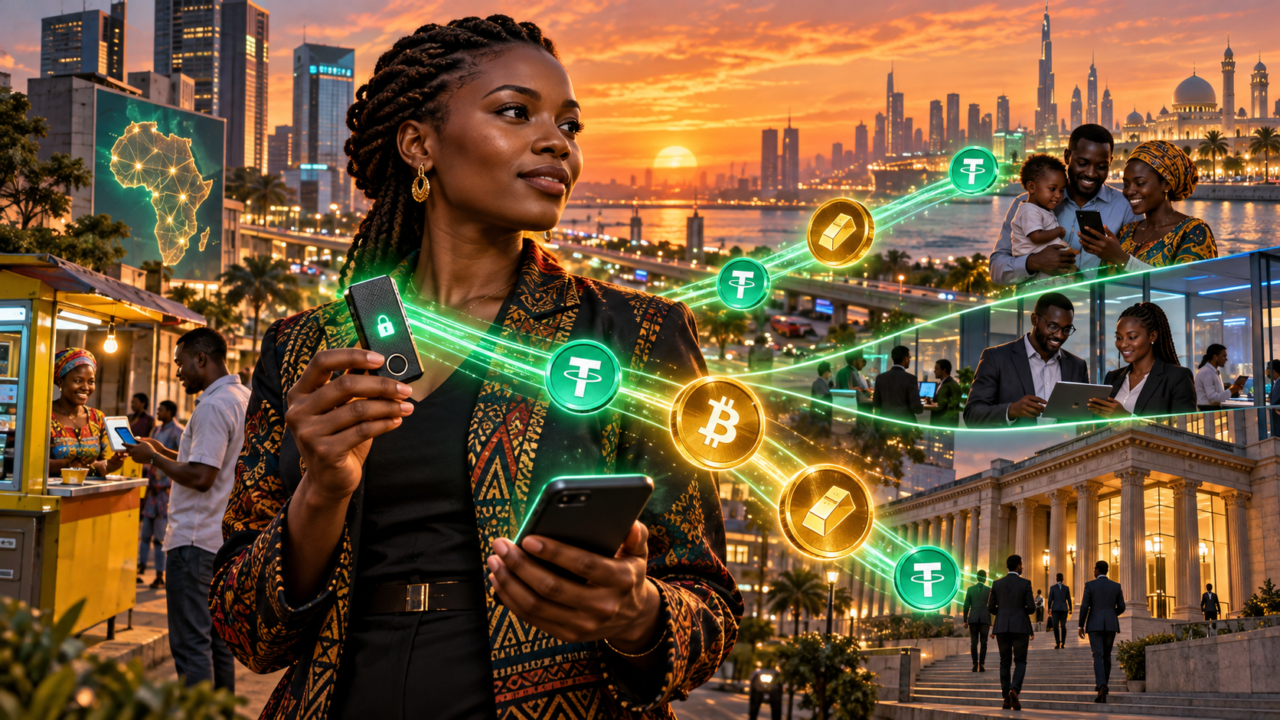
ENTA is intended to allow individuals, high-net-worth clients and businesses to fund a wallet with local currency, dollars or Bitcoin. They will then be able to hold and transfer USDT, Bitcoin and XAU₮, Tether’s gold-backed token.
According to Tether’s official announcement, WDK will provide the underlying technical layer. The open-source kit makes it possible to build non-custodial wallets without starting from scratch.
Shiga already operates between Africa and the Gulf, notably in Nigeria, Ghana, Senegal, Côte d’Ivoire, Kenya, Uganda, South Africa, the United Arab Emirates, Saudi Arabia and Qatar.
The corridor is far from insignificant. The average cost of a transfer to sub-Saharan Africa still stood at 8.46% in 2025, according to the World Bank.
Pulse directly targets banks and fintechs
Tether and Shiga are not stopping at individual wallets.
Pulse targets banks, fintechs and other financial institutions. They will be able to use the infrastructure to create their own services for international payments, treasury management or the settlement of digital assets.
Two options are available. An institution can allow Shiga to manage the infrastructure or run it directly in its own environment. In the latter case, it retains control of its keys, data and funds.
This is an important consideration for banks. They may want to use blockchain technology without sending their customers’ keys or sensitive data to a third-party infrastructure provider.
This architecture arrives as African authorities are beginning to scrutinize stablecoins more closely. In Kenya, the central bank is gaining greater oversight of stablecoins offered by licensed intermediaries. Self-custody therefore does not mean an absence of regulation, especially when a company converts local currencies into digital assets.
Shiga is already demonstrating this in Nigeria. The company says it is in the final stage of approval for a Digital Asset Intermediary licence. If granted, the licence would allow it to provide regulated dealing, brokerage and custody services to both individuals and institutions.
The situation may seem paradoxical: Shiga is building products in which users retain their assets while also seeking a licence that notably covers custody.
In practice, the two models can coexist depending on the service selected.
Tether is now building the rails
The announcement primarily shows how far Tether wants to expand its role.
For a long time, its business was essentially based on issuing USDT. The group is now also developing the building blocks for creating wallets, cross-chain transfers, payments and even infrastructure that can be used by AI agents.
WDK supports Bitcoin, Lightning, USDT and XAU₮, among others. Tether also says the kit can be extended to other blockchains and assets.
For Africa, this strategy is arriving in a market where stablecoin use is already widespread. Nigeria alone accounts for around 60% of sub-Saharan Africa’s stablecoin inflows. In several economies, digital dollars are used for international payments, savings, trade and temporary protection against currency depreciation.
Banks are also beginning to enter this space. Standard Bank is already preparing its own infrastructure with major international players, while South Africa accounts for billions of rand in USDT transactions.
Tether is taking a different route: providing the tools on which these new services can be built.
The announcement nevertheless leaves several points unanswered. No detailed country-by-country deployment schedule has been provided. The fees for ENTA and Pulse have not yet been specified, nor has the list of banks that will use Pulse.
The strategic shift is nevertheless clear. Tether no longer wants Africa merely to use USDT. It also wants the wallets and infrastructure that move USDT to be built with its technology.