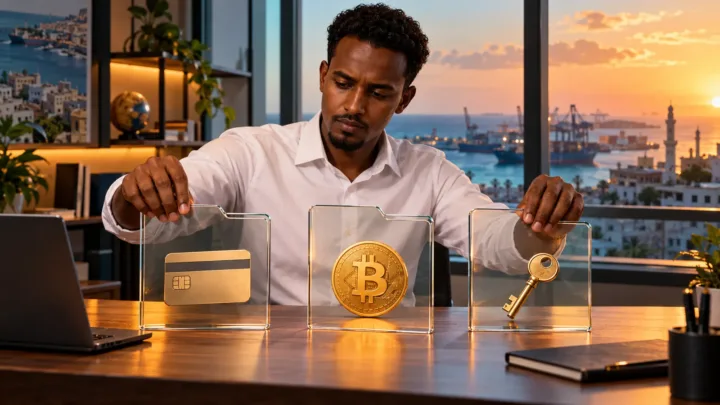
The question of whether crypto is legal in Somalia cannot be answered reliably by an registration button or a sellers’ group. Legal tender status, private ownership, professional services and payment conditions must be distinguished. Each situation requires different evidence, and none can automatically be inferred from the others.
The Central Bank of Somalia published an explicit warning in June 2024 and also issued a 2025 anti-money laundering text referring to virtual asset service providers. This guide compares those references but does not replace up-to-date legal advice concerning a specific transaction, business or territory. It does not confirm that any crypto provider is authorized.
In brief
- The absence of legal tender status does not answer every question about ownership and services.
- Authorization for mobile money does not prove authorization to exchange or custody cryptoassets.
- The text, its date and the exact activity must accompany any legal claim.
Crypto legality in Somalia: four separate questions
The framework for assessing crypto platform status helps avoid a common shortcut: a service being available does not necessarily mean it has the authorization required for your intended use. The first question concerns the official currency. The next concerns the user. The third focuses on the operator providing the service. Finally, the payment channel and its contract may impose their own conditions.
Legal tender describes a monetary status; it does not, by itself, provide an exhaustive list of what a person may hold. Saying that an asset is not legal tender therefore does not justify assuming either a general freedom or a universal criminal prohibition. A precise assessment requires reviewing the applicable provisions and their effects on the conduct the person actually intends to undertake.
An individual learning to use a wallet is not necessarily engaged in the same activity as a business collecting funds to purchase tokens on behalf of clients. Volume, repetition, remuneration and custody for others may change the questions that need to be examined. These facts should be described before seeking advice, rather than concealed behind an overly broad formula that obscures the actual activity.
A foreign platform may comply with the rules of its home country without being able to offer all of its products elsewhere. An international contract does not replace local requirements, and authorization in one jurisdiction does not automatically act as a universal passport. This distinction protects users from commercial arguments that conflate global reputation, registration and the right to serve a particular customer base.
What the Central Bank warning says
In its June 10, 2024 notice on virtual assets, the CBS stated that these assets were not legal tender and that no provider was licensed for such activities in Somalia at that time. It warned of potential losses and advised against investing and trading. The date is part of the information: removing it would turn a documented finding into an unjustified claim of current certification.
The warning remains relevant even when a seller accepts payment. An observed practice does not demonstrate legal permission. A successfully executed order proves neither a license nor customer protection. Ask for the document supporting the claimed status, verify its issuer and examine the activity it covers. A business registration number does not necessarily answer that question.
The English version of the 2025 anti-money laundering text published by the CBS defines VASPs and includes them within its preventive framework. This more recent document prevents the entire framework from being portrayed as frozen in 2024. However, it does not by itself demonstrate an individual license or all applicable operational requirements. Before acting, confirm the service’s current status and how the texts apply to your case.
Nor should broad language in a warning be turned into absolute technical claims. Bitcoin transactions do not guarantee anonymity: public information may be linked to an identity. The Bitcoin.org documentation on privacy and precautions recalls this limitation. Understanding the prudential meaning of an official notice does not require repeating every technical simplification in its wording without qualification.
Do not mistake a Mobile Money approval for a crypto license
The CBS separately publishes a list of mobile money service providers. It identifies operators in this sector, including Hormuud and Somtel. Appearing on that list does not show that an individual using their service can claim to be an approved crypto seller. Nor does it prove that the operator guarantees an order concluded with a third party.
The guide to Mobile Money and cryptocurrencies helps distinguish the payment from the item purchased. A receipt may establish a transfer to a number without validating the seller’s contract. If the seller fails to deliver the advertised token, the dispute is not necessarily limited to the technical operation of the payment. Responsibilities and remedies depend on the actual relationship between the parties.
The existence of an API does not change this principle. An interface that allows payments to be collected for a merchant website is not, by nature, authorization to operate an exchange platform. Developers must review the provider’s terms, the rules applicable to their activity and the obligations concerning client funds. A technical tool can support several uses without legally authorizing all of them.
Request evidence that corresponds exactly to the service being claimed: payments, custody, exchange, international transfers or advice. These terms are not interchangeable. A response that points only to a logo, an unverified certificate or past commercial success is insufficient. The scope must be stated in an identifiable document and confirmed by the legitimate issuer.
Describe the territory, the person and the flows
Commercial guides sometimes use imprecise geography when presenting regional availability. Yet the place of residence, the company’s place of establishment and the territory in which the service is provided may raise different regulatory issues. A reference to another administrative framework in the region should not be transferred automatically. The country name in an advertisement does not replace a concrete examination of the facts.
The currency requires the same care. The Somali shilling, SOS, should not be confused with every unit called a shilling in neighboring documentation. An error involving this unit can produce a false calculation and obscure the origin of a payment. For a professional file, retain the original amounts and currencies, executed conversions, beneficiaries and supporting documents. Legal analysis becomes fragile when the economic flow itself is poorly described.
The client’s residence may also differ from their nationality. A Somali living abroad should not assume that their account is subject to exactly the same conditions as one held by a resident in Somalia. The guide to KYC checks and personal data explains why providers request this information. Supplying accurate details helps avoid inconsistencies when making a withdrawal or filing a complaint.
Never use a false address or someone else’s identity to obtain a favorable response from a form. Technical approval obtained with inaccurate information does not regularize the transaction. It may instead create an additional basis for contractual restrictions. Useful advice must start from your actual circumstances, including when those circumstances limit available services or require you to abandon the intended process.
Review obligations without inventing an exemption
The absence of a simple text titled “crypto law” does not demonstrate that no rules apply. General obligations may concern a business, its clients, funds received, personal data or taxation. Their application should be assessed by a qualified professional, without extrapolating an entire regime from an online search. This guide therefore does not calculate a tax rate or an unconfirmed authorization threshold.
A merchant must in particular distinguish buying for its own account from providing a service to third parties. Regularly receiving other people’s funds to deliver tokens to them may raise different questions from a personal purchase. Billing, advertising and custody arrangements require specific review. Adding the words “simple intermediary” to a profile is not enough to erase the commitments actually undertaken.
Costs must also remain documented. The guide to the total cost of a crypto transaction helps separate the price, commission and conversion. This separation supports both financial understanding and the quality of accounting records. A statement without a clear unit, a commission paid from another account or an unidentified beneficiary can complicate substantiation, even when the amount appears limited.
Commercial insurance or a promise of reimbursement requires its own evidence. Ask who provides the coverage, what event triggers it, which exclusions apply and how to make a claim. A license does not automatically guarantee an asset’s value; a potential policy may not cover a network error or a particular type of fraud. The words “security” and “compliance” never replace the clauses that are actually enforceable.
Prepare a confirmation request that can actually be used
Present your project through a few facts: residence, individual or business status, the asset involved, the service’s role, expected frequency and the direction of payments. Add the provider’s legal name and the documents it relies on. This description makes it possible to ask an authority or adviser a precise question instead of receiving a general response that does not address the specific risk of the transaction.
Keep the response together with its date and limitations. A confirmation concerning a payment activity should not be reused for a custody activity. A change in contracting company, product or territory warrants a new check. Compliance is not a single screenshot kept indefinitely; it depends on continuity between the situation examined and the one that will actually be carried out.
If an incident occurs, gather the records without disclosing wallet secrets. The order, receipts, public references and timeline may help explain what happened. The guide to cryptoasset custody recalls the difference between evidence of a transaction and the key that allows funds to be spent. Someone asking for that key does not need a legal formality: they are asking for control of the funds.
The responsible answer to “is crypto legal in Somalia?” is therefore structured around a dated official warning, clearly distinguished activities and authorizations that must be proven before taking action. Until an essential point is resolved, do not present the transaction as compliant. The goal is not to find a reassuring formula, but to know precisely what the documents support and what still needs to be confirmed through a local review.