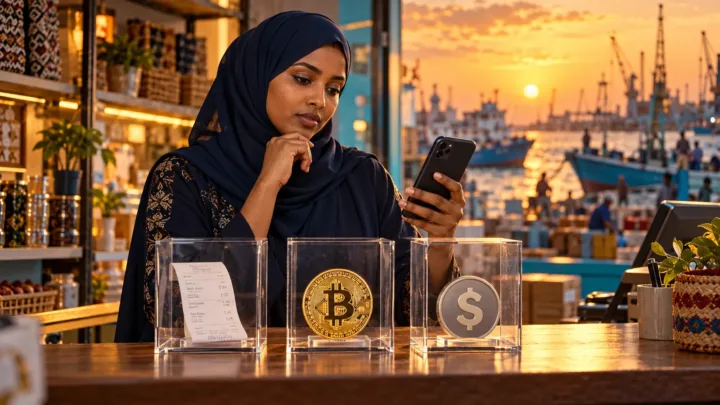
It is also important to distinguish the quoted price, the amount actually acquired and the right to withdraw the funds. This guide explains BTC fractions, custody and proof of delivery without stating a current price or certifying access to an intermediary for a Somali resident. The examples are purely illustrative and intended only to explain how the mechanisms work.
In brief
- One bitcoin is divided into 100 million satoshis, so buying a fraction does not require purchasing a whole unit.
- A dollar-denominated price does not necessarily include the seller’s premium and withdrawal costs.
- A balance held on a platform and BTC controlled through your own keys involve different responsibilities.
Bitcoin in Somalia: Start with the Amount, Not the Big Price
A sound understanding starts with how a crypto wallet works. A wallet does not contain physical coins. It allows users to consult information and, depending on its design, sign movements authorized by keys. A platform may display an internal balance without every change to that balance immediately corresponding to a public transaction on Bitcoin.
A satoshi represents one hundred-millionth of a BTC. Therefore, 0.001 BTC equals 100,000 satoshis. This division makes small amounts easier to read, but it does not make investing less risky. A 20% decline in the price affects the value of a small fraction proportionally in the same way as it affects a whole unit, even before fees are considered.
In a completely fictional example, with BTC priced at 80,000 dollars, 0.001 BTC would be worth 80 dollars before fees. This is neither a market quote nor an offer available in Somalia. The calculation simply links quantity and price: multiplying the number of bitcoins by their unit value gives an estimate in the selected currency at that moment.
A common mistake is to look only at the number of zeros. Seeing 0.0009 BTC after a purchase does not prove that the service withheld a specific commission. To understand the difference, you need to identify the price actually accepted, the amount paid and any deductions. The gap may result from the price, the spread, fixed fees or several factors combined.
Calculating Value in Dollars and SOS Shillings
The code SOS refers to the Somali shilling. A conversion requires an accurately identified quote, including the date, whether it applies to buying or selling and the unit used. Do not copy a figure found on a regional website without checking which currency it concerns. Units with similar names circulate in different contexts, and the simple word “shilling” is not enough to establish equivalence.
For learning purposes only, suppose a conventional rate of 30,000 SOS per dollar. The 80 dollars in the previous example would then equal 2,400,000 SOS. This invented rate should not be used to set a selling price or maintain real accounts. It illustrates why a serious guide must distinguish a conversion formula from a quote that can actually be executed with a provider.
The method for calculating crypto fees in Africa adds an essential point: compare net amounts. If funding first involves converting SOS into dollars and then buying BTC, each operation may have its own price difference. An advertised commission-free purchase does not automatically eliminate the margin embedded in the initial conversion.
If your budget is already denominated in dollars, do not force an SOS step that does not correspond to any real flow of funds. Keep one primary unit for comparing offers and record any conversions separately. This discipline prevents you from creating apparent fee savings simply by changing how the calculation is presented. The proper basis remains what actually leaves your account and what becomes usable afterward.
Understanding the Network Without Promising a Fixed Speed
Bitcoin groups transactions into blocks. Their arrival follows a probabilistic process: an average is not a guaranteed appointment for any particular transaction. Bitcoin.org’s educational documentation highlights the issues surrounding confirmations, volatility and responsibility. A pending order is therefore not necessarily suspicious simply because a few additional minutes have passed.
Fees depend in particular on the space occupied by a transaction and demand for that space. They do not automatically correspond to a percentage of the amount transferred. For a small purchase, a fixed withdrawal charge can represent a significant share of the total. Ask the service for its exact fee schedule rather than inferring costs from a network fee found elsewhere.
Some services may offer other forms of transfer, including Lightning. This requires compatible tools and a process genuinely supported by both parties. A phone number or mobile payment invoice is not a substitute for a suitable payment request. Do not choose an option simply because a tutorial claims it works everywhere: verify compatibility in the documentation before considering a financial commitment.
When an intermediary announces a transfer, ask which network it uses and request the relevant reference. For an internal transfer between two accounts on the same service, there may be no specific public transaction. That absence does not necessarily prove fraud, but it changes what evidence should be expected. The service’s contractual record must then clearly establish the transaction and beneficiary, without simulating a nonexistent blockchain transfer.
Separating Economic Ownership from Control of the Keys
A custodial account can simplify certain actions: the user logs in, checks the balance and requests a withdrawal. In return, the user depends on the service to access the funds. Maintenance, a compliance investigation or a failure may block the exit. That dependence does not disappear because the screen uses the word wallet or displays a padlock next to the balance.
Self-custody allows users to sign transactions themselves, but it transfers considerable responsibility to them. A recovery phrase may restore access, but its disclosure may also enable theft. No mobile payment agent should ask for it to verify a transaction. A properly stored backup is therefore not the same as a one-time code received by SMS, even if both protect digital access.
The guide to crypto platforms and their legal status helps frame the right question: who owes you what? For a balance held with an intermediary, review the custody and withdrawal terms. For a personal wallet, document the backup, compatibility and phone-replacement process. The choice should reflect concrete capabilities, not an abstract preference.
A limited technical test, where a lawful and compatible process exists, never certifies the service’s future security. It can only verify one sequence under the conditions prevailing at that time. Do not automatically increase the amounts after a small success. The risk of human error, suspension or failure remains and may become more costly as exposure grows.
Reviewing Somalia’s Framework and the Points of Access
The CBS notice dated June 10, 2024 is an important reference, but it should be read as a dated warning, not as an access agreement. Our research does not allow us to present any particular provider as currently authorized to sell BTC in Somalia. The availability of a foreign website does not resolve that question.
For users, several checks may apply at once: the provider’s terms, identity, residence, source of funds and payment-method limits. The KYC verification guide explains their logic and the precautions surrounding data. Using a relative’s identity document or declaring another residence creates inconsistencies that may make withdrawals and recourse even more difficult.
The funding channel should remain distinct from the product being purchased. A Mobile Money service may process a payment without checking the nature of the token advertised by an external seller. Technical success does not demonstrate that the seller honored its commitment. The Mobile Money and crypto guide helps map these steps and identify precisely where evidence is missing.
Nor should you assume how a gain, regular activity or business receipt will be treated for tax purposes. The classification may depend on the case and the applicable rules. A company should retain the necessary documentation and seek advice from a competent local professional. The absence of a crypto category in a filing interface does not, by itself, provide an exemption or commercial authorization.
Planning an Exit and an Affordable Loss
An investment is not measured solely by its entry price. First describe the exit: into which currency, which account and within what timeframe? A theoretical gain does not help pay an expense if the conversion channel remains inaccessible. Users must be able to distinguish between a displayed gain, a completed sale order and an amount actually available, with successive fees properly reconciled.
Let us return to a simulation independent of real prices. A fraction bought for 80 dollars before fees would be worth 64 dollars after a 20% decline. To move from 64 back to 80 dollars, it would require a 25% increase, still before costs. This asymmetry shows why simply waiting for the price to return to the purchase level does not guarantee recovery of the capital.
Set an exposure limit and a stop condition before checking daily price movements. The amount should remain compatible with essential expenses and the possibility of a total loss. Reject promises of fixed BTC returns or loans intended to increase a losing position. A volatile asset does not become an emergency reserve because a community describes its decline as temporary.
Ultimately, understanding Bitcoin in Somalia rests on four separate proofs: an identifiable quantity, an explainable price, a clear understanding of custody control and a documented exit. If one is missing, the actual risk exceeds what the chart shows. Learning these distinctions does not require paying a seller; it is precisely what helps identify when the conditions do not yet justify a transaction.