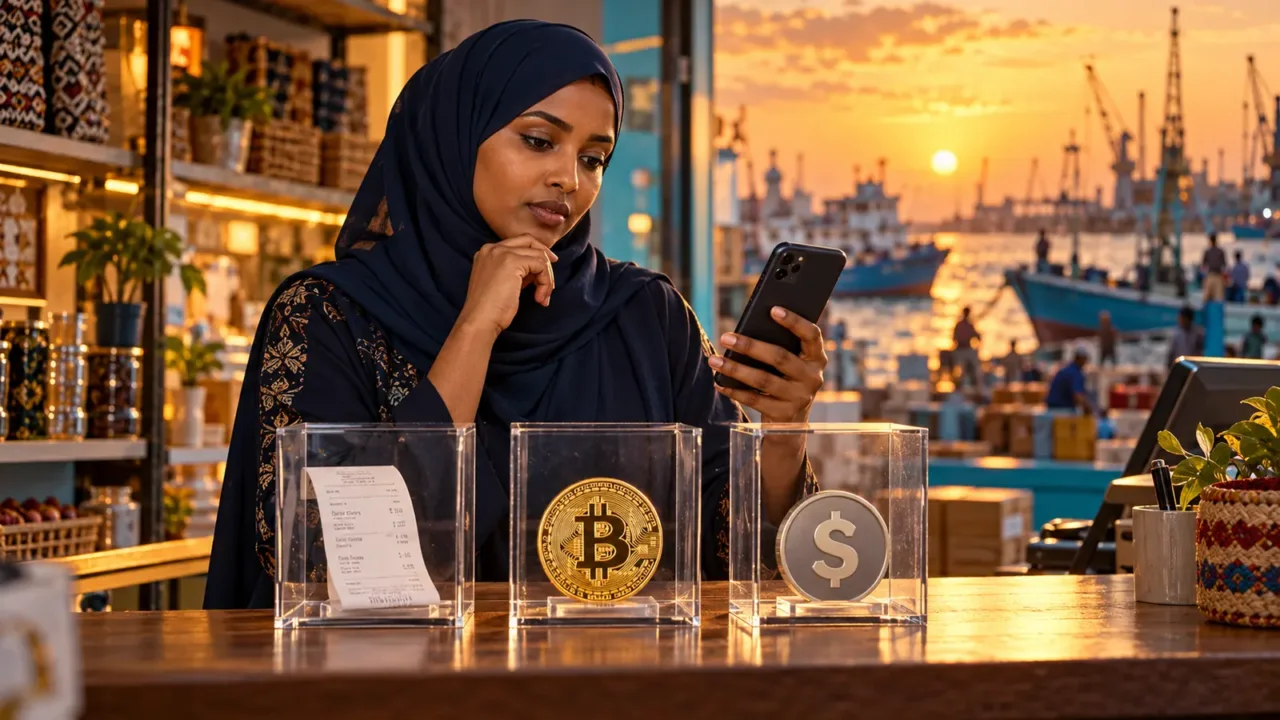
Crypto in Somalia comes with one essential precaution: do not confuse a payment made by phone with a transaction on a blockchain. A mobile-money balance, bitcoin and a stablecoin may all move through the same device while relying on different contracts, networks and parties responsible for them.
For individuals and merchants alike, this distinction changes how to calculate fees, preserve evidence and seek recourse. This guide examines possible uses without certifying that any platform is available to every resident or treating an operator’s presence in a payment-services register as crypto authorization.
In brief
- A phone is an access point, not proof of an asset’s monetary nature or authorization.
- The CBS crypto warning must be read in light of its date and scope.
- A useful comparison measures the amount ultimately available to the recipient, the timing and the parties’ responsibilities.
Crypto in Somalia: identify what the balance represents
The first step is to identify the asset. Our guide to crypto and mobile money explains why the payment channel alone is not enough to identify the product. An app may display dollars without providing access to cash, a bank deposit or a token transferable on a blockchain. You need to understand the contract connecting the user to the service.
The Central Bank of Somalia’s list of mobile-money providers includes Hormuud and Somtel, among others. This listing documents a payment sector identified by the CBS. It does not show that a seller contacted through a messaging service can receive funds and deliver BTC, nor that the operator guarantees such delivery. A single company may conduct several activities without their regulatory scopes being interchangeable.
Bitcoin relies on a distributed ledger and is an asset whose price fluctuates. A dollar-linked stablecoin targets a reference value but adds an issuer, redemption terms and, in some cases, the ability to freeze funds. Mobile money, meanwhile, depends on how the relevant service operates. These three instruments therefore do not face the same risks, even when their interfaces use the word wallet.
A simple check is to ask what can actually leave the account. An account statement, a mobile-transfer reference and a blockchain transaction ID answer three different questions. No single screenshot proves every step. For each balance, record its unit, the identity of any debtor, the transfer terms and the procedure to follow if access disappears.
Read the official position without assuming blanket permission
In its June 10, 2024 warning, the CBS stated that cryptoassets were not legal tender and that no provider had, at that time, received a license for such services. It advised against investing and trading. That dated wording should not be turned, by shortcut, into a current compliance endorsement for an international app or an individual.
Conversely, the absence of legal-tender status alone is not enough to establish a universal criminal prohibition on private ownership. A legal answer requires the rules applicable to the activity, the person and the territory concerned. The obligations of an intermediary that regularly collects funds cannot automatically be inferred from those of a user examining how a wallet works.
Before carrying out a real transaction, seek recent confirmation from the authorities and the provider. The research conducted for this guide does not allow us to certify a new, comprehensive crypto-licensing regime replacing that warning. This limitation narrows what we can recommend. It does not permit us to invent authorization or suggest a fictitious change of residence to open an account.
Territorial realities also require particular attention. Documentation concerning another administrative regime, currency or operator in the region cannot be transferred automatically. The Somali shilling identified by SOS should not, in particular, be confused with a quote expressed in another unit also called shilling. A commercial page’s geographic label does not resolve these differences.
Compare practical utility rather than technological promises
A family transfer, a supplier payment and a speculative investment serve different purposes. Before discussing blockchain, define the need: who must receive what amount, in which unit and by what date? A solution that adds more conversions may cost more than a conventional transfer service, even if its interface shows a very low network fee.
In its overview of the national payment system, the CBS describes the development of banking infrastructure and instant payments. This modernization does not require every transfer to become a crypto transaction. It mainly provides a benchmark: a new service should demonstrate a measurable improvement, rather than merely add technical terminology to a transaction that can already be completed another way.
Consider a hypothetical simulation that does not represent a current fee. Someone pays out 100 dollars, and the recipient can ultimately use 96 dollars after all the steps. The total cost reaches 4 dollars, or 4% of the initial amount. Showing only a 0.20-dollar blockchain fee would conceal the main issue. Our guide to the real cost of buying crypto in Africa helps structure this comparison.
Timing also carries a practical cost. Funds tied up when a bill is due may force the recipient to find an advance. That burden does not always appear in the technical record. Compare a completed transaction, with usable funds and retained proof, rather than two screens showing reassuring statuses while describing different stages of the process.
Choose an intermediary using limited but useful evidence
A well-known brand does not replace the identity of the company signing the contract. Record its legal name, address, governing law and complaints channel. Then check whether access genuinely matches your residence and intended use. A public page accessible from Somalia does not guarantee that an account can be opened, that your documents will be accepted or that withdrawals will be available.
To structure this comparison, the report on how to assess crypto platforms in Africa separates availability, status and operational quality. These criteria should not be artificially offset against one another. A fast withdrawal during a test does not make up for an untraceable contractual identity. Good French-language support is no more proof that competent assistance exists for a local dispute.
Reviews and reported volumes can guide research, but their limitations remain significant. A seller may have processed small amounts and fail on a larger order. Positive ratings may relate to another period or another product. Above all, ask for a written procedure for difficult cases: payment received without delivery, a suspended account, an unavailable network or a disputed refund.
When personal documents are collected, verify the recipient as well. The guide to KYC checks and remedies stresses that an identity request is not proof of legitimacy. Do not send your ID to a number found in a comment. Use the verified official domain, understand why the document is needed and never share a recovery phrase with someone claiming to be a compliance officer.
Plan custody and incident response before depositing funds
The user must decide who controls the keys that can move the assets. With a custodial service, the user depends on the intermediary’s rules and ability to process withdrawals. With self-custody, the user assumes responsibility for backup and access security. Our crypto wallet guide explains the difference without presenting either option as perfectly safe in every circumstance.
A lost phone can simultaneously affect messaging, authentication and the payment account. Concentrating every recovery method on the same device creates an additional dependency. Prepare an offline backup of relevant information, separate from everyday codes. Protecting a SIM card and protecting a recovery phrase are not the same process; an operator cannot reconstruct a lost Bitcoin key.
The incident file should remain easy to read. Keep the order, stated recipient, amount, time, payment receipt and, where available, the blockchain reference. Redact secrets before sending anything to support. An explorer may confirm movement on a network without identifying the author of a fraud or guaranteeing recovery. Technical traceability is one piece of evidence, not a judgment or insurance.
When something goes wrong, do not make a second payment described as an unlocking fee. A fraudster will often exploit the initial loss to demand more. Return to the service’s official channel, secure compromised access and document the exchanges. No legitimate support procedure requires taking control of your personal wallet through its secret backup.
Build a decision around the available budget
An experimental budget should not consume money needed for essentials. Before putting any funds at risk, separate housing, food, healthcare, debt and emergency savings. Receiving income in dollars does not turn a crypto investment into stable savings. Even an asset that tracks the dollar may temporarily become impossible to sell through the channel available to its holder.
A decision sheet can fit on one page: objective, maximum amount, verified service, unit, total cost, destination, exit route and incident contact. Add an explicit stop condition. For example, an identity that changes between the contract and the payment is enough to suspend the transaction. This rule prevents an alarming signal from being reinterpreted under pressure from the seller or community.
When evidence is missing, waiting is a rational decision. That does not mean rejecting all financial innovation. It means not entrusting an urgent need to a chain with an unknown step. Any potential economic benefit should appear in a verifiable outcome, after fees and delays, rather than in a promise of returns or the number of features on display.
To explore crypto in Somalia, start by mapping responsibilities. The phone facilitates access; the contract defines the service; the network records the transfer; the evidence explains the outcome. This separation helps you ask the right questions before making a payment and recognize situations in which no sufficiently documented route yet justifies putting your money at risk.