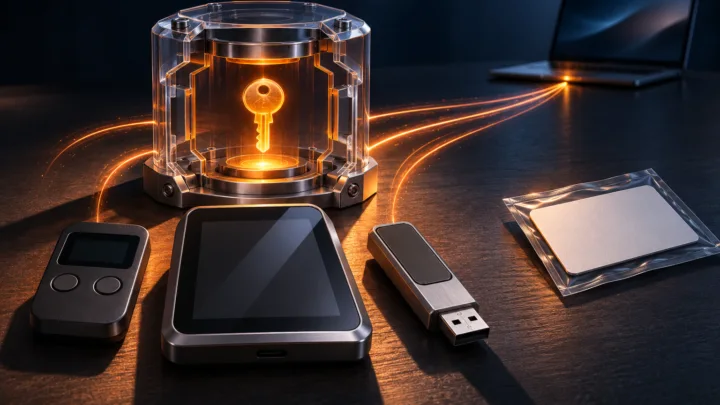
Ledger or Trezor in 2027: the question may sound simple, but each brand offers several models and different ways to back up access. A larger screen, wireless connectivity and a recovery method address different needs. None of these criteria replaces all the others.
This guide compares specific options based on official documentation reviewed on November 5, 2026. Prices and features for 2027 should be checked before purchase. The aim is not to name an outright winner, but to understand the trade-offs involved in a setup its owner can use and restore.
In brief
The article on the limitations of hardware wallets points out that a hardware device cannot protect users from every malicious signature. Comparing Ledger and Trezor means keeping this shared limitation in mind.
- A Nano S Plus and a Safe 3 do not represent all the features offered by their respective brands.
- Backup formats must be identified before preparing for recovery.
- An additional backup option may introduce dependencies that need to be understood.
Start with two models and a real use case
A useful comparison begins by defining its scope. Does the reader want to manage a Bitcoin reserve from a computer, use multiple assets or sign transactions regularly with a phone? A difference that matters for mobile use may be secondary for a reserve that is rarely moved. The need should therefore come before model selection.
Ledger’s official overview of its models distinguishes, among others, the wired Nano S Plus from devices offering other connections and larger screens. Trezor’s comparison page distinguishes the Safe 3, Safe 5 and Safe 7. These documents should not be reduced to a brand-versus-brand contest without specifying the devices involved.
An initial comparison could examine the Nano S Plus and Safe 3 for a computer-based setup. Another could focus on models with larger screens, such as the Ledger Flex and Trezor Safe 5. Their connectivity and features should not be assumed to be identical without consulting the specifications for the exact product.
Usage conditions matter too. A device must be comfortable for its owner to handle and read. The number of supported assets does not make up for a screen whose information the user cannot verify. An advanced feature that goes unused is not a demonstrated practical advantage.
The comparison should therefore maintain a profile for each model: device, computer or phone involved, software, assets, backup method and total budget. This gives the reader two genuinely comparable configurations. It also avoids comparing the price of a basic product with the features of the competing brand’s most expensive model.
Understand the architectures without reducing them to slogans
Ledger describes a Secure Element that protects keys and performs signing operations. For the Safe 3 and Safe 5, Trezor describes an arrangement in which a Secure Element contributes, among other things, to PIN protection, with a different allocation of functions. The presence of the same term does not prove that the architectures are identical.
Trezor’s documentation on Secure Elements details the role of the components in each model. These explanations should be read as the manufacturer’s technical documentation, not as an independent assessment conducted for this article. This guide does not calculate a probability of compromise based on the number of chips.
Open-source design is another dimension. It may enable public review, without guaranteeing that every user has examined the code or that no vulnerabilities remain. Hardware certification also applies to a specific scope; it does not automatically certify every contract the owner may choose to connect to.
The threat model makes these differences more concrete. An attack requiring physical access to the device cannot be directly compared with a fake website requesting the backup. Under certain conditions, the device may resist the first attack, then be bypassed if the owner personally discloses the secrets to the second.
Our guide to the self-custody wallet helps put this responsibility into perspective. Choosing a manufacturer means adopting a set of components, software and procedures. That system needs to be understood rather than replaced with a label supposedly offering freedom from vigilance.
Compare what the screen lets you verify
Transaction review is not limited to pressing a physical button. The owner must be able to read the relevant information, identify the account and verify the destination. Repeatedly confirming transactions by habit is not effective verification, regardless of the device’s price.
A larger screen may make details easier to review. It does not prove that the transaction matches the reader’s intention or that the contract is economically relevant. Ergonomics and the scope of the available information must be assessed separately from key isolation.
For a Bitcoin reserve, verification may include the address, amount and fees. When interacting with a contract, understanding the requested authorization becomes essential. The relevant software and asset workflow must be checked without extending a successful demonstration to every possible operation.
One simple question can usefully distinguish between configurations: what will the owner actually see before approving the operation they perform most often? If the answer remains unclear, a marketing table is not enough. It is better to study the documentation than to compensate for uncertainty with general trust in the brand.
Verification must remain possible under pressure. A fake support representative may announce an emergency or an essential update. The reader must know how to stop the process, find the official website and reject any request for the backup. The best interface does not eliminate this form of human manipulation.
Distinguish backup formats and options
Trezor’s documentation on backup formats distinguishes, among others, BIP39 and SLIP39 depending on the model and the choices made. The number of words and the actual procedure must be recorded. A backup should not be assumed to restore on any other device.
In its overview of recovery solutions, Ledger distinguishes the recovery sheet, Ledger Recovery Key and the Ledger Recover service. The physical card and subscription service are not the same mechanism. They should be assessed according to their own conditions and dependencies, rather than activated simply because they contain the word recovery.
An option involving service providers may change the trust model. A physical backup, meanwhile, requires a system for storage and access. Neither choice means that the risk has disappeared; its form has changed. The owner must understand what they will need to provide or recover if something is lost.
A passphrase introduces another distinction. The Trezor guide to passphrases explains that losing one may prevent access to the corresponding wallet, even with the correct backup. An advanced feature should therefore not be adopted solely to make the setup more complicated.
Threshold backup should not be confused with a multisignature policy. Our guide to the multisig wallet describes the latter approach. The owner must know what is required to recover the entire configuration, not merely possess several objects or multiple lists.
Check assets, software and the total cost of ownership
Asset support must be checked against the relevant model and software. The presence of an asset name on a page does not guarantee support for every operation on every network. The reader must distinguish between receiving, sending and interacting with applications. The interface used may also affect which features are available.
A reserve on a single network and regular use across several ecosystems involve different trade-offs. In the first case, ease of maintenance may carry considerable weight. In the second, the connections and signatures actually required must be examined without automatically exposing an entire reserve to every new application.
The purchase price is not the whole cost. Delivery, accessories, optional services and network operations should all be included in the budget. The article on crypto fees points out that owning a device does not make transfers free.
An honest comparison uses prices observed when the decision is made, under the same local conditions. This guide does not present a future promotion as guaranteed. A price difference may reflect a different screen or connection, without automatically establishing that a cheaper model would leave the keys unprotected.
Maintenance also deserves a plan: where to find official alerts, how to verify an update and what to do if the usual computer fails. A procedure documented before an incident helps avoid relying on the first person who offers to unlock the device in exchange for the recovery phrase.
Choose controlled recovery over a winning brand
The comparison can ultimately be reduced to a few verified answers. Does the model work with the intended device? Are routine operations readable? Does the owner know the backup format and recovery dependencies? Are the required assets actually supported in this configuration?
Before receiving a significant reserve, the owner should follow the official setup process, create the backup personally and use the available checks. A preconfigured device or words supplied by a third party is not an acceptable foundation. The testing procedure should not expose secrets to an unknown computer or website.
Ledger or Trezor in 2027 therefore cannot be settled with a verdict that applies to everyone. Two models may suit different needs while leaving human risks in place. The consistent choice protects the keys, makes signatures understandable and enables prepared recovery, without relying on a promise of invulnerability.