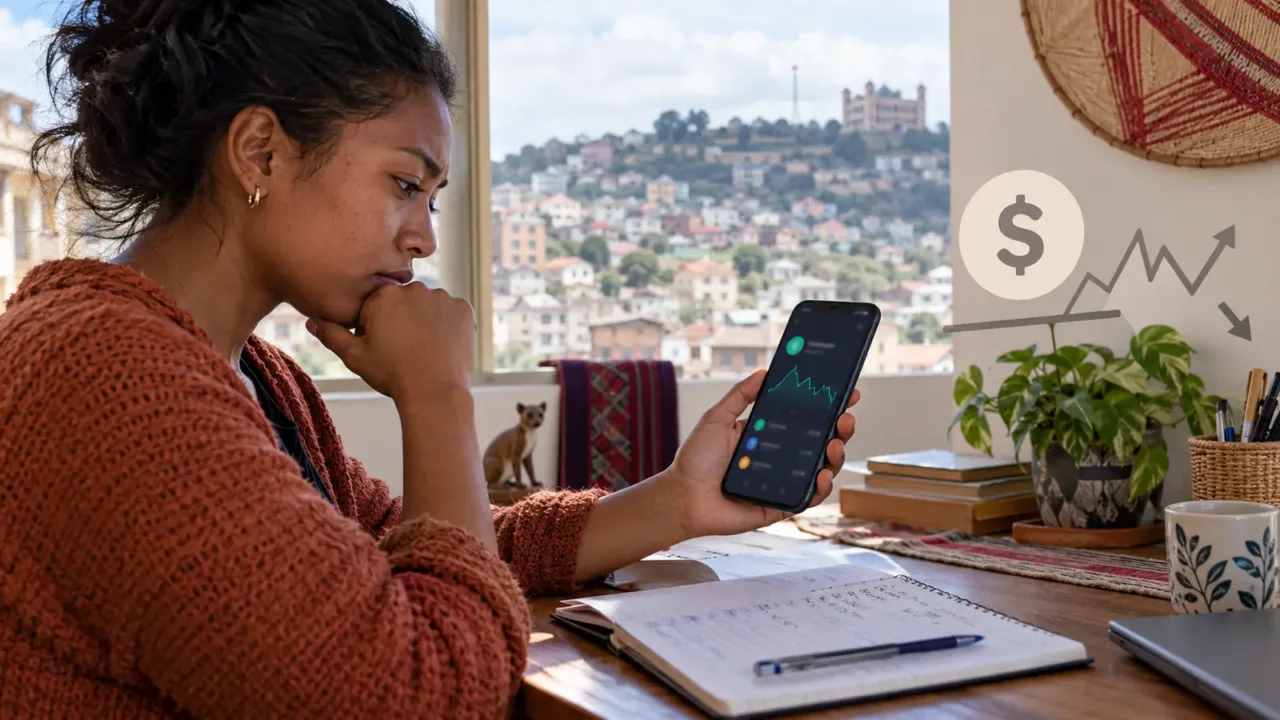
USDT is often presented as a way to hold an asset whose value is close to the dollar from Madagascar. That description overlooks several steps: the token’s price in a local offer, conversion into ariary, fees, the network used and the practical ability to sell or withdraw. A stablecoin therefore eliminates neither foreign-exchange risk nor intermediary risk.
Before considering a transaction, compare the advertised price with the amount actually received and the exit conditions. A figure shown in an app does not guarantee that the equivalent amount can be withdrawn in ariary at the same rate.
In brief
- USDT is designed to track the dollar, but it is not an official Malagasy currency or a deposit guaranteed by the state.
- The ariary price combines the token’s price, the exchange rate, the spread and the operator’s fees.
- Direct redemption through Tether comes with requirements and a high minimum; many users therefore depend on an intermediary to enter or exit the market.
The peg targets the dollar, not the ariary
USD₮, commonly known as USDT, is a token issued by Tether and designed to correspond to the US dollar under the issuer’s terms. That target does not mean every user can immediately obtain one bank dollar for each token. The price observed on a platform reflects supply, demand, liquidity and the conditions for accessing the service.
The total cost of buying crypto in Africa provides a useful framework for isolating the spread, commissions and withdrawal fees. For calculations in local currency, date the rates and avoid mixing quotes taken at different times.
To estimate a value in ariary, start with the dollar price and the exchange rate applicable on the transaction date. BFM publishes reference rates on its monetary and exchange-rate policy page. Its rate helps establish an arithmetic benchmark, but it is not necessarily the rate at which a particular crypto offer will execute.
If one USDT is worth one dollar in a given market and the exercise uses a hypothetical rate of 4,500 ariary per dollar, the theoretical conversion is 4,500 ariary per token before margin and fees. This is an educational example, not a current quote or an offer to sell in Madagascar. A P2P seller’s advertised price may exceed that amount, or move in the other direction depending on liquidity and the payment method.
The ariary value therefore depends on two prices: the USDT/USD ratio and the USD/MGA ratio. If the ariary depreciates against the dollar, a dollar-denominated unit may represent more ariary. But if USDT moves away from the dollar, or an intermediary applies a spread, the local result changes again.
An advertised peg does not prove an individual right of redemption
Tether’s official terms explain that issuance and redemption are subject to its service conditions, customer verification, minimums and fees. Tether’s legal terms state that the tokens are not legal tender and do not benefit from public insurance or a government guarantee.
Tether’s page on redeeming tokens for fiat currency states that the minimum redemption amount is the equivalent of 100,000 dollars and requires a verified account. The official fee schedule also lists a redemption fee equal to the greater of 1,000 dollars or 0.1%, along with a verification cost. These conditions may change; check them directly before relying on the possibility of redeeming through the issuer.
This minimum is far above the amounts held by most individual users. Many holders therefore do not redeem directly through Tether. Instead, they depend on a platform, market maker, P2P seller or service willing to convert the token. The quality of that exit depends on the intermediary and its liquidity, not solely on the issuer’s parity claim.
Do not confuse a reserve display, a periodic report and a guarantee of immediate payment. Tether publishes information about its reserves, but its terms specify who may request redemption and under what process. A buyer on the secondary market does not automatically become a direct customer of the issuer.
Calculating the net cost of the transaction
For a useful comparison, record the total amount of ariary debited and the net number of tokens received. Add any deposit, transaction, conversion and withdrawal fees. Then calculate the actual unit price paid. An offer stating “1 USDT = 1 USD” does not show the final cost in ariary when the seller’s spread remains hidden.
Consider a hypothetical example: a user spends 200,000 ariary. The quote indicates 42 USDT, but the operator deducts a commission and applies a local rate above the exchange-rate benchmark. The value of those 42 tokens must be compared with the total amount debited, not just with the global average price. Without the net quantity and a detailed fee breakdown, the offer cannot be properly compared.
Also analyze the reverse sale. How much ariary will you receive if you sell 42 USDT back to the same service? What is the minimum withdrawal amount? Which documents are required? Local sales may be less liquid than purchases, and the buyer may impose a verification delay. Anyone planning a short-term withdrawal should confirm these conditions first, without committing money needed for everyday expenses.
The network transfer creates another cost. It depends on the blockchain selected and the platform’s policy. A withdrawal to an external address may cost more than an internal transfer. Network fees are not necessarily fixed and are not always charged by Tether itself.
Choosing the right network and destination
USDT exists across multiple protocols. Tether’s official list of supported protocols includes ERC-20 on Ethereum, TRC-20 on Tron, Solana and several other networks. Two tokens bearing the USDT symbol on different chains do not necessarily share the same deposit format.
The network selected for a transfer must exactly match the network accepted by the receiving service. Also check the address, the network shown on the deposit screen and the minimum amount. If any of these details differs, the asset may not be credited automatically. Support may sometimes review the case, but there is no obligation to recover the funds.
Do not choose a network solely because the displayed fees appear lower. The recipient must support the token on that network, and you must be able to use or convert it afterward. A transaction can succeed on the blockchain and still fail at the service that was supposed to credit it.
For a first transfer, a small test transaction can help validate the address and network when the fees make that approach reasonable. Record the transaction hash and wait for sufficient confirmation. Never share your recovery phrase with the person providing the address.
Distinguishing USDT, electronic ariary and official currency
USDT remains a claim or token defined by the issuer’s terms and transferred on a blockchain. It is not an ariary banknote, MVola electronic money or the eAriary proposed by Banky Foiben’i Madagasikara. These instruments may all appear on a phone, but their issuers, protections and transfer mechanisms differ.
When comparing a locally offered price, separate the exchange-rate reference from the quote applied by the seller. The same method applies to USDT, without assuming that a dollar-stable token maintains a fixed price in ariary.
The payment method does not change this distinction. The guide to buying cryptocurrency with mobile money shows why the local transfer and delivery of a stablecoin remain two separate steps. To understand who controls a balance, also read our guide to wallets and private keys, along with the precautions related to crypto KYC.
Malagasy Law No. 2016-056 governs electronic money institutions. MVola’s terms define the account as an electronic-money service with its own fees, limits and complaint procedures. Buying USDT in ariary through a mobile service combines two services; it does not turn that mobile wallet into a crypto exchange.
Similarly, Law No. 2023-026 brings virtual assets and VASPs within Madagascar’s AML/CFT framework, as explained by the SAMIFIN glossary. The definition of a virtual asset does not guarantee that a particular token is authorized as a means of payment or that a platform holds a local license.
Assessing the issuer and counterparty
Tether says the tokens are backed by reserves and publishes periodic information about them. These statements should be read in light of their date, scope and the nature of the report provided. The reserves may include different categories of assets. The phrase “100% backed” in the issuer’s terms is not public insurance, a guaranteed bank deposit or an instant repayment right for every holder.
Also assess the risk of the application holding the tokens. An exchange may suspend withdrawals, impose an additional review or suffer a technical incident. If you control the keys yourself, you reduce dependence on a custodian but assume responsibility for safeguarding them and the risk of an irreversible mistake.
Before buying, check the company name, its country of contract, support channels and exit terms. Our guide to criteria for choosing a crypto platform helps distinguish a license, registration and commercial access. A popular app does not prove that the provider is supervised in Madagascar.
Be wary of offers promising conversion at a guaranteed fixed rate, a monthly return or immediate withdrawal without checks. Scammers reuse the word “stable” to present a risky investment as a safe deposit. No stablecoin eliminates counterparty, network, liquidity, regulatory or fraud risk.
What users should decide before converting their ariary
Write down the purpose of the transaction: dollar exposure, cross-border payment, temporary holding or transfer to a recipient. These uses do not necessarily require the same network or intermediary. If the goal remains an ordinary payment in ariary, a regulated electronic-money account may sometimes be simpler than using a stablecoin.
Compare the entry price and the available exit at the same time. Check the limits, fees, refund currency and the person receiving the funds. Keep the quote and supporting records. Transfer only an amount whose risks you can afford, and do not finance the purchase with a loan or money needed for an urgent expense.
Ultimately, USDT can provide digital exposure close to the dollar, but its use in Madagascar remains dependent on the market, the network and the intermediary. The targeted peg is neither a guaranteed ariary exchange rate nor an immediate conversion into cash. Controlling the total cost and the exit path matters more than an abstract promise of stability.