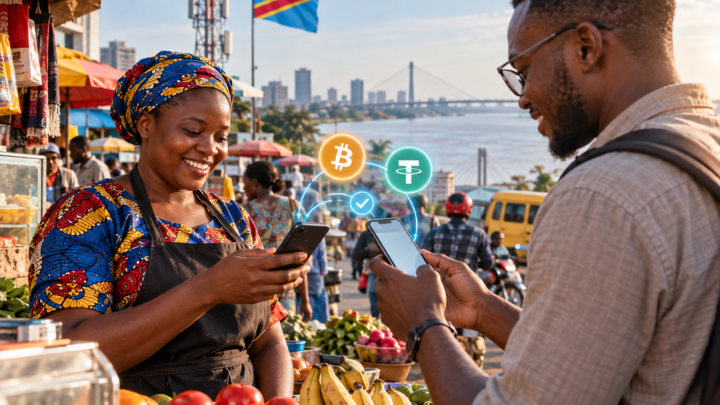
Stablecoins are stepping in
In South Africa, Bitcoin-related volumes no longer resemble those seen in 2019 or 2020. Carel de Jager, head of blockchain analytics firm Sixpence, says they now represent only a fraction of their former levels, while overall crypto activity has remained relatively stable. Stablecoins have filled part of the gap.
This trend aligns with what BrefCrypto recently observed: nearly 27 billion rand worth of USDT moved across three major South African platforms in one year. This is no longer solely about traders waiting for the market to rise.
Businesses and individuals use these digital dollars to transfer money, settle transactions and gain easier access to international payments.
The trend is also visible in Chainalysis’ global data. Despite an approximately 50% drop in crypto market capitalization during the period studied in 2025–2026, global on-chain economic activity declined by only 1.6%. Most importantly, 96% of the P2P activity measured by Chainalysis now runs through stablecoins.
Prices have suffered. Payment rails much less so.
African banks are starting to follow
Absa is no longer merely observing these transactions.
The bank has developed its own stablecoin, which has not yet been commercialized, with potential uses including business-to-business transactions. It also holds the rand reserves backing ZARsc, a stablecoin issued by Supercoin. Several million rand worth of ZARsc are reportedly already in circulation, with the reserves held in separate accounts and independently verified.
The shift is significant for Africa’s banking sector. A few years ago, crypto was primarily an asset operating outside its infrastructure. Banks are now seeking to understand how to integrate these new rails into foreign exchange, international trade and settlement.
On the ground, fintechs are moving even faster. DCS Pay and Kotani Pay, for example, are preparing to convert USDT and USDC into local currencies across six African markets, with connections to mobile money, USSD and domestic payment systems.
However, this progress creates a new problem for central banks. A dollar stablecoin can bypass some of the frictions of the traditional financial system while circulating a foreign currency in a much more accessible form.
Regulation is therefore beginning to catch up with usage.
Bitcoin is losing speculation, not its role
Still, saying that stablecoins are replacing Bitcoin would be an overstatement.
The two assets do not serve the same purpose. Bitcoin continues to be used as an investment asset, an alternative store of value and a means of transfer. A stablecoin, by contrast, seeks to maintain a relatively constant value. Buying USDT at $1 and selling it at $1 offers virtually no speculative appeal. Its value emerges when that dollar needs to be moved.
That is precisely what gives the African figures their significance.
Nigeria already accounts for around 60% of stablecoin inflows into sub-Saharan Africa. International transfers, trade, access to dollars and protection against currency depreciation are driving this demand. The IMF is also concerned about the risk of digital dollarization that this adoption could create.
The testimony gathered by Moneyweb now adds another piece to the picture: Absa’s corporate clients are already using these assets and asking the bank directly about integrating them into foreign exchange and trade finance operations.
This changes how crypto adoption in Africa should be understood. Looking only at Bitcoin trading volumes can create the impression of a market that is slowing. Looking at stablecoins tells almost the opposite story.
Bitcoin remains the sector’s emblematic asset. But when it comes to sending money, paying a business or moving dollars between two African countries, stablecoins are beginning to become the infrastructure users were looking for all along.