Bitcoin: Strategy suspends purchases and buys back $176 million of STRC
Strategy retains 845,050 BTC but spends $176.3 million to buy back STRC and doubles its preferred-securities repurchase program to $2 billion.

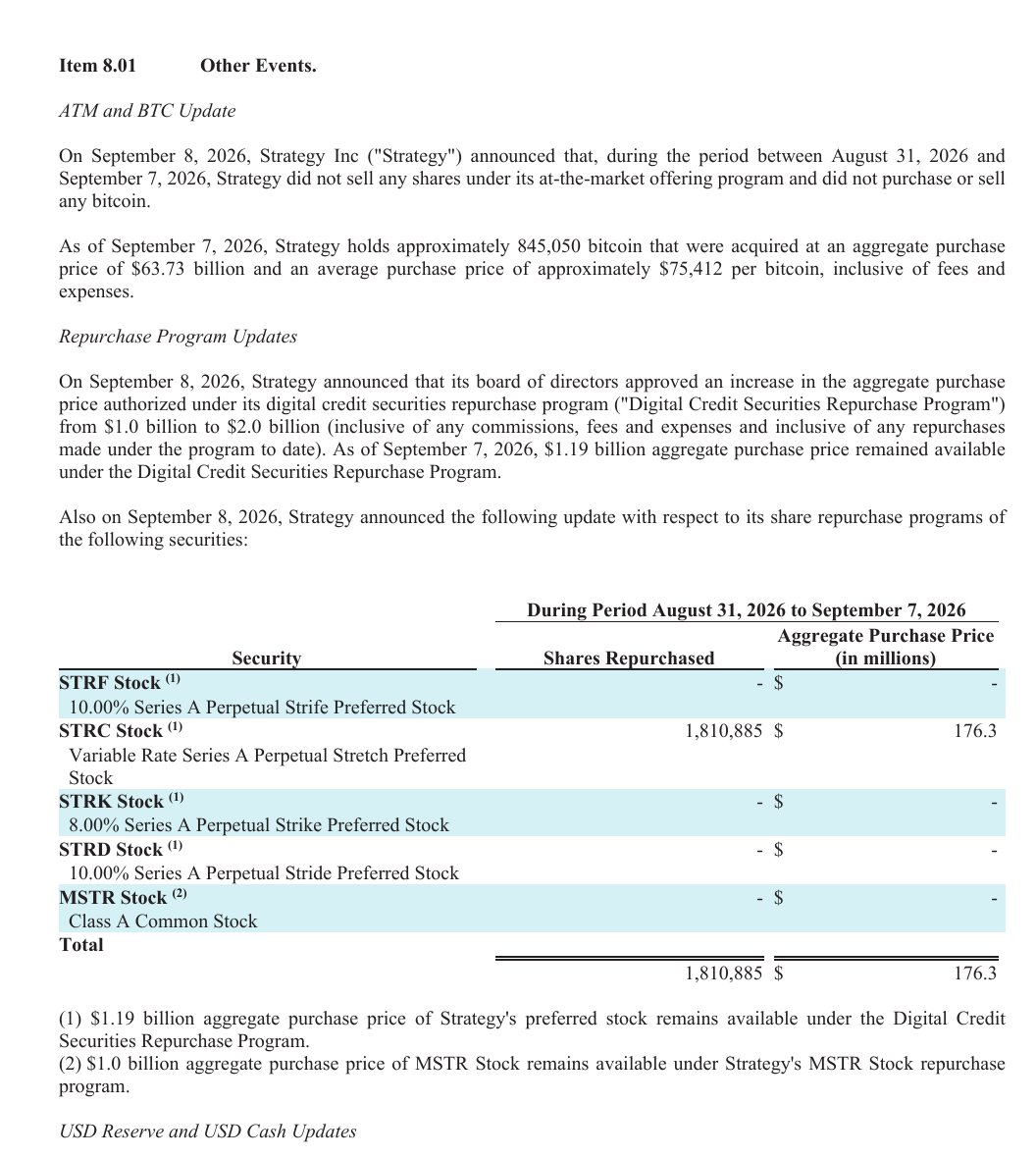
Strategy neither bought nor sold any bitcoin between August 31 and September 7. After resuming purchases a week earlier with 4,603 BTC, Michael Saylor’s company now holds 845,050 BTC acquired for $63.73 billion. Capital has taken a different direction: Strategy spent $176.3 million to buy back 1.81 million STRC preferred shares and doubled its “Digital Credit” securities repurchase program to $2 billion.
Bitcoin on hold as Strategy turns to STRC
The change comes just after a fairly unusual sequence of events. Bref Crypto showed how Strategy sold Bitcoin around $62,500 before buying back 4,603 BTC at $80,318. This time, there was no BTC transaction.
The Form 8-K filed by Strategy also specifies that the company sold no MSTR shares through its ATM program during the week. Its holdings remain at 845,050 BTC, acquired at an average price of $75,412.
Instead, $176.3 million in cash was used to buy back exactly 1,810,885 STRC shares.
The average price was approximately $97.36 per share, based on the amount spent and the number of shares repurchased. STRC, however, has a stated value of $100. Strategy is therefore buying back its own securities at a discount of approximately 2.6%.
This is not as dramatic as buying several thousand bitcoins. Financially, however, the transaction may be more attractive in the short term.
Strategy had already explained in July that its STRC buybacks became attractive when the stock traded below $100, as they reduce future dividend obligations at a price below par.
The buyback could save more than $20 million in annual dividends
STRC is not a regular Strategy share.
It is the Variable Rate Series A Perpetual Stretch Preferred Stock, a perpetual preferred security designed to generate relatively stable income. Strategy had raised its annual dividend rate to 12% and said it intended to maintain it at that level until STRC established itself sustainably around $100.
This makes it possible to measure the benefit of the buyback.
The 1.81 million STRC shares retired represent approximately $181.1 million in nominal value. At a 12% rate, these securities theoretically correspond to nearly $21.7 million in annual dividends.
This calculation assumes that the rate remains at 12%. Since STRC has a variable rate, the actual savings will change with Strategy’s future decisions. It nevertheless gives an indication of what the company is buying with its $176.3 million: not just its own shares, but also the elimination of part of its future expenses.
This is also why Strategy has just doubled the authorization for its Digital Credit Securities Repurchase Program from $1 billion to $2 billion. After the buybacks already completed, $1.19 billion remains available.
Bref Crypto had already observed that Wall Street was reassessing Strategy as STRC rebounded. The group is now showing that it is prepared to support this market itself when it considers its preferred securities undervalued.
This is an important shift: Saylor’s company is no longer automatically allocating every available dollar to Bitcoin.
Strategy is becoming a financial machine built around Bitcoin
The balance sheet helps explain this new logic.
As of September 7, Strategy had $5.10 billion in its USD reserve and $1.44 billion in “USD Cash”, or approximately $6.54 billion in total. The $176.3 million used for STRC came specifically from this second pool, rather than from the reserve primarily intended for preferred-share dividends and debt interest.
Bitcoin nevertheless remains at the center of the structure. With 845,050 BTC, Strategy remains by far the largest publicly traded holder of the cryptocurrency. Michael Saylor continues to defend Bitcoin as a commodity distinct from the rest of the crypto market.
What is changing is how this enormous reserve is managed.
For a long time, the Strategy model could almost be summed up as raising capital and then buying more BTC. In 2026, it is necessary to add Bitcoin sales, a dollar reserve, several classes of preferred shares, repurchase programs and active management of the cost of capital.
This week’s pause therefore does not mean that Saylor is abandoning Bitcoin. A single week without a purchase would in any case be insufficient to indicate a change in conviction.
It reveals something more interesting: Strategy is now comparing the purchase of one additional bitcoin with the return it can obtain by buying back its own financial obligations at a discount.
At $97, STRC won the week. The next allocation could perfectly well return to bitcoin.
À propos de l’auteur

Guy Gomez
Guy Gomez est analyste et journaliste spécialisé en cryptomonnaies chez BrefCrypto. Ses articles se distinguent par une lecture experte des marchés, intégrant cycles, psychologie des investisseurs et rapports de force macro-économiques. Il analyse avec précision les enjeux réglementaires internationaux, en évaluant leur impact concret sur Bitcoin, les altcoins et l’adoption institutionnelle. Guy Gomez accorde une place centrale aux risques systémiques et à la sécurité, en décortiquant les mécanismes de fraude, d’ingénierie sociale et les erreurs récurrentes des investisseurs. Il apporte enfin un regard stratégique sur l’Afrique, où il étudie l’équilibre entre régulation, souveraineté financière et usages réels des crypto-actifs.