Crypto: CLARITY Act Still Short of Senate Votes
Several Republicans warn that the CLARITY Act could fail on September 15 unless a compromise is reached on ethics rules.

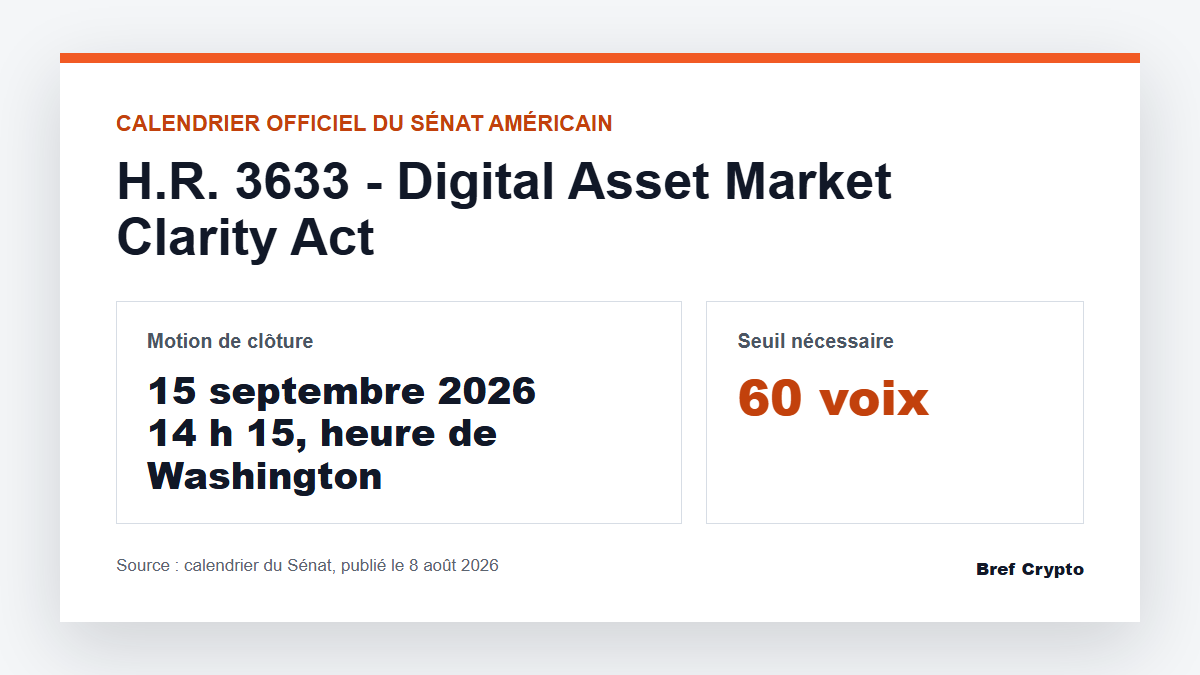
The CLARITY Act faces its procedural vote on September 15 at 2:15 p.m. in Washington, but several Republican senators now acknowledge that the 60 votes needed have not been secured. Mike Rounds says the situation “does not look good,” while Thom Tillis warns that the bill will fail unless the White House and Democrats reach a compromise on ethics rules surrounding the president’s and his family’s crypto interests. The Senate’s official schedule confirms that the cloture motion on H.R. 3633 will indeed expire next Tuesday.
Crypto: the 60-vote problem returns to the forefront
The situation has deteriorated significantly in just a few days. Bref Crypto had already reported that Cynthia Lummis viewed 2030 as the next real window if the bill failed this year. This time, the warning comes from senators directly involved in the negotiations.
Mike Rounds, a Republican from South Dakota and a member of the Banking Committee, considers the outlook poor. Thom Tillis goes further: without movement from the White House on the ethics provisions, “it is going to fail.” Tillis has been working for several months with Democrat Ruben Gallego on a bipartisan compromise.
The parliamentary math explains the nervousness. Republicans control 53 seats, while the cloture motion requires 60 votes. Even assuming perfect Republican discipline, seven additional votes are needed.
That assumption is itself fragile. Galaxy Research had already identified Josh Hawley and Rand Paul as two likely Republican defections. If they materialize, the bill’s supporters will have to win over more Democrats.
The contrast is significant: in May, the Banking Committee approved the bill by 15 votes to 9. The House had previously passed it by 294 votes to 134, with 78 Democrats in favor. Bipartisanship therefore exists. It is simply not yet broad enough in the Senate.
Ethics surrounding Trump still blocks a compromise
The disagreement is no longer primarily about the need for a U.S. crypto framework. It is focused in particular on conflicts of interest, despite the White House’s attempts to unblock the CLARITY Act’s ethics provisions.
Democrats are calling for stronger restrictions to prevent a president and his family from financially benefiting from crypto activities while in office. The issue has become particularly sensitive because of the TRUMP memecoin and the presidential family’s involvement in World Liberty Financial.
A proposal negotiated this summer notably barred certain public officials and their spouses from issuing or sponsoring digital assets, without applying the same restrictions to all members of their families. This distinction remains one of the main points of friction.
The White House nevertheless continues to publicly support the CLARITY Act. A spokesperson says Donald Trump wants Congress to pass the bill so that the United States remains competitive with other jurisdictions. Supporting the bill in principle, however, is not enough to produce the compromise required on its content.
The situation had briefly appeared to improve when the National Sheriffs’ Association moved from opposition to neutrality. Law enforcement agencies had been particularly concerned about certain provisions involving DeFi and illicit finance. Their shift to a neutral position removed one obstacle. It did not resolve the political deadlock in the Senate.
Other tensions also remain over rewards paid on stablecoins and the role of state attorneys general.
September 15 becomes a vote on the bill’s survival
Next Tuesday’s vote will not yet be the final vote to pass the CLARITY Act.
It is a cloture motion on the motion to proceed to consideration of the bill. Securing 60 votes would limit obstruction and allow the process to continue. If successful, further debate and votes would follow before any possible passage. The Senate’s official schedule sets this step for September 15 at 2:15 p.m. Washington time.
Time is nevertheless becoming extremely short as the midterm elections approach.
That gives greater weight to Lummis’s warning and to the one Tillis issued today. A procedural failure would not legally mean that all U.S. legislation on crypto market structure is impossible until 2030. Politically, rebuilding the same coalition after the elections could take years.
The industry is therefore pushing in the final stretch. Circle already describes the CLARITY Act as the missing piece of the U.S. regulatory framework following the passage of the GENIUS Act on stablecoins.
And yet, seven days before the vote, the problem is no longer convincing the crypto industry to support the reform.
It is convincing enough senators.
The CLARITY Act passed the House with a comfortable majority and the Senate Banking Committee with a bipartisan vote. Passage through the Senate now shows the limits of that coalition: without an agreement on ethics, 60 votes remain out of reach.
À propos de l’auteur

Mosengo Léon
Mosengo Léon est un analyste crypto et rédacteur pour BrefCrypto.com, reconnu pour ses analyses approfondies des marchés Bitcoin et cryptomonnaies, l’impact des événements structurants comme les crises et levées de fonds, et sa capacité à rendre accessibles les enjeux techniques et économiques de la blockchain pour investisseurs et passionnés