Four radically different prices. Four equally different valuation mechanisms.
The crypto market as a whole currently represents around $3.03 trillion, with Bitcoin dominance close to 57%. Stablecoins alone account for approximately $308 billion.
These figures are likely to continue changing significantly through 2027.
To understand cryptocurrency values, you therefore need to look beyond the price shown in an app. How many units exist? How many will circulate in the future? Who wants to buy them? Does the token have a use case? Is the network being used? Can holders sell easily? Does the crypto generate revenue? Is its supply shrinking or increasing? Is there a central company, community or protocol responsible for maintaining its economic model?
A Bitcoin priced at $86,000 can therefore be economically “cheaper” than a token priced at $0.10.
It all depends on what those figures represent.
Cryptocurrency values: price and value are different
The first step is to distinguish between price and value. The BrefCrypto glossary of the crypto ecosystem helps explain the difference between coins, tokens, market capitalization, supply and blockchain networks.
Price is simply the amount at which one unit is currently changing hands.
If a buyer agrees to pay $1,000 for an asset and a seller accepts that price, the market’s latest price becomes $1,000.
That does not mean every existing unit could be sold for $1,000.
Economic value is harder to define.
For Bitcoin, it may come from scarcity, network security, global liquidity and demand for an independent monetary asset.
For ETH, you also need to consider Ethereum usage, staking, gas, DeFi and collateral.
For a DeFi token, protocol revenue may also be relevant.
For a stablecoin, value depends primarily on its ability to maintain its peg and be redeemed.
Value is therefore not a single data point.
The market is constantly trying to translate all this information into a price.
It can be wrong.
Investors can be wrong too.
That uncertainty is precisely what creates a market.
Why is Bitcoin worth more than $80,000?
Bitcoin is probably the clearest example of why a crypto’s value does not necessarily depend on a company’s earnings.
BTC pays no dividends.
There is no Bitcoin revenue figure.
No CEO publishes quarterly results.
Its proposition is different.
The Bitcoin protocol imposes a limited and predictable issuance schedule. Approximately every 210,000 blocks, the subsidy paid to miners is cut in half. It currently stands at 3.125 BTC, before falling to 1.5625 BTC at the next halving, expected around 2028. Total supply is gradually approaching a maximum of 21 million BTC.
Scarcity alone would obviously not be enough.
Anyone can create a token limited to ten units. Without demand, those units are worthless.
Bitcoin’s value comes from the combination of limited supply and global demand.
Investors buy it.
Companies hold it.
Funds gain exposure through ETFs.
Miners devote energy to securing its network.
Users can transfer BTC without seeking permission from a central bank.
As of September 23, 2026, approximately 20 million BTC are circulating, with a combined value of more than $1.7 trillion.
Scarcity works because a vast market exists behind it.
A $0.01 token can be worth billions
Unit price probably creates one of the biggest illusions in the crypto market.
A crypto is priced at $0.01.
Bitcoin is worth $86,000.
A beginner may conclude:
“The first one is cheaper.”
That is not necessarily true.
Suppose it has 500 billion tokens in circulation.
At $0.01, its market capitalization already reaches $5 billion.
Now suppose another crypto is worth $500, with only one million units.
Its market capitalization is just $500 million.
The $500 asset is therefore ten times smaller economically than the one-cent token.
That is why expecting a $0.01 token to reach “just $1” can sometimes be completely unrealistic.
In our example, a move from $0.01 to $1 would increase market capitalization from $5 billion to $500 billion.
The price would have risen 100-fold.
The project’s economics would need to justify an additional $495 billion in valuation.
The number of decimal places is irrelevant in itself.
Cryptocurrencies are divisible.
You can buy $20 worth of BTC without buying one full Bitcoin.
Comparing cryptocurrency values therefore starts with market capitalization, never with the price of a single coin alone.
Market capitalization puts prices into context
A cryptocurrency’s market capitalization is its price multiplied by its circulating supply.
CoinGecko summarizes the formula as follows:
market capitalization = circulating supply × current price.
The platform also emphasizes a crucial point: market cap does not represent the amount of money actually invested in a crypto. It is primarily used to measure and compare the relative size of assets.
As of September 23, 2026, Bitcoin is worth approximately $1.73 trillion.
Ethereum approximately $334 billion.
Solana is approaching $70 billion.
These figures enable a much more useful comparison than $86,000, $2,737 and $118.
Bitcoin is not 31 times larger than Ethereum simply because its unit price is roughly 31 times higher.
Its market capitalization is currently just over five times larger.
That is the meaningful comparison.
For a large-cap asset to rise tenfold, it must attract far more value than a small-cap asset.
That explains why micro-caps can rise extremely quickly.
And why they can collapse just as quickly.
Market capitalization is not billions in cash
One subtlety deserves further explanation.
Imagine a token with one billion units in circulation.
Its price is $1.
Market capitalization: $1 billion.
That does not mean holders could all sell their tokens and collectively recover $1 billion.
To sell, there must be a buyer on the other side.
If available buyers disappear, the price falls.
Suppose the first sellers receive $1.
Then $0.95.
Then $0.80.
Then $0.50.
Market capitalization is recalculated each time the price changes.
When the token trades at $0.50, its market capitalization is only $500 million.
The market has not necessarily “removed” exactly $500 million.
The latest price has simply fallen by half.
This mechanism is particularly important for smaller cryptocurrencies.
A token can show an impressive market capitalization while having an extremely thin order book.
The way crypto exchanges work shows why actual liquidity matters as much as the theoretical value displayed.
A $10 billion market with several billion dollars in daily volume is not comparable to a $10 billion market where only a few million dollars actually change hands.
FDV shows the potential value of the entire supply
Market cap answers the question:
how much are the tokens currently in circulation worth?
Fully Diluted Valuation, or FDV, asks a different question:
what would the entire supply be worth if every token had the current price?
The difference can be enormous.
Take a project with 100 million tokens in circulation priced at $2.
Market capitalization: $200 million.
But its maximum supply is one billion tokens.
FDV: $2 billion.
The market appears to value the project at only $200 million.
In reality, it is already valuing every potential token at $2.
The remaining 900 million tokens simply have not entered circulation yet.
CoinGecko rightly points out that market cap and FDV must be distinguished when a significant portion of the supply remains locked.
In 2027, this metric will be particularly important for young Layer 1 networks, DeFi projects and venture-backed tokens.
A low market capitalization can make a crypto appear cheap.
An FDV ten times higher tells a less comfortable story.
You then need to examine when the new tokens will actually be released.
Vesting spread over thirty years is not the same as a massive unlock expected in three months.
Future supply can weigh on price
The amount of cryptocurrency available is not always fixed.
Bitcoin continues to issue new BTC.
Ethereum rewards validators while also destroying some ETH.
Younger projects sometimes distribute tokens to teams, investors, foundations or communities according to precise schedules.
These are known as unlocks.
An unlock does not automatically trigger a decline.
It simply makes more tokens available.
What happens next depends on what their owners decide to do.
Imagine a private investor who obtained a token at $0.05 before launch.
The market now values it at $2.
The position shows a 40x multiple.
When the investor’s vesting period ends, they may decide to keep the tokens.
They also have a strong financial incentive to take some profits.
Public-market investors need to know this information.
An analysis of a crypto’s value should therefore look at least at three figures:
circulating supply;
total or maximum supply;
issuance schedule.
The supply visible today is only a snapshot.
The 2027 price will be formed using the supply that exists in 2027.
This difference is crucial for recent tokens.
It matters much less for a mature asset whose planned supply is already almost entirely circulating.
Ethereum has a more dynamic monetary value
Ethereum illustrates another way to create scarcity.
ETH does not have a fixed cap comparable to Bitcoin’s 21 million.
Its supply is dynamic.
Ethereum creates new ETH to reward Proof-of-Stake validators. At the same time, EIP-1559 destroys part of the fees paid for transactions.
Ethereum.org explains that the balance between these two forces determines whether total supply increases or decreases over a given period.
When activity is high, burns can increase.
When the network is less heavily used, issuance can exceed burns.
This mechanism makes ETH very different from BTC.
Its value also depends more heavily on utility.
ETH is used to secure Ethereum through staking.
It is used as collateral.
It powers several DeFi markets.
It plays a role in the Layer 2 ecosystem.
It is used to settle transactions on the blockchain.
On September 23, approximately 122.1 million ETH were in circulation, with a combined value approaching $334 billion. Daily volume exceeded $15 billion.
To understand Ethereum’s value in 2027, simply looking at its supply would therefore be insufficient.
You also need to examine how much ETH the Ethereum economy requires.
Utility creates demand when it is real
A crypto can have a limited supply without being worth much.
Demand must exist.
Utility is one possible driver of that demand.
Take a Layer 1 network.
Its token may be required to pay gas fees.
Validators may stake it.
It may serve as collateral in DeFi.
It may be used in liquidity pools.
As the network grows, these uses can create structural demand.
But the term “utility token” is extremely easy to misuse.
A project can create an artificial function for its token simply so it can claim that the token has utility.
“You must pay for our subscription with TOKEN X” is not necessarily a good model if everyone would rather pay in USDC.
The real question is:
why does the token need to exist?
And then:
if more people use the product, do they need to hold more tokens?
This question is central to the different cryptocurrency categories and their narratives.
A network can achieve impressive adoption without its token properly capturing that growth.
Product usage and token value are connected.
They are not always identical.
Revenue changes the way DeFi tokens are analyzed
Some protocols now have economies mature enough to discuss fees and revenue.
DefiLlama distinguishes between several metrics.
Fees are the total fees paid by users.
Revenue is the portion of those fees retained by the protocol.
Holders’ revenue is the portion returned to token holders through mechanisms such as buybacks, distributions or burns.
This distinction is extremely important.
Imagine a DEX generating $500 million in annual fees.
The figure looks impressive.
But if $490 million goes to liquidity providers and only $10 million remains with the protocol, the economics differ from those of a protocol retaining $200 million.
Then comes a third question.
What happens to that revenue?
It may remain in a treasury.
Finance development.
Be used to buy back the token.
Be paid to stakers.
Or have almost no connection with holders.
From 2027 onward, DeFi cryptocurrency values should increasingly be analyzed this way.
Not simply:
“This application is popular.”
But rather:
“How much do users pay, how much does the protocol retain, and how much of that value actually flows to the token?”
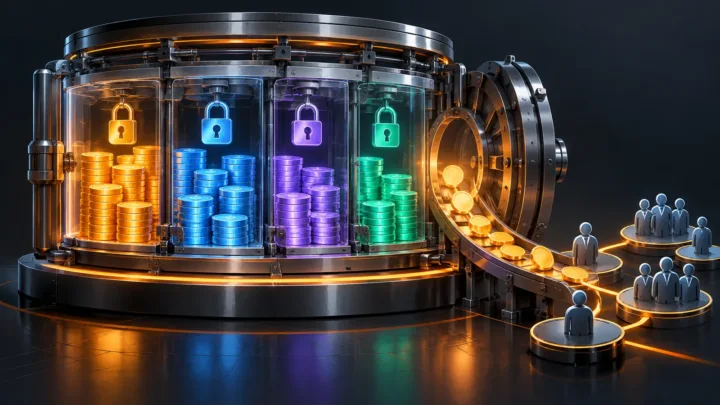
TVL measures capital, not necessarily token value
Total Value Locked is one of the most widely used measures in decentralized finance.
DefiLlama defines it as the value of assets deposited in a protocol’s smart contracts. For a blockchain, TVL generally represents the total value locked in its applications.
A protocol with $10 billion in TVL naturally inspires more confidence than a copy launched the previous day with $100,000.
However, TVL should not be treated as an automatic measure of fundamental value.
First problem: prices move.
If a protocol holds a large amount of ETH and the price of ETH doubles, its dollar-denominated TVL can nearly double without a single new dollar being deposited.
Second problem: incentives.
A project may distribute so many tokens that users deposit capital solely to collect those rewards.
When issuance falls, they leave.
Third problem: enormous TVL does not force the native token to appreciate.
You still need to verify whether value is being captured.
TVL is therefore an indicator of activity and confidence.
Not a price target.
A sound valuation combines more data: TVL, inflows, revenue, fees, users, liquidity, tokenomics and risk.
The figures become interesting when they tell the same story.
Liquidity gives crypto practical value
Owning an asset valued at $1 million on a screen is one thing.
Being able to convert it into $1 million in reality is another.
Liquidity partly measures this difference.
Bitcoin has a considerable advantage on this front.
On September 23, its daily volume exceeded $40 billion.
Solana recorded approximately $4.7 billion in volume against nearly $70 billion in market capitalization.
Tether sometimes exceeds Bitcoin’s volume, with nearly $80 billion on September 23 and more than $105 billion the previous day.
The ability to move large amounts without immediately causing a collapse has economic value.
At the other end of the spectrum, some small cryptos have a theoretical market capitalization of several hundred million dollars but only a few hundred thousand dollars in daily trading volume.
Large holders then become trapped in their own positions.
If they sell too quickly, they destroy the price.
The more liquid an asset is, the more easily large investors can enter and exit.
This helps explain why institutions favor certain major markets over a multitude of small tokens.
Liquidity is not as spectacular as a potential 100x gain.
It becomes essential when it is time to sell.
Stablecoins have enormous value without needing to rise
Tether is an excellent example of the difference between economic value and price appreciation.
USDT is worth approximately $1.
That is precisely the objective.
As of September 23, 2026, its market capitalization exceeds $183 billion.
USDT could become even more important in 2027 while remaining at $1.
Its success would be reflected in growth in circulating supply, volume, payments and usage.
Not in a move to $5.
That is why stablecoins must be assessed differently from Bitcoin or altcoins.
The quality of reserves matters.
The right to redemption.
Liquidity.
The issuer.
Regulation.
Availability across multiple networks.
Smart contract risk.
Peg stability.
The total stablecoin market capitalization currently stands at around $308 billion, or slightly more than 10% of the crypto market according to CoinGecko.
This size shows the sector’s economic importance.
It does not mean that 1 USDT should one day be worth $10.
Its success consists precisely in avoiding that outcome.
Meme coins prove that attention also has value
How can a token with little technical utility be worth several billion dollars?
The answer can be uncomfortable for purely fundamental analyses.
Attention has value.
A large community can create liquidity.
A brand can become globally recognizable.
Millions of people can decide that an asset deserves to be traded and held.
Dogecoin is the oldest example.
That does not mean a meme coin should receive the same valuation as a monetary network or financial infrastructure.
Its economic engine is different.
To study Bitcoin versus meme coins, you need to distinguish the reasons holders assign value to each asset.
For a meme coin, you should look more closely at:
liquidity;
community size;
token distribution;
concentration among large wallets;
exchange listings;
longevity;
level of attention;
ability to survive after a period of hype.
These factors are much less predictable than a protocol’s revenue.
Attention can disappear abruptly.
A meme coin can therefore have genuine market value while remaining extremely difficult to value fundamentally.
The crypto market does not reward cash flows alone.
It sometimes rewards culture.
Blockchains are also valuable because of network effects
Why create a new blockchain if Ethereum or Solana can already run applications?
The answer may be technical.
Greater speed.
Lower cost.
Different architecture.
Privacy.
Specialization.
But technology alone does not determine value.
A network becomes more useful as more people, applications, capital and developers join it.
This is the network effect.
A DeFi developer will often prefer to deploy where liquidity already exists.
Users prefer a network that hosts the applications they use.
Stablecoins go where users and volume are found.
Infrastructure providers follow.
Each layer reinforces the others.
Solana illustrates this growth. Its market capitalization is currently approaching $70 billion, with several billion dollars in daily volume.
Chainlink follows a different model: its infrastructure claims to have facilitated $34.18 trillion in Transaction Value Enabled and secured $56.6 billion in value in September 2026. These figures come from the project itself, but they indicate the scale reached by its oracle network.
Value then comes less from an isolated piece of software than from the ecosystem built around it.
On-chain data lets you look under the hood
A public blockchain provides an unusual amount of information.
Transactions.
Wallets.
Amounts.
Fees.
Supply.
Held tokens.
Contracts used.
All of this can be verified directly or analyzed through specialized platforms.
The BrefCrypto guide to block explorers shows how to find some of this information without relying solely on a project’s own figures.
This transparency considerably improves value analysis.
A protocol claims to have enormous activity?
It may be possible to examine the contracts.
A token announces a decentralized distribution?
You can examine its largest holders.
A stablecoin claims to have a $10 billion supply?
On-chain issuance can be observed.
The data must nevertheless be interpreted correctly.
An address does not necessarily correspond to a person.
An exchange may control a wallet representing the funds of millions of users.
A bot can generate thousands of transactions.
A user may control fifty addresses.
The blockchain provides the data.
The analyst must always provide the context.
In 2027, cryptocurrency values will probably be judged increasingly on this data rather than on the promises contained in a white paper.
Decentralization can create a value premium
Two networks can process similar transactions and receive very different valuations.
Decentralization can sometimes explain the gap.
How many independent validators or miners are there?
Is the required hardware accessible?
Do a few actors control most block production?
Can a foundation shut down the network?
Do administrative keys allow a contract to be modified?
Is governance distributed?
The debate between centralization and decentralization in crypto is therefore not merely philosophical.
It has an economic dimension.
Infrastructure that is genuinely censorship-resistant may receive a higher valuation precisely because it is difficult to control.
Conversely, a highly centralized blockchain may be more efficient.
Faster transactions.
Simpler technical decisions.
Faster upgrades.
There is therefore a trade-off.
Value depends on the function being sought.
For a monetary system such as Bitcoin, neutrality and resistance to control are extremely important.
For a specialized blockchain designed for a company, more centralized governance may sometimes be acceptable.
No metric provides a universal answer.
You need to understand what the network promises.
Then verify whether its architecture actually matches that promise.
Security directly influences value
A crypto that cannot protect its users’ funds eventually loses their trust.
Security must therefore be part of the valuation.
For a Proof-of-Work blockchain, you can examine hashrate, pool distribution and the potential cost of an attack.
For Proof of Stake, you need to consider the amount staked, the validators and their concentration.
For a DeFi protocol, the analysis becomes even broader.
Smart contracts.
Oracles.
Bridges.
Multisigs.
Administrative keys.
Collateral.
Audits.
Bug bounties.
Exploit history.
An application generating $50 million in annual revenue may appear cheap.
If a smart contract could lose its TVL through a single vulnerability, that discount may not be accidental.
Security has an economic cost.
Bitcoin shows this particularly clearly: miners spend energy and capital to secure the network.
Ethereum locks ETH in staking.
Networks do not acquire credibility for free.
The token’s price can in turn contribute to security. The more valuable the staked or mined asset, the more expensive an attack can become.
Economics and cryptography meet here.
It is one of the most distinctive characteristics of cryptocurrencies.
Value also depends on traditional market conditions
Bitcoin can function perfectly and still fall.
Ethereum can continue producing blocks while ETH loses 30%.
Solana can record more users while SOL corrects.
Why?
Because market value is never created by technology alone.
Interest rates.
The dollar.
Global liquidity.
Inflation.
Geopolitical risk.
Equity markets.
Risk appetite.
All these factors influence the amount of capital willing to buy crypto assets.
This is precisely why Bitcoin volatility can remain high even when its protocol barely changes.
The code does not need to change for the price to change.
The value investors assign to it changes with their environment.
Higher rates can make bonds more attractive.
Greater liquidity can push capital toward risk assets.
A crisis can trigger either a flight to cash or, in some situations, stronger interest in Bitcoin.
No relationship is perfectly mechanical.
In 2027, understanding cryptocurrency values will therefore still require looking beyond the blockchain.
Price is where the crypto economy meets the global economy.
Narratives can add billions very quickly
AI.
RWAs.
DePIN.
Meme coins.
Restaking.
Stablecoins.
Tokenization.
Every cycle has its own vocabulary.
A narrative influences how investors imagine a crypto’s future.
It can change the asset’s value before revenue or usage catches up.
This is not necessarily irrational.
Markets often price future expectations.
A fast-growing company may be valued well above its current earnings.
A crypto can work the same way.
The danger appears when the narrative becomes completely disconnected from the project’s ability to deliver on its promise.
The rotation into certain crypto narratives can then produce impressive valuations for a few months.
Then the market demands results.
How many users?
How many useful transactions?
What revenue?
How much capital?
What advantage over competitors?
This is often when the gaps widen.
Two tokens can ride the same narrative.
One builds lasting infrastructure.
The other disappears with the hashtag.
In 2027, the ability to separate narrative from real adoption will probably be one of the most important skills for crypto investors.
Why do values change 24 hours a day?
Cryptocurrencies have one distinctive feature: the market almost never closes.
Bitcoin can move at three in the morning.
Ethereum can fall on a Sunday.
An Asian trader can respond to a move in the United States without waiting for a stock exchange to reopen.
Price is therefore constantly reassessed.
Every new transaction becomes information.
Every liquidation.
Every institutional purchase.
Every withdrawal from an exchange.
Every important piece of news.
The derivatives market adds another layer.
Perpetual futures, options and leveraged positions can amplify market moves.
A market heavily loaded with long positions can experience a cascade of liquidations.
Price falls.
Positions are liquidated.
Those liquidations trigger more selling.
The decline accelerates.
The opposite phenomenon occurs during short squeezes.
That is why a crypto can lose 10% in a few hours even though its fundamentals have not changed by the same proportion.
Market value reflects constant negotiation.
It is not an accounting valuation performed once a year.
This feature also explains why two price screenshots taken a few hours apart can tell very different stories.
For an investor, the time horizon is therefore as important as the figure itself.
How can you find a cryptocurrency’s real-time value?
Several types of tools are available for tracking price.
Aggregators such as CoinGecko compile data from numerous exchanges and provide price, market capitalization, volume, circulating supply and FDV.
Exchanges show the price actually traded on their own markets.
Block explorers allow users to observe data directly on the network.
DeFi platforms such as DefiLlama add TVL, fees and revenue.
This diversity is necessary because there is no global crypto price set by a central authority.
BTC/USDT may show a slightly different level from one platform to another.
Arbitrageurs help narrow these gaps.
For the largest assets, they are generally small.
For an illiquid small-cap crypto, they can become much more significant.
You also need to check the trading pair.
1 BTC can be valued in dollars.
In euros.
In USDT.
In USDC.
Or in ETH.
The “value of Bitcoin” therefore also depends on the unit of account selected.
For tracking a portfolio, local currency may be more intuitive.
For analyzing the international market, the dollar remains the most widely used reference.
Always check the unit before interpreting the figure.
It may seem obvious.
The most costly reading errors sometimes begin with much simpler details.
What could a crypto be worth in 2027?
No one knows Bitcoin, Ethereum or Solana’s exact price on December 31, 2027.
A serious forecast should start with scenarios rather than certainty.
For Bitcoin, you can examine institutional demand, the approach of the 2028 halving, ETFs, global liquidity and available supply.
For Ethereum, you also need to consider the evolution of DeFi, Layer 2 networks, stablecoins, staking and its technical roadmap.
For Solana, payments, on-chain activity, stablecoins, developers and institutional adoption become important.
For a DeFi token, revenue and value capture should carry more weight.
For a young crypto, unlocks may dominate the equation.
This method is much more useful than a table claiming:
BTC: $150,000.
ETH: $10,000.
SOL: $500.
These figures create an impression of precision that does not exist.
A scenario might instead say:
if demand grows faster than supply and the macroeconomic environment remains favorable, valuation may rise.
If capital leaves risk assets or adoption slows, it may fall.
That may sound less spectacular.
It is much closer to financial reality.
A higher price does not necessarily mean higher fundamental value
A token can triple because an influencer talks about it.
Its technology has not changed.
Nor have its users.
Nor its revenue.
Its market value, however, has changed.
This distinction between market price and fundamental value is essential.
The two can remain far apart for a long time.
An undervalued asset does not automatically rise tomorrow.
An overvalued asset does not necessarily fall today.
The market can remain euphoric for much longer than an analyst expects.
That is why sound fundamental analysis is not always a good short-term trading signal.
An investor is instead trying to understand whether today’s asking price appears reasonable relative to future prospects.
They can still be wrong.
The method for investing in Bitcoin should therefore never rely solely on the idea that an asset “deserves” to rise.
The market has no obligation to recognize your estimate immediately.
This is also why risk and investment horizon remain essential.
An excellent crypto bought at an extremely excessive valuation can deliver poor performance.
Quality and price are two different questions.
Comparing cryptocurrencies requires comparing similar models
Putting Bitcoin, USDT, Aave and Dogecoin into the same valuation table quickly produces absurdities.
Bitcoin does not have TVL in the conventional DeFi sense.
USDT does not need to rise.
Aave generates revenue.
Dogecoin depends heavily on its liquidity, network and community.
The first step in any comparison should therefore be classification.
Bitcoin against other Proof-of-Work monetary assets.
Ethereum against other smart contract infrastructures, while accounting for their different architectures.
Aave against other lending protocols.
Uniswap against comparable DEXs.
USDC against other centralized stablecoins.
This approach makes ratios much more useful.
A DeFi protocol trading at 20 times revenue may appear expensive.
If it is growing much faster than a competitor valued at 15 times revenue, the premium may be justified.
A blockchain with fewer transactions may be worth more if each transaction carries considerably more value.
There is therefore no universal ratio.
Crypto makes this challenge even greater than in equities because tokens represent extremely different economic rights.
Before comparing two figures, always check that they are actually measuring the same thing.
Value always comes from a combination of factors
No single variable explains cryptocurrency values.
Scarcity without demand is worth almost nothing.
Utility without value capture can benefit the product without enriching the token.
Revenue without security can disappear after an exploit.
A community without liquidity may struggle to maintain a market.
Brilliant technology without users remains software.
Low market capitalization combined with massive unlocks may be much less attractive than it appears.
Even Bitcoin rests on several pillars at once.
Scarcity.
Security.
Liquidity.
Track record.
Decentralization.
Global recognition.
Demand.
Ethereum adds programmable economics.
Stablecoins add reserves.
DeFi protocols add revenue.
Meme coins add attention.
This combination makes the crypto market so difficult to reduce to a single financial model.
It is also what makes it interesting.
In 2027, investors will have more data than ever before.
The challenge will probably no longer be finding the figures.
It will be knowing which ones actually matter for the type of token being studied.
Conclusion: price is visible, value requires work
Cryptocurrency price is the easiest data point to obtain.
An app is enough.
Bitcoin: approximately $86,000.
Ethereum: around $2,700.
Solana: around $118.
USDT: almost exactly $1.
These figures are immediately available.
Understanding what they mean requires much more work.
Bitcoin is worth approximately $1.73 trillion collectively, representing close to 57% of the current crypto market. Ethereum accounts for around $334 billion. Solana is approaching $70 billion. Stablecoins as a whole represent approximately $308 billion.
Yet these values do not come from the same mechanisms.
Bitcoin relies heavily on monetary scarcity and its network.
ETH has an economy based on issuance, burns, staking and usage.
Solana depends more heavily on the growth of its infrastructure and activity.
Stablecoins primarily seek to maintain their peg.
DeFi can be analyzed through its fees and revenue.
Meme coins turn attention into liquidity and market capitalization.
The first step for 2027 should therefore be to stop asking only:
“How much does this crypto cost?”
Ask instead:
how much is the entire network worth?
How many tokens exist?
How many will arrive later?
Who wants to buy them?
Why?
What does the token actually enable?
How much volume is traded?
Does the project have real users?
Does it generate revenue?
Does the token capture that value?
Is the network secure?
And above all, what would need to happen for the current valuation to be justified several years from now?
That is where cryptocurrency value begins.
Price is merely the number the market displays after attempting, more or less successfully, to answer all these questions.