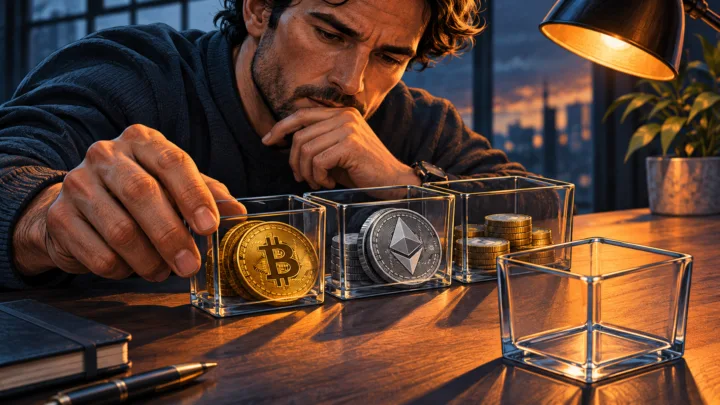
Which cryptocurrency should you invest €100 in in 2027? For a first purchase, Bitcoin and Ethereum generally deserve consideration before smaller tokens presented as the market’s future winners. This research priority does not guarantee any return; it mainly makes it possible to compare two identifiable options without spreading a limited budget across a multitude of bets.
With €100, the real issue goes beyond choosing a name. Fees, custody and the ability to withstand a loss may matter more than a performance difference between two assets. This forward-looking analysis, prepared on November 3, 2026, offers a method for making a decision in 2027—not a price forecast or a recommendation tailored to any individual situation.
In brief
- A €100 budget can buy a fraction of Bitcoin or Ethereum: the price of one unit does not determine accessibility.
- Building multiple small positions can increase fees and make tracking more complicated without providing meaningful diversification.
- The numerical examples below are hypothetical; losing the entire amount invested must remain financially bearable.
Investing €100 in crypto in 2027: start with the real cost
Our guide to investing money in crypto with a method sets out the general principles. With €100 in capital, one question takes priority: how many euros are actually working after the deposit, conversion and purchase? The amount debited does not always match the market value of the assets received.
Consider a purely educational example. Someone deposits €100, pays €1 in deposit fees and then €1 for the purchase. Without any additional spread, they obtain €98 of exposure at the reference price used. The asset must rise by approximately 2.04% to reach €100 again, before any selling or withdrawal fee. This calculation does not describe the pricing of any particular platform.
Now add an exit fee of €2. To recover €100 net, the position would need to reach €102—a rise of approximately 4.08% from €98. If a spread or currency conversion also applies, the required gain increases. The same logic applies to a loss: fees reduce what remains after the decline.
Comparing two apps therefore requires a quote obtained at the same time, using the same payment method and the same final destination. The number of tokens displayed is not enough. Ask how much an immediate sale would cost, then how many euros would actually reach the original account. Our breakdown of trading fees, spreads and network costs can help establish that comparison.
Rejecting an overly expensive service does not automatically mean choosing the cheapest one. Custody quality, withdrawal options, contractual terms and the provider’s status in the country of residence remain decisive. Saving a few cents does not make up for an opaque intermediary or an impractical recovery process.
Bitcoin or Ethereum: two starting points, not two certainties
Bitcoin is a research option for anyone seeking to understand exposure to digital money rather than a collection of applications. Investors must nevertheless accept that its price can fall sharply and that the absence of a dividend provides holders with no contractual income. Buying BTC means taking on market risk; it is not the same as opening an interest-bearing savings account.
The price of one whole bitcoin does not prevent a €100 purchase. The Bitcoin FAQ explains how it is divided into smaller units, including the satoshi. The relevant question concerns the fraction received and its total cost—not whether it is possible to buy a complete coin. Any commercial minimums then depend on the service selected.
Ethereum calls for a different analysis. ETH is used in particular to pay for network operations and plays a role in its proof-of-stake mechanism. Its economic significance therefore also depends on demand for using the network and on how that ecosystem is organized. Ethereum’s documentation on gas describes the function of these fees, but does not by itself demonstrate that ETH is inexpensive.
Choosing between BTC and ETH requires a simple premise: what use or property justifies holding this asset despite a decline? An answer limited to “it has already gone up” or “everyone is talking about it” does not provide a decision criterion. An investor should also be able to explain what would invalidate their reasoning.
With a small amount, sticking to a single exposure can simplify the learning process, provided simplicity is not confused with safety. Splitting between BTC and ETH offers two different theses, but does not automatically protect against a broad decline in cryptocurrencies. Having two names does not turn €100 at risk into a guaranteed investment.
Three ways to structure €100—and what they involve
First hypothetical scenario: €100 allocated to a single exposure, such as BTC, before fees. The operational advantage is the limited number of orders and statements. In return, the entire amount depends on the same asset and the same custody method. This scenario illustrates concentration; it is not a recommendation to commit essential savings in this way.
Second demonstration scenario: €60 in BTC and €40 in ETH, before fees. This allocation comes neither from an optimization model nor from a return forecast. It is intended to show that a small portfolio can carry two identifiable rationales without multiplying the number of positions. Each purchase must nevertheless be compatible with the service’s minimums and commissions.
Third scenario: €50 invested and €50 kept outside crypto. The reserve does not need to take the form of a stablecoin or remain on an exchange. If the crypto portion loses 60%, it theoretically falls from €50 to €20. With an unchanged €50 reserve, the total reaches €70, excluding fees. The risk does not disappear; its initial amount is reduced.
A reserve held outside the market obviously does not guarantee a future portfolio return. It may even underperform a fully invested position if prices rise. Its purpose is to limit the amount exposed and preserve room to make decisions—not to beat the market. The comparison should focus on that trade-off, rather than on an imaginary maximum gain.
For someone whose €100 may be needed for rent, healthcare or an upcoming expense, none of these scenarios makes buying compulsory. Temporarily staying out may be the consistent decision. The relevant question is not only which crypto to choose, but which euro loss could genuinely be absorbed without having to borrow or sell in an emergency.
Why cryptos priced at a few cents do not solve the problem
A token selling for a few cents may appear more accessible than a fraction of BTC. Yet holding many units does not automatically create greater potential. An asset priced at €0.01 with 100 billion units in circulation represents a theoretical market capitalization of €1 billion. These figures are used only to explain the mechanism, not to describe any particular project.
The unit price also says nothing about how many tokens may later enter the market. Token unlocks, concentrated distribution or significant issuance can change the balance between supply and demand. Our guide to tokenomics and token unlock schedules sets out the checks required before drawing a conclusion from the price alone.
The ability to resell deserves as much attention as the ease of buying. A price displayed on a screen does not guarantee that a sell order will receive that price for the entire holding. In a shallow market, execution slippage can have a significant impact. A small budget offers no protection against this issue, particularly when liquidity suddenly becomes insufficient.
Adding a small cryptocurrency may be defensible as a separate area of study if its risks, utility and trading conditions are understood. Replacing that analysis with a promise to multiply capital, however, is not a method. With €100, avoiding a network error, a fake website or an order one does not understand often provides more lasting learning than searching for ten future winners.
One-off purchase or staggered contributions: test both calculations
Splitting €100 into four €25 purchases can reduce dependence on a single entry point. It guarantees neither a lower average price nor a positive result. If the market rises steadily after the first purchase, the amount held in reserve does not immediately benefit from that increase. Conversely, an initial decline would allow subsequent contributions to buy more units.
Fixed fees can significantly change this comparison. With a hypothetical €1 commission per order, one purchase costs €1, compared with €4 for four transactions. Before any spread, that represents 1% and 4% of the starting budget, respectively. Percentage-based pricing produces a different result: the actual fee schedule must be examined rather than this calculation generalized.
Our report on DCA and progressive investing explains this approach. With €100, the goal should not become an expensive daily automation. A less frequent schedule may remain easier to follow when the available sums or the time devoted to monitoring do not justify numerous transactions.
Writing down a rule before placing the first order can help resist changes in mood. For example: a maximum total amount, a planned number of contributions, no leverage and a review date. The rule can be revised if important information invalidates the thesis, but not simply because a video announces an urgent opportunity. The schedule should support the decision, not replace the analysis.
Custody and review: what you should have learned from €100
Keeping a small position on a platform can sometimes avoid an immediately costly withdrawal, but it preserves dependence on that intermediary. Self-custody removes some of that dependence while transferring responsibility for access management to the user. No option eliminates every risk. The guide to the crypto wallet and its custody methods helps distinguish these responsibilities.
The AMF highlights the practical risks of crypto-assets, including volatility and custody-related difficulties. The country of residence, the service selected and the applicable rules must be checked at the time of purchase. No marketing statement replaces that verification.
The first review should bring together a few straightforward facts: total amount spent, quantity received, cumulative fees, approximate liquidation value and a recovery procedure that is understood. A positive gross return can conceal a negative net result when additional costs accumulate. Conversely, a technically successful experience does not turn a financial loss into a gain: the two aspects must remain separate.
For 2027, BTC and ETH therefore offer two understandable candidates to study with €100, without any obligation to buy both or to buy immediately. The useful outcome is not owning the greatest number of tokens. It is knowing why a position is held, how much it costs and how to exit it without discovering its constraints at the last minute.