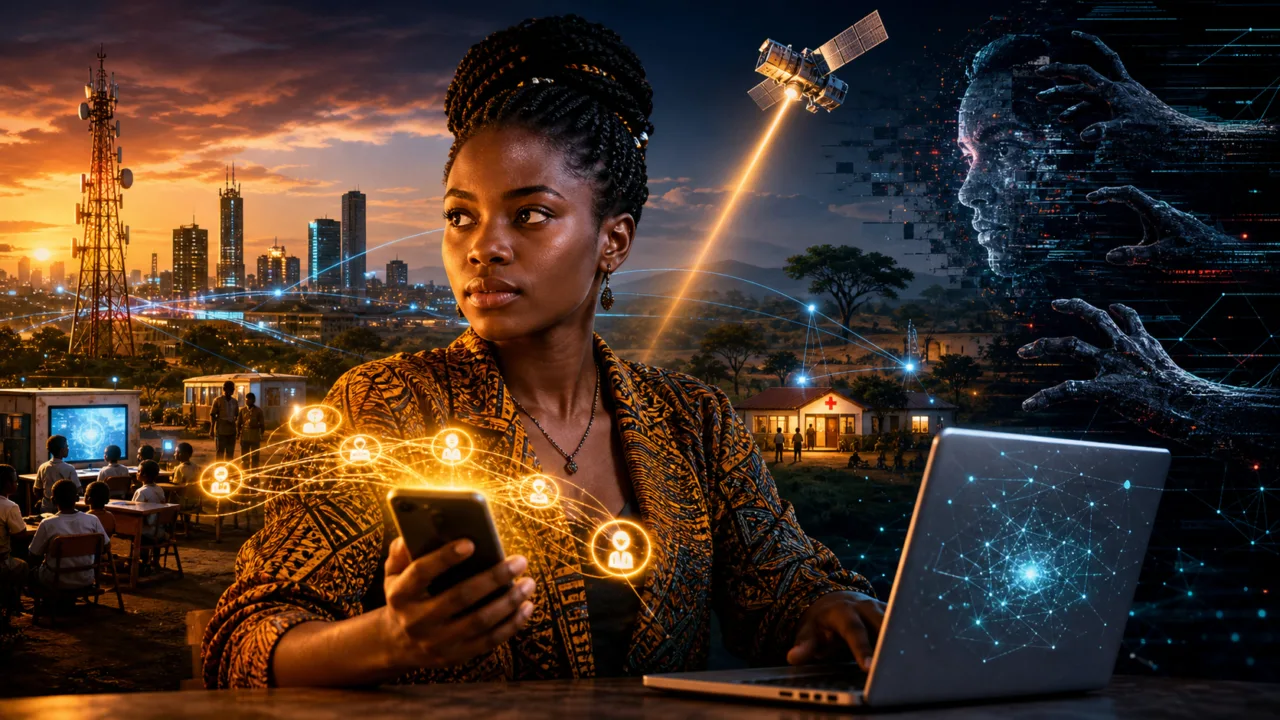
Digital Africa is rapidly changing scale. Connectivity is expanding, use cases are becoming more sophisticated and local initiatives are multiplying. At the same time, scams, sextortion, deepfakes and technological dependence are also growing.
The continent therefore no longer only needs to get connected. It must learn to build, protect and master this new economy.
Digital Africa: connectivity is no longer enough
Internet access is obviously the first building block. Without a reliable network, it is impossible to seriously discuss artificial intelligence, online education, digital public services or e-commerce.
The DRC knows this limitation all too well. As we explained in our analysis of mobile Internet in the DRC, data has already become the main source of revenue for Congolese telecom operators. It generated 1.287 billion dollars in 2025, or more than half of the sector’s revenue.
That does not mean the connectivity battle has been won.
In many African regions, coverage remains uneven, outages are frequent and connectivity costs are still a burden for households. A school connected every other day is not truly a digital school. A healthcare center with a telemedicine application but no stable Internet has only a technological promise.
The challenge is therefore changing.
More people need to be connected, certainly, but above all, infrastructure must be reliable enough for economic, administrative and educational activities to depend on it.
This is where satellites are beginning to change the equation.
Starlink becomes a complement to mobile networks
MTN Uganda has partnered with Starlink to offer satellite connectivity to businesses and institutions operating in remote, underserved or hard-to-reach regions.
Healthcare, education, agriculture, energy, tourism, public services and humanitarian operations are among the targeted sectors.
In its official announcement of the Starlink partnership, MTN clearly explains that satellite connectivity is intended as a complementary layer to mobile and fiber infrastructure, not as a replacement.
This distinction matters greatly for Digital Africa.
For a long time, connecting a rural community meant physically extending a network: towers, fiber, power supplies and costly equipment. Low-Earth-orbit constellations can now bypass some of these constraints.
For a country like the DRC, with its vast territory and areas that are sometimes extremely difficult to access, this approach deserves consideration.
Satellite connectivity can connect a school, mining company, NGO or hospital before fiber arrives. But its cost, dependence on foreign providers and regulatory framework remain important issues.
The technology therefore makes it possible to move faster.
The question is what happens once people are connected.
Young people must move from users to creators
Uganda offers an initial answer. MTN Uganda has just graduated 503 young people through its MTN ACE program.
They did not simply learn how to use a computer. The program covers ICT, digital marketing, e-commerce, artificial intelligence and cybersecurity.
This is precisely the shift that Digital Africa must achieve.
Bref Crypto recently reported on a 50 million naira initiative designed to train 100 new African technology talents. The need extends far beyond programmers. African economies will need data analysts, cloud specialists, cybersecurity experts, content creators, network technicians, AI developers and entrepreneurs able to turn these skills into products.
South Sudan is following a comparable path with the opening of the Aweil ICT Hub, intended to provide training, scholarships and support for innovation.
In Nigeria, NITDA is intervening even earlier: children are already using their holidays to learn programming, computational thinking, digital creativity and emerging technologies.
Training people to use ChatGPT will not be enough.
They must understand how these systems work and gradually learn how to build around them. This is also the ambition behind the African applied AI laboratory launched in Accra: turning more local ideas into genuine technology products.
Africa is beginning to build its own AI systems
This shift is particularly visible in Nigeria.
The startup Decide has launched DAX-1, an artificial intelligence model specialized in spreadsheet editing. The company previously used technologies from OpenAI, Anthropic and other major providers.
It is not trying to build another ChatGPT, however.
DAX-1 is based on an open-source Qwen model and focuses on a much narrower task. Decide says this delivers better cost performance for certain use cases than systematically routing queries to large general-purpose models. Its benchmarks remain internal and should be viewed accordingly.
The strategy is nevertheless interesting.
Building a model that directly competes with GPT or Gemini requires billions of dollars, massive computing infrastructure and vast quantities of data. Specializing an existing model around a local problem is far more accessible.
Africa may need AI specialized in OHADA documents, local languages, tropical agriculture, national education systems or administrative procedures long before it needs an African competitor to GPT.
This approach is connected to the debate over African digital sovereignty in the face of major foreign platforms.
The issue is not about manufacturing everything locally. It is about gradually understanding what is actually under local control.
TikTok and Mobile Money attract scammers
As usage expands, fraudsters are following exactly the same path.
In Ghana, TrustGH says it has linked more than 6,000 telephone numbers to scam reports or its own investigations. Around half of the recorded cases are reportedly connected to TikTok.
WhatsApp and SMS also play an important role.
The mechanism is now well known. A fake job offer appears on a social network. The victim is invited to continue the conversation on WhatsApp. The scammer then requests a Mobile Money payment.
Each service functions normally. It is their combination that creates the scam.
The phenomenon extends far beyond Ghana. INTERPOL estimates that artificial intelligence is already involved in 55% of reported cybercrimes in Africa, notably by automating fraudulent messages and making certain impersonation attempts more credible.
Bref Crypto recently documented the lead some African cybercriminals have gained in using AI.
The Bank of Ghana has also just published an official alert about a fake “Worldremit” operation promising to double victims’ money.
The vocabulary is changing. The old scam much less so.
Whenever a stranger promises to quickly multiply a Mobile Money payment, the first warning sign is already there.
Deepfakes: seeing is no longer enough to believe
Ghana’s National Commission for Civic Education has just raised an even deeper problem: the image itself is losing some of its value as evidence.
Artificial intelligence tools can now reproduce a voice, create a realistic photograph or make a public figure say things they have never said.
For Digital Africa, this development directly affects political and social information.
A video showing a minister announcing an exceptional measure can be fabricated. A voice resembling that of a director can request a bank transfer. A public figure can appear in a fake advertisement for an investment platform.
INTERPOL already reports a sharp increase in cyberthreats using AI and synthetic media across the continent. The organization also highlights the use of deepfakes in sextortion, impersonation and manipulation operations.
In a country like the DRC, where WhatsApp and Facebook play a considerable role in the circulation of information, the consequence is immediate.
Media literacy must change.
Verifying information no longer means simply asking: “Does a video exist?”
People must look for the original source, compare it with official accounts, check the context, see whether several reliable media outlets are reporting the same information and learn to recognize possible inconsistencies.
One rule is becoming increasingly essential: a familiar voice is no longer proof. Neither is a video.
Sextortion requires a different kind of digital education
The most serious story in this review comes from Nigeria.
Two men have been extradited to the United States in an online sextortion case that, according to U.S. allegations, contributed to the deaths of two teenagers.
Sextortion often begins with an interaction that appears ordinary. Someone gains a teenager’s trust, obtains or fabricates an intimate image, and then threatens to send it to the victim’s parents, friends or classmates unless the victim pays.
Blackmail works because it exploits shame and urgency.
For a minor, this pressure can become extremely dangerous.
The first response should therefore never be financial. Paying does not guarantee that the image will be deleted. Above all, it confirms to the criminal that the victim can be pressured into paying more.
The victim should end the exchange, preserve screenshots and identifiers, report the account and immediately seek help from a trusted adult or the relevant authorities.
Digital Africa cannot only teach children how to code.
It must also teach them what online manipulation is, why an intimate image should never become a secret imposed by a blackmailer, how to protect their accounts and, above all, whom to talk to when something goes wrong.
This is now a fundamental digital skill.
Mobile Money: interoperability will be the next battle
Africa’s digital transformation is not limited to the Internet and AI.
In Cameroon, Looping Binary is launching LBPay with an interesting ambition: enabling payments, digital wallets, airtime purchases and, above all, transfers between different Mobile Money networks.
APIs should also allow developers to build their own services around this infrastructure.
Interoperability may seem less spectacular than a new AI model. Yet it could have a much more immediate economic impact.
Users should not have to think about their recipient’s telecom network before sending money. Small businesses should not have to multiply integrations to receive payments from customers using different operators.
The DRC is already familiar with this problem, with several highly active Mobile Money ecosystems.
Making it easier for them to communicate could reduce friction, expand the digital economy and give local developers more room to create new services.
This is also where security becomes central again.
The more interconnected financial systems become, the more quickly fraudsters can move between platforms. Interoperability must therefore be accompanied by strong identification mechanisms, information-sharing on fraud reports and user-protection measures.
Progress does not simply mean connecting more systems.
They must be able to work together without multiplying vulnerabilities.
Digital Africa is entering its most difficult phase
Africa is no longer simply discovering the Internet.
It is beginning to connect isolated regions by satellite, train young people in AI, create its own specialized models, make payments more interoperable and introduce digital technology into education from childhood.
At the same time, the cost of this acceleration is becoming much more visible.
Scammers are using TikTok and Mobile Money. AI is making fraud more credible. Deepfakes are weakening trust in images. Children are becoming targets of digital blackmail.
For the DRC, waiting for these problems to become widespread before responding would be a poor strategy.
The country can already learn from what is happening in Ghana, Nigeria, Uganda, Cameroon and South Sudan: connect citizens, train young people, support local developers and integrate cybersecurity at every stage.
This also ties into the COMESA regional debate over a common strategy for AI and digital inclusion.
The next stage of Digital Africa will therefore not be judged solely by the number of connected users.
It will be measured above all by its ability to turn connectivity into skills, local businesses and useful services, without leaving security and control of these technologies to others.